Give an algorithm that takes an n-node path G with weights and returns an independent set...
Give an algorithm that takes an n-node path G with weights and returns an independent set of maximum total weight. The running time should be polynomial in n, independent of the values of the weights.
Homework Answers
`Hey,
Note: Brother in case of any queries, just comment in box I would be very happy to assist all your queries
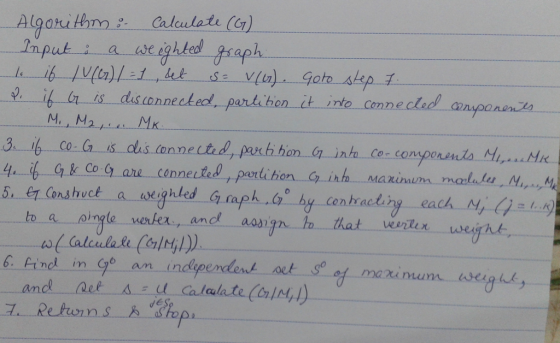
Kindly revert for any queries
Thanks.
Add Answer to:
Give an algorithm that takes an n-node path G with weights and
returns an independent set...
Give pseudocode that performs the traceback to construct an LCS from a filled dynamic programming table...
Give pseudocode that performs the traceback to construct an LCS from a filled dynamic programming table without using the “arrows”, in O(n + m) time. 2. Suppose we are given a “chain” of n nodes as shown below. Each node i is “neighbors” with the node to its left and the node to its right (if they exist). An independent set of these nodes is a subset of the nodes such that no two of the chosen nodes are neighbors....
Give the specifications of a pseudo-polynomial time algorithm for Galactic Shortest Path. Hint: G...
 Hi, I'm confused about how to do this, any help is appreciated
thanks!
Give the specifications of a pseudo-polynomial time algorithm for Galactic Shortest Path. Hint: Given an instance of GSP such that G has n vertices and m edges, you may want to use a 5 dimensional m by n by n by L by R array.
Give the specifications of a pseudo-polynomial time algorithm for Galactic Shortest Path. Hint: Given an instance of GSP such that G has...
Hi, I'm confused about how to do this, any help is appreciated
thanks!
Give the specifications of a pseudo-polynomial time algorithm for Galactic Shortest Path. Hint: Given an instance of GSP such that G has n vertices and m edges, you may want to use a 5 dimensional m by n by n by L by R array.
Give the specifications of a pseudo-polynomial time algorithm for Galactic Shortest Path. Hint: Given an instance of GSP such that G has...
PRINCETON UNIVERSITY 12. Algorithm design. (8 points) Given an edge-weighted digraph G the bottleneck capacity of a path is the minimum weight of an edge on the path. For each part elow, give a c...
 PRINCETON UNIVERSITY 12. Algorithm design. (8 points) Given an edge-weighted digraph G the bottleneck capacity of a path is the minimum weight of an edge on the path. For each part elow, give a crisp and concise English description of your algorithm in the space provided. Your ansuer will be graded on correctness, eficieney, clarity, and conciseness (a) Given an edge-weighted digraph G, two distinguished vertices s and t, and a threshold value T, design an algorithm to find any...
(a) Give the pseudo-code for a recursive algorithm called Find_Smallest(A, n) that returns the value of...
(a) Give the pseudo-code for a recursive algorithm called Find_Smallest(A, n) that returns the value of the smallest element in an array of n integers called A. Assume the elements in the array are at locations A[1]..A[n]. (b) Give a recurrence T(n) for the running time of your algorithm. (c) Solve the recurrence in part (b)
(Q4 - 30 pts: 15, 15) a) Give an O (n) time algorithm for finding the...
 (Q4 - 30 pts: 15, 15) a) Give an O (n) time algorithm for finding the longest (simple) path in a tree on n vertices. Prove the correctness of your algorithm. Give a polynomial time algorithm for finding the longest (simple) path in a graph whose blocks have size bounded by a constant. Prove the correctness of your algorithm. b)
Problem 5. (Lexicographical Optimisation with Paths) Provide pseudocode and an expla- nation for an algorithm that comp...
 Problem 5. (Lexicographical Optimisation with Paths) Provide pseudocode and an expla- nation for an algorithm that computes a path between two nodes in an undirected graph such that: . The maximum weight in the path is minimised, ie., there does not exist another path with a smaller maximum weight .Amongst all such paths, it finds the path with minimum cost. . The time complexity is no worse than 0(( and V is the set of nodes. ·IvD-log(IVD), where E is...
Instructions Write a program in Java that implements the A* algorithm to find a path from...
Instructions Write a program in Java that implements the A* algorithm to find a path from any two given nodes. Problem Overview & Algorithm Description In a fully-observable environment where there are both pathable and blocked nodes, an agent must find a good path from their starting node to the goal node. The agent must use the A* algorithm to determine its path. For this program, you must use the Manhattan method for calculating the heuristic. Remember: your heuristic function...
Give a dynamic programming algorithm that runs within the time complexity. Also give the space complexity of the algorit...
 Give a dynamic programming algorithm that runs within the time
complexity. Also give the space complexity of the algorithm.
Please
Given a directed graph with non-negative integer edge weights, a pair of vertices s and t, and integers K and W, describe a dynamic-programming algorithm for deciding whether there exists a path from s to t that has total weight W and uses exactly K edges. Your algorithm should run in time O(nm)WK). Analyze the time- and space-complexity of your...
Give a dynamic programming algorithm that runs within the time
complexity. Also give the space complexity of the algorithm.
Please
Given a directed graph with non-negative integer edge weights, a pair of vertices s and t, and integers K and W, describe a dynamic-programming algorithm for deciding whether there exists a path from s to t that has total weight W and uses exactly K edges. Your algorithm should run in time O(nm)WK). Analyze the time- and space-complexity of your...
2 Node removal Consider the following specifications: Algorithm 1 Removes node vk from graph G represented...
 2 Node removal Consider the following specifications: Algorithm 1 Removes node vk from graph G represented as an adjacency matrix A Require: A E {0,1}"x", kEN, k<n Ensure: A' E {0,1)(n-1)×(1-1) 1: function NODEREMOVAL(A,k) 2: ... 3: return A 4: end function The function accepts an adjacency matrix A, which represents a graph G, and an integer k, and returns adjacency matrix A', representing graph G', that is the result of removing node the k-th node us from G. Question:...
3. Give an efficient algorithm that takes as input a directed graph G-(V,E) with edges labeled wi...
 Please show your work
3. Give an efficient algorithm that takes as input a directed graph G-(V,E) with edges labeled with either 0 or 1, and vertices s and t that ouputs TRUE if and only if there is a path (not necessarily simple) that goes from s to t such that the binary sequence of edges in the path avoids the substring "11" and outputs FALSE otherwise. (For example, the string 10100010 avoids 11 but the string 00101101110 does...
Please show your work
3. Give an efficient algorithm that takes as input a directed graph G-(V,E) with edges labeled with either 0 or 1, and vertices s and t that ouputs TRUE if and only if there is a path (not necessarily simple) that goes from s to t such that the binary sequence of edges in the path avoids the substring "11" and outputs FALSE otherwise. (For example, the string 10100010 avoids 11 but the string 00101101110 does...
 Hi, I'm confused about how to do this, any help is appreciated
thanks!
Give the specifications of a pseudo-polynomial time algorithm for Galactic Shortest Path. Hint: Given an instance of GSP such that G has n vertices and m edges, you may want to use a 5 dimensional m by n by n by L by R array.
Give the specifications of a pseudo-polynomial time algorithm for Galactic Shortest Path. Hint: Given an instance of GSP such that G has...
Hi, I'm confused about how to do this, any help is appreciated
thanks!
Give the specifications of a pseudo-polynomial time algorithm for Galactic Shortest Path. Hint: Given an instance of GSP such that G has n vertices and m edges, you may want to use a 5 dimensional m by n by n by L by R array.
Give the specifications of a pseudo-polynomial time algorithm for Galactic Shortest Path. Hint: Given an instance of GSP such that G has...
 PRINCETON UNIVERSITY 12. Algorithm design. (8 points) Given an edge-weighted digraph G the bottleneck capacity of a path is the minimum weight of an edge on the path. For each part elow, give a crisp and concise English description of your algorithm in the space provided. Your ansuer will be graded on correctness, eficieney, clarity, and conciseness (a) Given an edge-weighted digraph G, two distinguished vertices s and t, and a threshold value T, design an algorithm to find any...
 (Q4 - 30 pts: 15, 15) a) Give an O (n) time algorithm for finding the longest (simple) path in a tree on n vertices. Prove the correctness of your algorithm. Give a polynomial time algorithm for finding the longest (simple) path in a graph whose blocks have size bounded by a constant. Prove the correctness of your algorithm. b)
 Problem 5. (Lexicographical Optimisation with Paths) Provide pseudocode and an expla- nation for an algorithm that computes a path between two nodes in an undirected graph such that: . The maximum weight in the path is minimised, ie., there does not exist another path with a smaller maximum weight .Amongst all such paths, it finds the path with minimum cost. . The time complexity is no worse than 0(( and V is the set of nodes. ·IvD-log(IVD), where E is...
 Give a dynamic programming algorithm that runs within the time
complexity. Also give the space complexity of the algorithm.
Please
Given a directed graph with non-negative integer edge weights, a pair of vertices s and t, and integers K and W, describe a dynamic-programming algorithm for deciding whether there exists a path from s to t that has total weight W and uses exactly K edges. Your algorithm should run in time O(nm)WK). Analyze the time- and space-complexity of your...
Give a dynamic programming algorithm that runs within the time
complexity. Also give the space complexity of the algorithm.
Please
Given a directed graph with non-negative integer edge weights, a pair of vertices s and t, and integers K and W, describe a dynamic-programming algorithm for deciding whether there exists a path from s to t that has total weight W and uses exactly K edges. Your algorithm should run in time O(nm)WK). Analyze the time- and space-complexity of your...
 2 Node removal Consider the following specifications: Algorithm 1 Removes node vk from graph G represented as an adjacency matrix A Require: A E {0,1}"x", kEN, k<n Ensure: A' E {0,1)(n-1)×(1-1) 1: function NODEREMOVAL(A,k) 2: ... 3: return A 4: end function The function accepts an adjacency matrix A, which represents a graph G, and an integer k, and returns adjacency matrix A', representing graph G', that is the result of removing node the k-th node us from G. Question:...
 Please show your work
3. Give an efficient algorithm that takes as input a directed graph G-(V,E) with edges labeled with either 0 or 1, and vertices s and t that ouputs TRUE if and only if there is a path (not necessarily simple) that goes from s to t such that the binary sequence of edges in the path avoids the substring "11" and outputs FALSE otherwise. (For example, the string 10100010 avoids 11 but the string 00101101110 does...
Please show your work
3. Give an efficient algorithm that takes as input a directed graph G-(V,E) with edges labeled with either 0 or 1, and vertices s and t that ouputs TRUE if and only if there is a path (not necessarily simple) that goes from s to t such that the binary sequence of edges in the path avoids the substring "11" and outputs FALSE otherwise. (For example, the string 10100010 avoids 11 but the string 00101101110 does...
Most questions answered within 3 hours.
-
Where is the error in this code sequence?
String s1 = "Hello";
String s2 = "ello";...
asked 10 months ago -
Financial data for Joel de Paris, Inc., for last year
follow:
Joel de Paris, Inc.
Balance...
asked 10 months ago -
Consider this reaction:
Al2(SO4)3 (aq)+ BaCl3
(aq) Al2Cl6 (aq)- +
3BaSO4(s) . What is the...
asked 10 months ago -
Suppose that Savneet is considering increasing her
recent random sample from 20 car rentals to 40...
asked 10 months ago -
Trucks arrive at an unloading terminal at an average rate of 120
per hour.
Trucks arrive...
asked 10 months ago -
Why are methanol and ethanol completely soluble in water while
octanol is not very little soluble....
asked 10 months ago -
A facilities manager at a university reads in a research report
that the mean amount of...
asked 10 months ago -
When the CuSO4 is rehydrated by adding water to the anhydrous
compound, is this an endothermic...
asked 10 months ago -
A ray of sunlight is passing from diamond into crown glass; the
angle of incidence is...
asked 10 months ago -
A block of mass 0.249 kg is placed on top of a light, vertical
spring of...
asked 10 months ago -
how do the kidneys compensate in the presences of acidosis
a) trigger hyperventilate
b) reserve acid...
asked 10 months ago -
Question 501 pts
The rental rate of capital to the firm increases. Which of the
following...
asked 10 months ago