Maria throws an apple vertically upward from a height of 1.3 m with an initial velocity...
Maria throws an apple vertically upward from a height of 1.3 m with an initial velocity of +2.9 m/s. Will the apple reach a friend in a tree house 7.0 m above the ground? The acceleration due to gravity is 9.81 m/s2.
1. No, the apple will reach 5.27136 m below the tree house
2. Yes, the apple will reach 5.27136 m above the tree house
3. No, the apple will reach 1.43117 m below the tree house
4. No, the apple will reach 1.5289 m below
5. Yes, the apple will reach 1.5289 m above the tree house
6. Yes, the apple will reach 1.43117 m above the tree house
If the apple is not caught, how long will it be in the air before it hits the ground; i.e., the total time from when the apple leaves the hand until it hits the ground? Answer in units of s.
Homework Answers
Given initial vertical velocity, 
Find max height
Use formula 

At max height, vertical velocity becomes zero




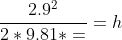

Max height from ground = 1.3m + h = 1.3m+ 0.42864m

Distance = 7m - H =7m-1.72864m
ANSWER: No, Apple will reach 5.27136m below the tree house.
========================
Time of flight
Consider rising part
Use formula 






===========
Consider Falling part
Use formula 
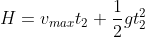



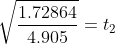

============
Time of Flight, 
ANSWER :
=================
Add Answer to:
Maria throws an apple vertically upward from a height of 1.3 m
with an initial velocity...
A red ball is thrown down with an initial speed of 1.3 m/s from a height...
A red ball is thrown down with an initial speed of 1.3 m/s from a height of 26 meters above the ground. Then, 0.4 seconds after the red ball is thrown, a blue ball is thrown upward with an initial speed of 23.9 m/s, from a height of 1 meters above the ground. The force of gravity due to the earth results in the balls each having a constant downward acceleration of 9.81 m/s2. What is the speed of the...
A blue ball is thrown upward with an initial speed of 24.1 m/s, from a height...
A blue ball is thrown upward with an initial speed of 24.1 m/s, from a height of 0.8 meters above the ground. 2.9 seconds after the blue ball is thrown, a red ball is thrown down with an initial speed of 10.4 m/s from a height of 31.4 meters above the ground. The force of gravity due to the earth results in the balls each having a constant downward acceleration of 9.81 m/s2. What is the height of the red...
You throw a ball vertically upward with a velocity of 10 m/s from a window located...
You throw a ball vertically upward with a velocity of 10 m/s from a window located 20 m above the ground. Knowing that the acceleration of the ball is constant and equal to 9.81 m/s^2 downward, determine (a) the velocity v and elevation y of the ball above the ground at any time t, (b) the highest elevation reached by the ball and the corresponding value of t, (c) the time when the ball hits the ground and the corresponding...
A blue ball is thrown upward with an initial speed of 23.9 m/s, from a height...
A blue ball is thrown upward with an initial speed of 23.9 m/s, from a height of 0.5 meters above the ground. 2.9 seconds after the blue ball is thrown, a red ball is thrown down with an initial speed of 7.5 m/s from a height of 31.5 meters above the ground. The force of gravity due to the earth results in the balls each having a constant downward acceleration of 9.81 m/s^2. How long after the blue ball is...
While standing at the edge of the roof of a building, a man throws a stone...
While standing at the edge of the roof of a building, a man throws a stone upward with an initial speed of 6.09 m/s. The stone subsequently falls to the ground, which is 17.5 m below the point where the stone leaves his hand. At what speed does the stone impact the ground? Ignore air resistance and use ?=9.81 m/s2 for the acceleration due to gravity.
A blue ball is thrown upward with an initial speed of 20 m/s, from a height...
A blue ball is thrown upward with an initial speed of 20 m/s, from a height of 0.8 meters above the ground. 2.4 seconds after the blue ball is thrown, a red ball is thrown down with an initial speed of 5.3 m/s from a height of 22.4 meters above the ground. The force of gravity due to the earth results in the balls each having a constant downward acceleration of 9.81 m/s2. 1) How long after the blue ball...
9). A small bag of sand is released from an ascending hot‑air balloon whose constant, upward...
9). A small bag of sand is released from an ascending hot‑air balloon whose constant, upward velocity is ?0=2.75 m/s. Knowing that at the time of the release the balloon was 58.3 m above the ground, determine the time ? it takes for the bag to reach the ground from the moment of its release. Use ?=9.81 m/s2. r= 10) You throw a baseball directly upward at time ?=0 at an initial speed of 14.1 m/s. What is the maximum height...
While standing at the edge of the roof of a building, a man throws a stone...
While standing at the edge of the roof of a building, a man throws a stone upward with an initial speed of 6.95 m/s. The stone subsequently falls to the ground, which is 13.7 m below the point where the stone leaves his hand. At what speed does the stone impact the ground? Ignore air resistance and use ?=9.81 m/s2 for the acceleration due to gravity. impact speed: m/s How much time is the stone in the air? elapsed time:...
A catapult launches a test rocket vertically upward from a well, giving the rocket an initial...
A catapult launches a test rocket vertically upward from a well, giving the rocket an initial speed of 80.2 m/s at ground level. The engines then fire, and the rocket accelerates upward at 4.10 m/s2 until it reaches an altitude of 1190 m. At that point its engines fail, and the rocket goes into free fall, with an acceleration of −9.80 m/s2. (You will need to consider the motion while the engine is operating and the free-fall motion separately.) (a)...
While standing at the edge of the roof of a building, a man throws a stone...
 While standing at the edge of the roof of a building, a man throws a stone upward with an initial speed of 7.25 m/s. The stone subsequently falls to the ground, which is 12.1 m below the point where the stone leaves his hand. At what speed does the stone impact the ground? Ignore air resistance and use g 9.81 m/s2 for the acceleration due to gravity. impact speed: m/s How much time is the stone in the air? elapsed...
 While standing at the edge of the roof of a building, a man throws a stone upward with an initial speed of 7.25 m/s. The stone subsequently falls to the ground, which is 12.1 m below the point where the stone leaves his hand. At what speed does the stone impact the ground? Ignore air resistance and use g 9.81 m/s2 for the acceleration due to gravity. impact speed: m/s How much time is the stone in the air? elapsed...
Most questions answered within 3 hours.
-
Where is the error in this code sequence?
String s1 = "Hello";
String s2 = "ello";...
asked 11 months ago -
Financial data for Joel de Paris, Inc., for last year
follow:
Joel de Paris, Inc.
Balance...
asked 11 months ago -
Consider this reaction:
Al2(SO4)3 (aq)+ BaCl3
(aq) Al2Cl6 (aq)- +
3BaSO4(s) . What is the...
asked 11 months ago -
Suppose that Savneet is considering increasing her
recent random sample from 20 car rentals to 40...
asked 11 months ago -
Trucks arrive at an unloading terminal at an average rate of 120
per hour.
Trucks arrive...
asked 11 months ago -
Why are methanol and ethanol completely soluble in water while
octanol is not very little soluble....
asked 11 months ago -
A facilities manager at a university reads in a research report
that the mean amount of...
asked 11 months ago -
When the CuSO4 is rehydrated by adding water to the anhydrous
compound, is this an endothermic...
asked 11 months ago -
A ray of sunlight is passing from diamond into crown glass; the
angle of incidence is...
asked 11 months ago -
A block of mass 0.249 kg is placed on top of a light, vertical
spring of...
asked 11 months ago -
how do the kidneys compensate in the presences of acidosis
a) trigger hyperventilate
b) reserve acid...
asked 11 months ago -
Question 501 pts
The rental rate of capital to the firm increases. Which of the
following...
asked 11 months ago