Consider a coating (n=1.25) applied to a glass surface (n=1.50). If we wish to have this...
Consider a coating (n=1.25) applied to a glass surface (n=1.50). If we wish to have this coating be non-reflective of 6.0 x 10⁻⁷ m wavelength light, what coating thickness(es) will work?
Homework Answers

Add Answer to:
Consider a coating (n=1.25) applied to a glass surface (n=1.50).
If we wish to have this...
We wish to coat flat glass (n = 1.50) with a transparent material (n = 1.21)...
We wish to coat flat glass (n = 1.50) with a transparent material (n = 1.21) so that reflection of light at wavelength 469 nm is eliminated by interference. What minimum thickness can the coating have to do this? I will give five stars for the correct answer
Chapter 35, Problem 035 we wish to coat flat glass (n = 1.50) with a transparent...
 Chapter 35, Problem 035 we wish to coat flat glass (n = 1.50) with a transparent material (n = 1.32) so that reflection of light at wavelength 539 nm is eliminated by interference, what minimum thickness can the coating have to do this? Number the tolerance is +/-9% Units
A material having an index of refraction of 1.25 is used as an antireflective coating on a piece of glass (n = 1.50). W...
 A material having an index of refraction of 1.25 is used as an antireflective coating on a piece of glass (n = 1.50). What should be the minimum thickness of this film in order to minimize reflection of 490 nm light? nITm
A material having an index of refraction of 1.25 is used as an antireflective coating on a piece of glass (n = 1.50). What should be the minimum thickness of this film in order to minimize reflection of...
A material having an index of refraction of 1.25 is used as an antireflective coating on a piece of glass (n = 1.50). What should be the minimum thickness of this film in order to minimize reflection of 490 nm light? nITm
A material having an index of refraction of 1.25 is used as an antireflective coating on a piece of glass (n = 1.50). What should be the minimum thickness of this film in order to minimize reflection of...
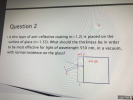
diffraction Question 2 A thin layer of anti-reflective coating (n=1.2) is placed on the surface of...
 diffraction
Question 2 A thin layer of anti-reflective coating (n=1.2) is placed on the surface of glass (n=1.55). What should the thickness be in order to be most effective for light of wavelength 550 nm, in a vacuum, with normal incidence on the glass? n=1.2 n=1.55 UNIVERSITY OF WOLLONGONG
diffraction
Question 2 A thin layer of anti-reflective coating (n=1.2) is placed on the surface of glass (n=1.55). What should the thickness be in order to be most effective for light of wavelength 550 nm, in a vacuum, with normal incidence on the glass? n=1.2 n=1.55 UNIVERSITY OF WOLLONGONG
A transparent film (n=1.3) is deposited on a glass lens (n=1.5) to form a reflective coating....
A transparent film (n=1.3) is deposited on a glass lens (n=1.5) to form a reflective coating. What is the minimum thickness that would maximize reflection of light with a wavelength of 500.0 nm in air? and the answer 96 nm is incorrect
2) A company that sells an anti-reflective coating for glass plates uses a material with index...
 2) A company that sells an anti-reflective coating for glass plates uses a material with index of refraction n, which is higher than that of air and of glass. When a customer specifies what air wavelength 2 of light to block, the thinnest effective layer is applied. Give the thickness of this layer in terms of 2 and n.
A thin layer of magnesium fluoride (n = 1.38) is applied to the outer surface of...
 A thin layer of magnesium fluoride (n = 1.38) is applied to the outer surface of a glass (n = 1.52) camera lens as an anti-reflective coating. When viewed from a direction that is nearly perpendicular to the lens in white light, the lens appears slightly green in color, since it only reflects light with a wavelength in vacuum of 540 nm. Based on this information, what is the smallest nonzero thickness of the magnesium fluoride film? 135 nm 152...
Athin layer of magnesium fluoride (n = 1.38) is applied to the outer surface of a...
 Athin layer of magnesium fluoride (n = 1.38) is applied to the outer surface of a glass (n = 1.52) camera lens as an anti-reflective coating. When viewed from a direction that is nearly perpendicular to the lens in white light, the lens appears slightly green in color, since it only reflects light with a wavelength in vacuum of 540 nm. Based on this information, what is the smallest nonzero thickness of the magnesium fluoride film? 135 nm 152 nm...
Chapter 27, Problem 15 provides some pertinent background information for this problem. A transparent film (n 1.31) is deposited on a glass plate (n-1.52) to form a nonreflective coating. The film ha...
 Chapter 27, Problem 15 provides some pertinent background information for this problem. A transparent film (n 1.31) is deposited on a glass plate (n-1.52) to form a nonreflective coating. The film has a thickness of 1.00 x 10⁻⁷ m, what is the longest possible wavelength (in vacuum) of light for which this film has been designed? Incident light Film Glass plate Units Number the tolerance is +-2%
Chapter 27, Problem 15 provides some pertinent background information for this problem. A...
Chapter 27, Problem 15 provides some pertinent background information for this problem. A transparent film (n 1.31) is deposited on a glass plate (n-1.52) to form a nonreflective coating. The film has a thickness of 1.00 x 10⁻⁷ m, what is the longest possible wavelength (in vacuum) of light for which this film has been designed? Incident light Film Glass plate Units Number the tolerance is +-2%
Chapter 27, Problem 15 provides some pertinent background information for this problem. A...
My question is related to Optics- Interference from thin films: If we wish to coat flat...
My question is related to Optics- Interference from thin films: If we wish to coat flat glass [ index of refraction (n)=1.50] with a transparent material (n =1.25) so that reflection of light at wavelength 600 nm is eliminated by interference.What minimum thickness can the coating have to do this? I know that the waves will experience a phase change of pi rad or (0.5 wavelength) since the first medium has a small index of refraction. How does this connect...
 Chapter 35, Problem 035 we wish to coat flat glass (n = 1.50) with a transparent material (n = 1.32) so that reflection of light at wavelength 539 nm is eliminated by interference, what minimum thickness can the coating have to do this? Number the tolerance is +/-9% Units
 A material having an index of refraction of 1.25 is used as an antireflective coating on a piece of glass (n = 1.50). What should be the minimum thickness of this film in order to minimize reflection of 490 nm light? nITm
A material having an index of refraction of 1.25 is used as an antireflective coating on a piece of glass (n = 1.50). What should be the minimum thickness of this film in order to minimize reflection of...
A material having an index of refraction of 1.25 is used as an antireflective coating on a piece of glass (n = 1.50). What should be the minimum thickness of this film in order to minimize reflection of 490 nm light? nITm
A material having an index of refraction of 1.25 is used as an antireflective coating on a piece of glass (n = 1.50). What should be the minimum thickness of this film in order to minimize reflection of...
 diffraction
Question 2 A thin layer of anti-reflective coating (n=1.2) is placed on the surface of glass (n=1.55). What should the thickness be in order to be most effective for light of wavelength 550 nm, in a vacuum, with normal incidence on the glass? n=1.2 n=1.55 UNIVERSITY OF WOLLONGONG
diffraction
Question 2 A thin layer of anti-reflective coating (n=1.2) is placed on the surface of glass (n=1.55). What should the thickness be in order to be most effective for light of wavelength 550 nm, in a vacuum, with normal incidence on the glass? n=1.2 n=1.55 UNIVERSITY OF WOLLONGONG
 2) A company that sells an anti-reflective coating for glass plates uses a material with index of refraction n, which is higher than that of air and of glass. When a customer specifies what air wavelength 2 of light to block, the thinnest effective layer is applied. Give the thickness of this layer in terms of 2 and n.
 A thin layer of magnesium fluoride (n = 1.38) is applied to the outer surface of a glass (n = 1.52) camera lens as an anti-reflective coating. When viewed from a direction that is nearly perpendicular to the lens in white light, the lens appears slightly green in color, since it only reflects light with a wavelength in vacuum of 540 nm. Based on this information, what is the smallest nonzero thickness of the magnesium fluoride film? 135 nm 152...
 Athin layer of magnesium fluoride (n = 1.38) is applied to the outer surface of a glass (n = 1.52) camera lens as an anti-reflective coating. When viewed from a direction that is nearly perpendicular to the lens in white light, the lens appears slightly green in color, since it only reflects light with a wavelength in vacuum of 540 nm. Based on this information, what is the smallest nonzero thickness of the magnesium fluoride film? 135 nm 152 nm...
 Chapter 27, Problem 15 provides some pertinent background information for this problem. A transparent film (n 1.31) is deposited on a glass plate (n-1.52) to form a nonreflective coating. The film has a thickness of 1.00 x 10⁻⁷ m, what is the longest possible wavelength (in vacuum) of light for which this film has been designed? Incident light Film Glass plate Units Number the tolerance is +-2%
Chapter 27, Problem 15 provides some pertinent background information for this problem. A...
Chapter 27, Problem 15 provides some pertinent background information for this problem. A transparent film (n 1.31) is deposited on a glass plate (n-1.52) to form a nonreflective coating. The film has a thickness of 1.00 x 10⁻⁷ m, what is the longest possible wavelength (in vacuum) of light for which this film has been designed? Incident light Film Glass plate Units Number the tolerance is +-2%
Chapter 27, Problem 15 provides some pertinent background information for this problem. A...
Most questions answered within 3 hours.
-
Where is the error in this code sequence?
String s1 = "Hello";
String s2 = "ello";...
asked 10 months ago -
Financial data for Joel de Paris, Inc., for last year
follow:
Joel de Paris, Inc.
Balance...
asked 10 months ago -
Consider this reaction:
Al2(SO4)3 (aq)+ BaCl3
(aq) Al2Cl6 (aq)- +
3BaSO4(s) . What is the...
asked 10 months ago -
Suppose that Savneet is considering increasing her
recent random sample from 20 car rentals to 40...
asked 10 months ago -
Trucks arrive at an unloading terminal at an average rate of 120
per hour.
Trucks arrive...
asked 10 months ago -
Why are methanol and ethanol completely soluble in water while
octanol is not very little soluble....
asked 10 months ago -
A facilities manager at a university reads in a research report
that the mean amount of...
asked 10 months ago -
When the CuSO4 is rehydrated by adding water to the anhydrous
compound, is this an endothermic...
asked 10 months ago -
A ray of sunlight is passing from diamond into crown glass; the
angle of incidence is...
asked 10 months ago -
A block of mass 0.249 kg is placed on top of a light, vertical
spring of...
asked 10 months ago -
how do the kidneys compensate in the presences of acidosis
a) trigger hyperventilate
b) reserve acid...
asked 10 months ago -
Question 501 pts
The rental rate of capital to the firm increases. Which of the
following...
asked 10 months ago