Say car A and B are both traveling at 60 mph but car A takes twice...
Homework Answers
 Thanks! I hope you
understand.
Thanks! I hope you
understand.Add Answer to:
Say
car A and B are both traveling at 60 mph but car A takes twice...
PHYS 110 Lab #6 Wrap up question 1: Say the car in Collision B (1000 kg,...
PHYS 110 Lab #6 Wrap up question 1: Say the car in Collision B (1000 kg, 100 mph) takes 0.2 seconds to come to a stop rather than 0.1 s. Would you expect the damage to be the same as before, or would it be less? Justify your answer with a force comparison. Wrap up question 2: Using your energy numbers from your measurements, explain why the impact of the 100 mph car is more than twice as bad in...
SHOW ALL WORK Car A is traveling at twice the speed of car B. They both...
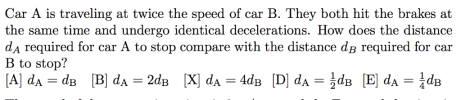 SHOW ALL WORK
Car A is traveling at twice the speed of car B. They both hit the brakes at the same time and undergo identical decelerations. How does the distance da required for car A to stop compare with the distance dB required for car B to stop?
SHOW ALL WORK
Car A is traveling at twice the speed of car B. They both hit the brakes at the same time and undergo identical decelerations. How does the distance da required for car A to stop compare with the distance dB required for car B to stop?
3. A car is traveling at 55 MPH? a) What does it mean to say that this car is traveling at 55 MPH? b) How many mil...
 3. A car is traveling at 55 MPH? a) What does it mean to say that this car is traveling at 55 MPH? b) How many miles the car will cover in 120 minutes? 4. You are driving at 18 m/s, and a cat runs out in front of your car. You stop rani which takes 3 seconds, and miss the cat. What is your deceleration? 5. A car traveling in a straight line with an initial velocity of 10...
A 1200 kg car traveling at 60 mph quickly brakes to a halt. The kinetic energy...
A 1200 kg car traveling at 60 mph quickly brakes to a halt. The kinetic energy of the car is converted to thermal energy of the disk brakes. The brake disks (one per wheel) are iron disks with a mass of 4.0 kg. Estimate the temperature rise in each disk as the car stops. Express your answer using two significant figures.
P2.4-4) A car initially traveling at 60 mph coasts for 5 seconds. Due to friction and...
 P2.4-4) A car initially traveling at 60 mph coasts for 5 seconds. Due to friction and wind resistance, the car decelerates while coasting at a rate of 1 ft/s2. After the 5 seconds of coasting, the driver applies the brakes and decelerates at a constant rate eventually bringing the car to a stop. If the total time that the car travels is 8 seconds, determine the car's braking acceleration. Given: Find: Solution: Draw the acceleration and velocity curves. v (ft/s)...
v: velocity (mph) 20 30 40 50 60 70 80 d: stopping distance (feet) 39 75...
v: velocity (mph) 20 30 40 50 60 70 80 d: stopping distance (feet) 39 75 118 172 230 305 395 The table above gives the stopping distance d of a car driven at velocity v by an unimpaired person on a paved road in good weather. The function d(v), measured in feet, is twice differentiable with d'(v)>0 and d"(v)>0. 1) Find the average rate of change of the stopping distance of the car between 50 and 60 mph. Specify...
16. A 300-kg motorcycle is traveling at 10 m/s. The driver notices a wreck ahead, applies...
16. A 300-kg motorcycle is traveling at 10 m/s. The driver notices a wreck ahead, applies the brakes. The motorcycle slides across the ground with a coefficient of kinetic friction uk = 0.3. A) Using work-energy, find the distance it takes to stop the motorcycle. B) Use work-energy to find the speed of the car 4 meters after the brakes are applied.
The driver of a 1.19 103 kg car traveling on the interstate at 35.0 m/s (nearly...
The driver of a 1.19 103 kg car traveling on the interstate at 35.0 m/s (nearly 80.0 mph) slams on his brakes to avoid hitting a second vehicle in front of him, which had come to rest because of congestion ahead. After the brakes are applied, a constant kinetic friction force of magnitude 7.96 103 N acts on the car. Ignore air resistance. (a) At what minimum distance should the brakes be applied to avoid a collision with the other...
A car is moving at a relatively slow speed, let's say a good running speed for...
A car is moving at a relatively slow speed, let's say a good running speed for a short distance sprint, when it hits a solid wall (top figure). The car comes to a complete stop, with a somewhat shorter front section now. The driver, who was not wearing a seat belt, tries to hold himself off the steering wheel. Let us find the necessary average force acting on the 86-kg driver that is necessary to bring him to a complete...
Please help 12-17. Car B is traveling a distance d ahead of car A. Both cars...
 Please help
12-17. Car B is traveling a distance d ahead of car A. Both cars are traveling at 60 ft/s when the driver of B suddenly applies the brakes causing his car to decelerate at 12 ft/s. It takes the driver of car A 0.75 s to react (this is the normal reaction time for drivers). When he applies his brakes he decelerates at 15.ft/s2. Determine the minimum distance d be tween the cars so as to avoid a...
Please help
12-17. Car B is traveling a distance d ahead of car A. Both cars are traveling at 60 ft/s when the driver of B suddenly applies the brakes causing his car to decelerate at 12 ft/s. It takes the driver of car A 0.75 s to react (this is the normal reaction time for drivers). When he applies his brakes he decelerates at 15.ft/s2. Determine the minimum distance d be tween the cars so as to avoid a...
 SHOW ALL WORK
Car A is traveling at twice the speed of car B. They both hit the brakes at the same time and undergo identical decelerations. How does the distance da required for car A to stop compare with the distance dB required for car B to stop?
SHOW ALL WORK
Car A is traveling at twice the speed of car B. They both hit the brakes at the same time and undergo identical decelerations. How does the distance da required for car A to stop compare with the distance dB required for car B to stop?
 3. A car is traveling at 55 MPH? a) What does it mean to say that this car is traveling at 55 MPH? b) How many miles the car will cover in 120 minutes? 4. You are driving at 18 m/s, and a cat runs out in front of your car. You stop rani which takes 3 seconds, and miss the cat. What is your deceleration? 5. A car traveling in a straight line with an initial velocity of 10...
 P2.4-4) A car initially traveling at 60 mph coasts for 5 seconds. Due to friction and wind resistance, the car decelerates while coasting at a rate of 1 ft/s2. After the 5 seconds of coasting, the driver applies the brakes and decelerates at a constant rate eventually bringing the car to a stop. If the total time that the car travels is 8 seconds, determine the car's braking acceleration. Given: Find: Solution: Draw the acceleration and velocity curves. v (ft/s)...
 Please help
12-17. Car B is traveling a distance d ahead of car A. Both cars are traveling at 60 ft/s when the driver of B suddenly applies the brakes causing his car to decelerate at 12 ft/s. It takes the driver of car A 0.75 s to react (this is the normal reaction time for drivers). When he applies his brakes he decelerates at 15.ft/s2. Determine the minimum distance d be tween the cars so as to avoid a...
Please help
12-17. Car B is traveling a distance d ahead of car A. Both cars are traveling at 60 ft/s when the driver of B suddenly applies the brakes causing his car to decelerate at 12 ft/s. It takes the driver of car A 0.75 s to react (this is the normal reaction time for drivers). When he applies his brakes he decelerates at 15.ft/s2. Determine the minimum distance d be tween the cars so as to avoid a...
Most questions answered within 3 hours.
-
Where is the error in this code sequence?
String s1 = "Hello";
String s2 = "ello";...
asked 11 months ago -
Financial data for Joel de Paris, Inc., for last year
follow:
Joel de Paris, Inc.
Balance...
asked 11 months ago -
Consider this reaction:
Al2(SO4)3 (aq)+ BaCl3
(aq) Al2Cl6 (aq)- +
3BaSO4(s) . What is the...
asked 11 months ago -
Suppose that Savneet is considering increasing her
recent random sample from 20 car rentals to 40...
asked 11 months ago -
Trucks arrive at an unloading terminal at an average rate of 120
per hour.
Trucks arrive...
asked 11 months ago -
Why are methanol and ethanol completely soluble in water while
octanol is not very little soluble....
asked 11 months ago -
A facilities manager at a university reads in a research report
that the mean amount of...
asked 11 months ago -
When the CuSO4 is rehydrated by adding water to the anhydrous
compound, is this an endothermic...
asked 11 months ago -
A ray of sunlight is passing from diamond into crown glass; the
angle of incidence is...
asked 11 months ago -
A block of mass 0.249 kg is placed on top of a light, vertical
spring of...
asked 11 months ago -
how do the kidneys compensate in the presences of acidosis
a) trigger hyperventilate
b) reserve acid...
asked 11 months ago -
Question 501 pts
The rental rate of capital to the firm increases. Which of the
following...
asked 11 months ago