Balance the equation HCl + As2O3 + NaNO3 + H2O = NO + H3AsO4 + NaCl...
Balance the equation
HCl + As2O3 + NaNO3 + H2O = NO + H3AsO4 + NaCl
I know the answer, it was shared before, but I don’t know how to do it. Where do I start?
Homework Answers
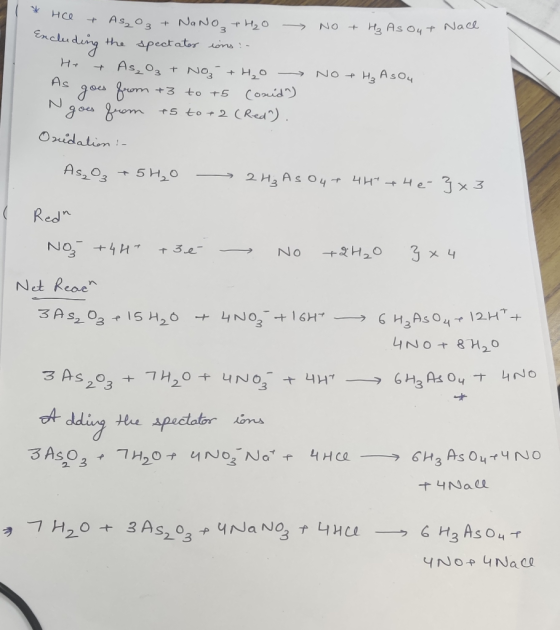
This equation can be balanced by using half equations method.
Balanced Oxidation and reduction reaction is written first and then the net reaction is written.
Add Answer to:
Balance the equation
HCl + As2O3 + NaNO3 + H2O = NO +
H3AsO4 + NaCl...
Balance the chemical equation by adding coefficients as needed:HCl + AS2O3 + NANO3 + H20 =...
Balance the chemical equation by adding coefficients as needed:HCl + AS2O3 + NANO3 + H20 = NO + H3ASO4 + NACl
For the following reaction in acidic solution As2O3 + I2 → H3AsO4 + I- a correct...
For the following reaction in acidic solution As2O3 + I2 → H3AsO4 + I- a correct set of stoichiometric coefficients in the balanced equation is As2O3 H2O I- A. 2,10,2 B. 1,5,2 C. 1,5,4 D. 1,10,2 E. 2,5,4
The reaction of NaHCO3 and HCl produces NaCl, H2O and CO2. The balanced equation is: NaHCO3...
The reaction of NaHCO3 and HCl produces NaCl, H2O and CO2. The balanced equation is: NaHCO3 + HCl = NaCl + H2O + CO2 You combine 5.0 g of NaHCO3 and 5.0 g of HCl. Determine the limiting reagent. Determine the amount of NaCl formed in the reaction based on these quantities of reactants. How much of the excess reactant remains? Thank you in advance!
****** Balance all of the following equations******* Part A Na2CO3(aq)+HCl(aq)→NaCl(aq)+H2O(l)+CO2(g)Na2CO3(aq)+HCl(aq)→NaCl(aq)+H2O(l)+CO2(g) Express your answer as a chemical...
****** Balance all of the following equations******* Part A Na2CO3(aq)+HCl(aq)→NaCl(aq)+H2O(l)+CO2(g)Na2CO3(aq)+HCl(aq)→NaCl(aq)+H2O(l)+CO2(g) Express your answer as a chemical equation. Identify all of the phases in your answer. Part B Submit Request Answer HgO(s)→Hg(l)+O2(g)HgO(s)→Hg(l)+O2(g) Express your answer as a chemical equation. Identify all of the phases in your answer. Part C Submit Request Answer Fe(s)+O2(g)→Fe2O3(s)Fe(s)+O2(g)→Fe2O3(s) Express your answer as a chemical equation. Identify all of the phases in your answer. Part D Submit Request Answer Na(s)+Cl2(g)→NaCl(s)Na(s)+Cl2(g)→NaCl(s) Express your answer as a chemical equation....
Write the reaction equation with line structures for the following reactions: NaCl + H2O--> NaCl +...
Write the reaction equation with line structures for the following reactions: NaCl + H2O--> NaCl + Et2O--> NaCl + HCl--> NaCl + NaOH --> NaCl + NaHCO3-->
Mixture ΔT NaCl + H2O -0.2 NaNO3 + H2O -0.9 NaCH3COO + H2O 0.9 Which reactions...
Mixture ΔT NaCl + H2O -0.2 NaNO3 + H2O -0.9 NaCH3COO + H2O 0.9 Which reactions are endothermic? Which are exothermic? What is the sign of enthalpy ΔH in each case? What is the sign of change in Gibbs free energy ΔG for each process in the forward direction? Could you predict the sign for entropy ΔS for these reactions? How could you tell the sign?
Solution Stoichiometry Hydrochloric acid (HCl) reacts with sodium carbonate (Na2CO3), forming sodium chloride (NaCl), water (H2O),...
Solution Stoichiometry Hydrochloric acid (HCl) reacts with sodium carbonate (Na2CO3), forming sodium chloride (NaCl), water (H2O), and carbon dioxide (CO2). This equation is balanced as written: 2HCl(aq)+Na2CO3(aq)→2NaCl(aq)+H2O(l)+CO2(g) a) What volume of 2.75 M HCl in liters is needed to react completely (with nothing left over) with 0.750 L of 0.300 M Na2CO3? b) A 565-mL sample of unknown HCl solution reacts completely with Na2CO3 to form 10.1 g CO2. What was the concentration of the HCl solution? How do I...
QUESTION 14 What is the net ionic equation for: HCl(aq) + NaOH(aq) → NaCl(aq) + H2O(1)...
 QUESTION 14 What is the net ionic equation for: HCl(aq) + NaOH(aq) → NaCl(aq) + H2O(1) Option A: HCl(aq) + NaOH(aq) → NaCl(aq) + H2O(1) Option B: Option C: Option D: H*(aq) + Cl(aq) + Nat(aq) + OH (aq) → Na*(aq) + Cl (aq) + H2O(1) H*(aq) + OH (aq) → H20(1) Na (aq) + Cl(aq) → Na*(aq) + Cl(aq) O Option A O Option B Optionc O Option D
balance the following equation in acidic conditions. phases are optional. h3aso4
Balance the following equation in acidic conditions. Phases are optional. H3AsO3 + I2 --> H3AsO4 + I- Asked Jul. 28, 2013
chemistry 3 of 17 > e chemical equation by adding coefficients as needed. HCl(aq) + As,O,(s)...
 chemistry
3 of 17 > e chemical equation by adding coefficients as needed. HCl(aq) + As,O,(s) + NaNO3(aq) + H20(1) NO(g) + H, Aso, (aq) + NaCl Balance the chemical equation by adding coefficients as needed. equation: HCl(aq) + As,0,(s) + NaNO, (aq) + H,00) - NO(g) + H 4:0 (aq) + NaCl(a)
chemistry
3 of 17 > e chemical equation by adding coefficients as needed. HCl(aq) + As,O,(s) + NaNO3(aq) + H20(1) NO(g) + H, Aso, (aq) + NaCl Balance the chemical equation by adding coefficients as needed. equation: HCl(aq) + As,0,(s) + NaNO, (aq) + H,00) - NO(g) + H 4:0 (aq) + NaCl(a)
 QUESTION 14 What is the net ionic equation for: HCl(aq) + NaOH(aq) → NaCl(aq) + H2O(1) Option A: HCl(aq) + NaOH(aq) → NaCl(aq) + H2O(1) Option B: Option C: Option D: H*(aq) + Cl(aq) + Nat(aq) + OH (aq) → Na*(aq) + Cl (aq) + H2O(1) H*(aq) + OH (aq) → H20(1) Na (aq) + Cl(aq) → Na*(aq) + Cl(aq) O Option A O Option B Optionc O Option D
 chemistry
3 of 17 > e chemical equation by adding coefficients as needed. HCl(aq) + As,O,(s) + NaNO3(aq) + H20(1) NO(g) + H, Aso, (aq) + NaCl Balance the chemical equation by adding coefficients as needed. equation: HCl(aq) + As,0,(s) + NaNO, (aq) + H,00) - NO(g) + H 4:0 (aq) + NaCl(a)
chemistry
3 of 17 > e chemical equation by adding coefficients as needed. HCl(aq) + As,O,(s) + NaNO3(aq) + H20(1) NO(g) + H, Aso, (aq) + NaCl Balance the chemical equation by adding coefficients as needed. equation: HCl(aq) + As,0,(s) + NaNO, (aq) + H,00) - NO(g) + H 4:0 (aq) + NaCl(a)
Most questions answered within 3 hours.
-
Where is the error in this code sequence?
String s1 = "Hello";
String s2 = "ello";...
asked 11 months ago -
Financial data for Joel de Paris, Inc., for last year
follow:
Joel de Paris, Inc.
Balance...
asked 11 months ago -
Consider this reaction:
Al2(SO4)3 (aq)+ BaCl3
(aq) Al2Cl6 (aq)- +
3BaSO4(s) . What is the...
asked 11 months ago -
Suppose that Savneet is considering increasing her
recent random sample from 20 car rentals to 40...
asked 11 months ago -
Trucks arrive at an unloading terminal at an average rate of 120
per hour.
Trucks arrive...
asked 11 months ago -
Why are methanol and ethanol completely soluble in water while
octanol is not very little soluble....
asked 11 months ago -
A facilities manager at a university reads in a research report
that the mean amount of...
asked 11 months ago -
When the CuSO4 is rehydrated by adding water to the anhydrous
compound, is this an endothermic...
asked 11 months ago -
A ray of sunlight is passing from diamond into crown glass; the
angle of incidence is...
asked 11 months ago -
A block of mass 0.249 kg is placed on top of a light, vertical
spring of...
asked 11 months ago -
how do the kidneys compensate in the presences of acidosis
a) trigger hyperventilate
b) reserve acid...
asked 11 months ago -
Question 501 pts
The rental rate of capital to the firm increases. Which of the
following...
asked 11 months ago