The cleavage of a silyl ether (R-O-SiR'3) is accomplished by treatment with (C4H9)4NF in the presence...
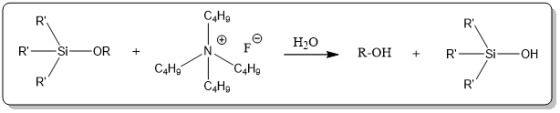
The cleavage of a silyl ether (R-O-SiR'3) is accomplished by treatment with (C4H9)4NF in the presence of a small amount of water. One product is the alcohol, R-OH. Give the complete mechanism using curved arrow formalism and show the other product which is formed.
Homework Answers
ANSWER:
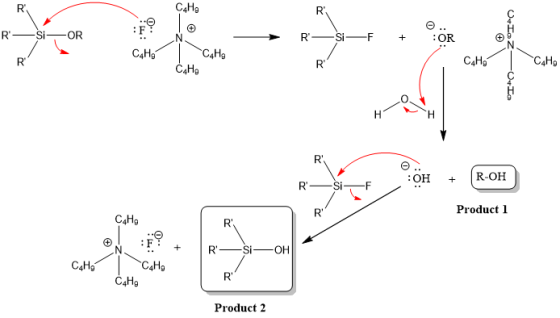
- Proposed mechanism:
- Nucleophilic substituion on silyl ether by fluoride ion producing an OR- and a molecules of R'3Si-F
- The OR- ion atacks the water molecule to generate the alcohol and OH-
- The OH- reacts with R'3Si-F (formed in the first step) to produce R'3Si-OH and regenerate the F-
- General reaction
Add Answer to:
The cleavage of a silyl ether (R-O-SiR'3) is
accomplished by treatment with
(C4H9)4NF in the presence...
3. Draw the product and give the complete arrow pushing reaction mechanism for the ether cleavage...
 3. Draw the product and give the complete arrow pushing reaction mechanism for the ether cleavage of compound A with HBr. HBr
Show the alkyl bromide and alcohol used to make methyl t-butyl ether using the Williamson ether...
 Show the alkyl bromide and alcohol used to make methyl t-butyl
ether using the Williamson ether synthesis to the right of the
retrosynthetic arrow.
Mapoob a) Show the alkyl bromide and alcohol used to make methyl t-butyl ether using the Williamson ether synthesis to the right of the retrosynthetic arrow. alcohol alkyl bromide click to edit CHa H3 H3 b) Complete the general mechanism by adding curved arrows and drawing the final organic product. (Note that R is an abbreviation...
Show the alkyl bromide and alcohol used to make methyl t-butyl
ether using the Williamson ether synthesis to the right of the
retrosynthetic arrow.
Mapoob a) Show the alkyl bromide and alcohol used to make methyl t-butyl ether using the Williamson ether synthesis to the right of the retrosynthetic arrow. alcohol alkyl bromide click to edit CHa H3 H3 b) Complete the general mechanism by adding curved arrows and drawing the final organic product. (Note that R is an abbreviation...
Show the alkyl bromide and alcohol used to make methyl t-butyl ether using the Williamson ether...
 Show the alkyl bromide and alcohol used to make methyl t-butyl ether using the Williamson ether synthesis to the right of the retrosynthetic arrow. Complete the general mechanism by adding curved arrows and drawing the final organic product. (Note that R is an abbreviation for any alkyl group and can be found on the bottom row in the pull down periodic table in the drawing tools menu.)
Acid Catalyzed Hydration-treatment of alkenes with water in the presence of acid catalyst leads to the...
 Acid Catalyzed Hydration-treatment of alkenes with water in the presence of acid catalyst leads to the formation of alcohols. H2SO4/H2O > 150°C Mechanism Major Product Acid catalyzed dehydration goes through a carbocation intermediate. This means that the Markovnikov product is obtained when carbocation rearrangements do not occur. The need for excessively high temperatures makes this reaction of limited use in laboratory synthesis. Oxymercuration - Oxymercuration involves the addition of Hg to the alkene using mercury (II) acetate Hg(OAc) followed by...
For the dehydration shown, use curved arrows to show the formation of the carbocation intermediate in...
 For the dehydration shown, use curved arrows to show the formation of the carbocation intermediate in the presence of sulfuric acid H, SO4, then draw the structure of the major product of the elimination. OH to selectivacain intermediate in the prese H2SO4 - product Step 1: Use curved arrows to complete the protonation mechanism of the alcohol. Step 2: Use a curved arrow to show the formation of the carbocation intermediate. Note: HSO, is formed from step 1, but not...
estion 14 of 14 Attemp For the dehydration shown, use curved arrows to show the formation...
 estion 14 of 14 Attemp For the dehydration shown, use curved arrows to show the formation of the carbocation intermediate in the presence of sulfuric acid H,SOą, then draw the structure of the major product of the elimination. ОН H, SO product Step 1: Use curved arrows to complete the protonation mechanism of the alcohol. Step 2: Use a curved arrow to show the formation the carbocation intermediate. Note: HSO, is formed from step 1, but not shown. Select Draw...
For the dehydration shown, use curved arrows to show the formation of the carbocation intermediate in...
 For the dehydration shown, use curved arrows to show the formation of the carbocation intermediate in the presence of sulfuric acid H, SO4, then draw the structure of the major product of the elimination. ОН H2SO4 - product Step 1: Use curved arrows to complete the protonation mechanism of the alcohol. Step 2: Use a curved arrow to show the formation the carbocation intermediate. Note: HSOZ is formed from step 1, but not shown. Select Draw Rings More Erase Select...
Gradescope #2 This question is worth 10 points. The reaction between (R)-2-bromo-3-methylbutane and water in the...
 Gradescope #2 This question is worth 10 points. The reaction between (R)-2-bromo-3-methylbutane and water in the presence of heat forms Br. H30* and two organic products. Draw a stepwise mechanism for this reaction, clearly showing how each product is formed. Use curved arrows to show electron movement, and include all reactive intermediates, resonance structures, etc. Br H20
(Review Topics 1. Hg(OAC)2, H20 2. NaBH, . H2O OH CHI CH3 H3C H3C Hoc Acid-catalyzed...
 (Review Topics 1. Hg(OAC)2, H20 2. NaBH, . H2O OH CHI CH3 H3C H3C Hoc Acid-catalyzed addition of water to an alkene yields an alcohol with Markovnikov repiochemistry. The electrophilic adds to the sp? carbon with the most hydrogens to yield the most stable carbocation intermediate, which then adds water to give the product alcohol Because a carbocation intermediate is formed, rearrangements can occur prior to the addition of water To avoid the possibility of rearrangement and still give a...
ОН 3. Glucuronic acid is an oxidized derivative of glucose found in animal secretions such as...
 ОН 3. Glucuronic acid is an oxidized derivative of glucose found in animal secretions such as saliva. Biological conversaion of glucuronic acid into its isomer, fructuronic acid, is catalyzed by an enzyme called uronic acid isomerase O OH OH o= H2O, H* OH uronic acid isomerase HO O O H OH glucuronic acid fructuronic acid a. Provide a complete curved-arrow mechanism for this transformation. You may assume that the enzyme active site will supply all necessary equivalents of water and...
 3. Draw the product and give the complete arrow pushing reaction mechanism for the ether cleavage of compound A with HBr. HBr
 Show the alkyl bromide and alcohol used to make methyl t-butyl
ether using the Williamson ether synthesis to the right of the
retrosynthetic arrow.
Mapoob a) Show the alkyl bromide and alcohol used to make methyl t-butyl ether using the Williamson ether synthesis to the right of the retrosynthetic arrow. alcohol alkyl bromide click to edit CHa H3 H3 b) Complete the general mechanism by adding curved arrows and drawing the final organic product. (Note that R is an abbreviation...
Show the alkyl bromide and alcohol used to make methyl t-butyl
ether using the Williamson ether synthesis to the right of the
retrosynthetic arrow.
Mapoob a) Show the alkyl bromide and alcohol used to make methyl t-butyl ether using the Williamson ether synthesis to the right of the retrosynthetic arrow. alcohol alkyl bromide click to edit CHa H3 H3 b) Complete the general mechanism by adding curved arrows and drawing the final organic product. (Note that R is an abbreviation...
 Show the alkyl bromide and alcohol used to make methyl t-butyl ether using the Williamson ether synthesis to the right of the retrosynthetic arrow. Complete the general mechanism by adding curved arrows and drawing the final organic product. (Note that R is an abbreviation for any alkyl group and can be found on the bottom row in the pull down periodic table in the drawing tools menu.)
 Acid Catalyzed Hydration-treatment of alkenes with water in the presence of acid catalyst leads to the formation of alcohols. H2SO4/H2O > 150°C Mechanism Major Product Acid catalyzed dehydration goes through a carbocation intermediate. This means that the Markovnikov product is obtained when carbocation rearrangements do not occur. The need for excessively high temperatures makes this reaction of limited use in laboratory synthesis. Oxymercuration - Oxymercuration involves the addition of Hg to the alkene using mercury (II) acetate Hg(OAc) followed by...
 For the dehydration shown, use curved arrows to show the formation of the carbocation intermediate in the presence of sulfuric acid H, SO4, then draw the structure of the major product of the elimination. OH to selectivacain intermediate in the prese H2SO4 - product Step 1: Use curved arrows to complete the protonation mechanism of the alcohol. Step 2: Use a curved arrow to show the formation of the carbocation intermediate. Note: HSO, is formed from step 1, but not...
 estion 14 of 14 Attemp For the dehydration shown, use curved arrows to show the formation of the carbocation intermediate in the presence of sulfuric acid H,SOą, then draw the structure of the major product of the elimination. ОН H, SO product Step 1: Use curved arrows to complete the protonation mechanism of the alcohol. Step 2: Use a curved arrow to show the formation the carbocation intermediate. Note: HSO, is formed from step 1, but not shown. Select Draw...
 For the dehydration shown, use curved arrows to show the formation of the carbocation intermediate in the presence of sulfuric acid H, SO4, then draw the structure of the major product of the elimination. ОН H2SO4 - product Step 1: Use curved arrows to complete the protonation mechanism of the alcohol. Step 2: Use a curved arrow to show the formation the carbocation intermediate. Note: HSOZ is formed from step 1, but not shown. Select Draw Rings More Erase Select...
 Gradescope #2 This question is worth 10 points. The reaction between (R)-2-bromo-3-methylbutane and water in the presence of heat forms Br. H30* and two organic products. Draw a stepwise mechanism for this reaction, clearly showing how each product is formed. Use curved arrows to show electron movement, and include all reactive intermediates, resonance structures, etc. Br H20
 (Review Topics 1. Hg(OAC)2, H20 2. NaBH, . H2O OH CHI CH3 H3C H3C Hoc Acid-catalyzed addition of water to an alkene yields an alcohol with Markovnikov repiochemistry. The electrophilic adds to the sp? carbon with the most hydrogens to yield the most stable carbocation intermediate, which then adds water to give the product alcohol Because a carbocation intermediate is formed, rearrangements can occur prior to the addition of water To avoid the possibility of rearrangement and still give a...
 ОН 3. Glucuronic acid is an oxidized derivative of glucose found in animal secretions such as saliva. Biological conversaion of glucuronic acid into its isomer, fructuronic acid, is catalyzed by an enzyme called uronic acid isomerase O OH OH o= H2O, H* OH uronic acid isomerase HO O O H OH glucuronic acid fructuronic acid a. Provide a complete curved-arrow mechanism for this transformation. You may assume that the enzyme active site will supply all necessary equivalents of water and...
Most questions answered within 3 hours.
-
Where is the error in this code sequence?
String s1 = "Hello";
String s2 = "ello";...
asked 11 months ago -
Financial data for Joel de Paris, Inc., for last year
follow:
Joel de Paris, Inc.
Balance...
asked 11 months ago -
Consider this reaction:
Al2(SO4)3 (aq)+ BaCl3
(aq) Al2Cl6 (aq)- +
3BaSO4(s) . What is the...
asked 11 months ago -
Suppose that Savneet is considering increasing her
recent random sample from 20 car rentals to 40...
asked 11 months ago -
Trucks arrive at an unloading terminal at an average rate of 120
per hour.
Trucks arrive...
asked 11 months ago -
Why are methanol and ethanol completely soluble in water while
octanol is not very little soluble....
asked 11 months ago -
A facilities manager at a university reads in a research report
that the mean amount of...
asked 11 months ago -
When the CuSO4 is rehydrated by adding water to the anhydrous
compound, is this an endothermic...
asked 11 months ago -
A ray of sunlight is passing from diamond into crown glass; the
angle of incidence is...
asked 11 months ago -
A block of mass 0.249 kg is placed on top of a light, vertical
spring of...
asked 11 months ago -
how do the kidneys compensate in the presences of acidosis
a) trigger hyperventilate
b) reserve acid...
asked 11 months ago -
Question 501 pts
The rental rate of capital to the firm increases. Which of the
following...
asked 11 months ago