The net realizable method of allocating joint costs is most suitable for processes where a.physical measures...
The net realizable method of allocating joint costs is most suitable for processes where
a.physical measures are the most accurate way to allocate joint costs
b.weighted physical measures are the most accurate way to allocate joint costs
c.some products can be processed beyond the split-off point and sold for much higher prices
d.market values are hard, if not impossible, to estimate
Homework Answers

Add Answer to:
The net realizable method of allocating joint costs is most
suitable for processes where
a.physical measures...
Joint Cost Allocation-Net Realizable Value Method Nature's Garden Inc. produces wood chips, wood pulp, and mulch....
 Joint Cost Allocation-Net Realizable Value Method Nature's Garden Inc. produces wood chips, wood pulp, and mulch. These products are produced through harvesting trees and sending the logs through a wood chipper machine. One batch of logs produces 20,304 cubic yards of wood chips, 14,100 cubic yards of mulch, and 9,024 cubic yards of wood pulp. The joint production process costs a total of $32,000 per batch. After the split-off point, wood chips are immediately sold for $25 per cubic yard...
Net Realizable Value Method, Decision to Sell at Split-off or Process Further Pacheco, Inc., produces two...
Net Realizable Value Method, Decision to Sell at Split-off or Process Further Pacheco, Inc., produces two products, overs and unders, in a single process. The joint costs of this process were $50,000, and 14,000 units of overs and 35,000 units of unders were produced. Separable processing costs beyond the split-off point were as follows: overs, $18,000; unders, $19,900. Overs sell for $2.00 per unit; unders sell for $3.14 per unit. Required: 1. Allocate the $50,000 joint costs using the estimated...
Net Realizable Value Method, Decision to Sell at Split-off or Process Further Pacheco, Inc., produces two...
Net Realizable Value Method, Decision to Sell at Split-off or Process Further Pacheco, Inc., produces two products, overs and unders, in a single process. The joint costs of this process were $50,000, and 15,000 units of overs and 35,000 units of unders were produced. Separable processing costs beyond the split-off point were as follows: overs, $20,000; unders, $19,900. Overs sell for $2.00 per unit; unders sell for $3.14 per unit. Required: 1. Allocate the $50,000 joint costs using the estimated...
Allocating Joint Product Costs and Decsions to Process Further 3 Build a worksheet to allocate joint...
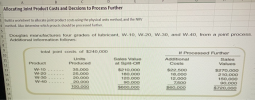 Allocating Joint Product Costs and Decsions to Process Further 3 Build a worksheet to allocate joint product costs using the physical units method, and the NRV 4 method. Also determine which proucts should be processed further. 6 2 Douglas manufactures four grades of lubricant, W-10 W-20, W-30, and W-40, from a joint process. Additional information follows: total joint costs of $240,000 Units Product Produced W-10 35.000 W-20 25.000 W-30 20.000 W-40 20.000 100.000 Sales Value at Split-Off $210.000 180.000 120.000...
Physical Units Method, Relative Sales-Value-at-Split-off Method, Net Realizable Value Method, Decision Making Sonimad Sawmill, Inc. (SSI),...
Physical Units Method, Relative Sales-Value-at-Split-off Method, Net Realizable Value Method, Decision Making Sonimad Sawmill, Inc. (SSI), purchases logs from independent timber contractors and processes them into the following three types of lumber products: Studs for residential construction (e.g., walls and ceilings) Decorative pieces (e.g., fireplace mantels and beams for cathedral ceilings) Posts used as support braces (e.g., mine support braces and braces for exterior fences around ranch properties) These products are the result of a joint sawmill process that involves...
Allocating Joint Costs Using the Constant Gross Margin Method A company manufactures three products, L. Ten,...
 Allocating Joint Costs Using the Constant Gross Margin Method A company manufactures three products, L. Ten, Triol, and Pioze, from a joint process. Each production run costs $12,900. None of the products can be sold at split off, but must be processed further. Information on one batch of the three products is as follows: Product Gallons Further Processing Cost per Gallon $0.50 Eventual Market Price per Gallon L-Ten $2.00 Triol 3,700 4,000 2,300 1.00 5.00 Pioze 1.50 6.00 Required: 1....
Allocating Joint Costs Using the Constant Gross Margin Method A company manufactures three products, L-Ten, Triol,...
Allocating Joint Costs Using the Constant Gross Margin Method A company manufactures three products, L-Ten, Triol, and Pioze, from a joint process. Each production run costs $12,900. None of the products can be sold at split-off, but must be processed further. Information on one batch of the three products is as follows: Product Gallons Further Processing Cost per Gallon Eventual Market Price per Gallon L-Ten 3,500 $0.50 $ 2.00 Triol 4,000 1.00 5.00 Pioze 2,500...
5. Joint Cost Allocation—Net Realizable Value Method Nature's Garden Inc. produces wood chips, wood pulp, and...
5. Joint Cost Allocation—Net Realizable Value Method Nature's Garden Inc. produces wood chips, wood pulp, and mulch. These products are produced through harvesting trees and sending the logs through a wood chipper machine. One batch of logs produces 20,304 cubic yards of wood chips, 14,100 cubic yards of mulch, and 9,024 cubic yards of wood pulp. The joint production process costs a total of $32,000 per batch. After the split-off point, wood chips are immediately sold for $25 per cubic...
Joint Cost Allocation-Net Realizable Value Method Nature's Garden Inc. produces wood chips, wood pulp, and mulch....
 Joint Cost Allocation-Net Realizable Value Method Nature's Garden Inc. produces wood chips, wood pulp, and mulch. These products are produced through harvesting trees and sending the logs through a wood chipper machine. One batch of logs produces 20,304 cubic yards of wood chips, 14,100 cubic yards of mulch, and 9,024 cubic yards of wood pulp. The joint production process costs a total of $32,000 per batch. After the split-off point, wood chips are immediately sold for $25 per cubic yard...
Joint Cost Allocation—Net Realizable Value Method Nature's Garden Inc. produces wood chips, wood pulp, and mulch....
 Joint Cost Allocation—Net Realizable Value Method
Nature's Garden Inc. produces wood chips, wood pulp, and mulch.
These products are produced through harvesting trees and sending
the logs through a wood chipper machine. One batch of logs produces
20,304 cubic yards of wood chips, 14,100 cubic yards of mulch, and
9,024 cubic yards of wood pulp. The joint production process costs
a total of $32,000 per batch. After the split-off point, wood chips
are immediately sold for $25 per cubic yard...
Joint Cost Allocation—Net Realizable Value Method
Nature's Garden Inc. produces wood chips, wood pulp, and mulch.
These products are produced through harvesting trees and sending
the logs through a wood chipper machine. One batch of logs produces
20,304 cubic yards of wood chips, 14,100 cubic yards of mulch, and
9,024 cubic yards of wood pulp. The joint production process costs
a total of $32,000 per batch. After the split-off point, wood chips
are immediately sold for $25 per cubic yard...
 Joint Cost Allocation-Net Realizable Value Method Nature's Garden Inc. produces wood chips, wood pulp, and mulch. These products are produced through harvesting trees and sending the logs through a wood chipper machine. One batch of logs produces 20,304 cubic yards of wood chips, 14,100 cubic yards of mulch, and 9,024 cubic yards of wood pulp. The joint production process costs a total of $32,000 per batch. After the split-off point, wood chips are immediately sold for $25 per cubic yard...
 Allocating Joint Product Costs and Decsions to Process Further 3 Build a worksheet to allocate joint product costs using the physical units method, and the NRV 4 method. Also determine which proucts should be processed further. 6 2 Douglas manufactures four grades of lubricant, W-10 W-20, W-30, and W-40, from a joint process. Additional information follows: total joint costs of $240,000 Units Product Produced W-10 35.000 W-20 25.000 W-30 20.000 W-40 20.000 100.000 Sales Value at Split-Off $210.000 180.000 120.000...
 Allocating Joint Costs Using the Constant Gross Margin Method A company manufactures three products, L. Ten, Triol, and Pioze, from a joint process. Each production run costs $12,900. None of the products can be sold at split off, but must be processed further. Information on one batch of the three products is as follows: Product Gallons Further Processing Cost per Gallon $0.50 Eventual Market Price per Gallon L-Ten $2.00 Triol 3,700 4,000 2,300 1.00 5.00 Pioze 1.50 6.00 Required: 1....
 Joint Cost Allocation-Net Realizable Value Method Nature's Garden Inc. produces wood chips, wood pulp, and mulch. These products are produced through harvesting trees and sending the logs through a wood chipper machine. One batch of logs produces 20,304 cubic yards of wood chips, 14,100 cubic yards of mulch, and 9,024 cubic yards of wood pulp. The joint production process costs a total of $32,000 per batch. After the split-off point, wood chips are immediately sold for $25 per cubic yard...
Most questions answered within 3 hours.
-
Where is the error in this code sequence?
String s1 = "Hello";
String s2 = "ello";...
asked 10 months ago -
Financial data for Joel de Paris, Inc., for last year
follow:
Joel de Paris, Inc.
Balance...
asked 10 months ago -
Consider this reaction:
Al2(SO4)3 (aq)+ BaCl3
(aq) Al2Cl6 (aq)- +
3BaSO4(s) . What is the...
asked 10 months ago -
Suppose that Savneet is considering increasing her
recent random sample from 20 car rentals to 40...
asked 10 months ago -
Trucks arrive at an unloading terminal at an average rate of 120
per hour.
Trucks arrive...
asked 10 months ago -
Why are methanol and ethanol completely soluble in water while
octanol is not very little soluble....
asked 10 months ago -
A facilities manager at a university reads in a research report
that the mean amount of...
asked 10 months ago -
When the CuSO4 is rehydrated by adding water to the anhydrous
compound, is this an endothermic...
asked 10 months ago -
A ray of sunlight is passing from diamond into crown glass; the
angle of incidence is...
asked 10 months ago -
A block of mass 0.249 kg is placed on top of a light, vertical
spring of...
asked 10 months ago -
how do the kidneys compensate in the presences of acidosis
a) trigger hyperventilate
b) reserve acid...
asked 10 months ago -
Question 501 pts
The rental rate of capital to the firm increases. Which of the
following...
asked 10 months ago