Including an irrelevant variable in a regression model causes A. the se(bk) to decrease. B. the...
Including an irrelevant variable in a regression model causes
A. the se(bk) to decrease.
B. the OLS coefficient estimates to be more efficient.
C. the OLS coefficient estimates to be more inefficient.
D. the coefficient estimates to be biased.
Homework Answers
When an irrelevant variable in a regression model is added the variance of the estimates increase
Hence,
C. the OLS coefficient estimates to be more inefficient.
Add Answer to:
Including an irrelevant variable in a regression model
causes
A. the se(bk) to decrease.
B. the...
Which of the following problems will cause OLS estimates of β1 to be biased? Including an...
Which of the following problems will cause OLS estimates of β1 to be biased? Including an irrelevant X5 variable Failing to include an independent variable that is not correlated with Y Failing to include an independent variable that is correlated with Y only Failing to include an independent variable that is correlated with Y and X1 Not only does X cause Y, but Y causes X.
1. For a simple linear regression BMI = a + BIncome+u. Suppose you have a random...
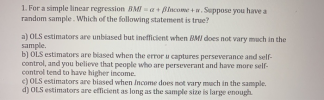 1. For a simple linear regression BMI = a + BIncome+u. Suppose you have a random sample. Which of the following statement is true? a) OLS estimators are unbiased but inefficient when BMI does not vary much in the sample. b) OLS estimators are biased when the error u captures perseverance and self- control, and you believe that people who are perseverant and have more self- control tend to have higher income. C) OLS estimators are biased when Income does...
1. Carefully go through each statement. Answer true or false with explanation (only answers with an...
 1. Carefully go through each statement. Answer true or false with explanation (only answers with an explanation will gain credit). (a) In a regression model, a stochastic regressor is an explanatory variable that has a random component (4 marks] (b) When a stochastic regressor is used in a regression model, OLS regression estimates will be biased. [4 marks] (c) Heteroscedasticity occurs when the disturbance term in a regression model is correlated with one of the explanatory variables. [4 marks] (d)...
1. Changing the unit of measurement of dependent variable, where log of the dependent variable appears...
1. Changing the unit of measurement of dependent variable, where log of the dependent variable appears in the regression: a. affects only the slope coefficient. b. affects neither the slope nor the intercept coefficient. c. affects only the intercept coefficient. d. affects both the slope and intercept coefficients. 2. Which of the following statements is true when the dependent variable, y > 0? a. Taking log of variables make OLS estimates more sensitive to extreme values. b. Models using log(y)...
Multiple regression analysis produces a _______ for each independent variable in the model. Choices A. Partial...
Multiple regression analysis produces a _______ for each independent variable in the model. Choices A. Partial adjusted R-Square B. Partial regression coefficient C. Partial chi-square D. Partial correlation coefficient
1. Consider the following linear regression model: (a) Which assumptions are needed to make the B,...
 1. Consider the following linear regression model: (a) Which assumptions are needed to make the B, unbiased estimators for the B, (b) Explain how one can test the hypothesis that A +As = 0 by means of a t-test. (c) Explain how one can test the hypothesis that A-A-0. Indicate the relevant test statistic. (d) Suppose that ri is an irrelevant explanatory variable in the population model and that you estimate the model including both and r2. What are the...
10.1 Understanding a linear regression model. Consider a linear regression model for the decrease in blood...
10.1 Understanding a linear regression model. Consider a linear regression model for the decrease in blood pressure (mmHg) over a four-week period with μy = 2.8 + 0.8x and standard deviation σ = 3.2. The explanatory variable x is the number of servings of fruits and vegetables in a calorie-controlled diet. (a) What is the slope of the population regression line? (b) Explain clearly what this slope says about the change in the mean of y for a change in...
Question 3. Multiple linear regression [6 marks] Create a multiple linear regression model, including as explanatory...
 Question 3. Multiple linear regression [6 marks] Create a multiple linear regression model, including as explanatory variables wt, am and qsec. To run multiple linear regression to predict variable A based on variables B, C and D you need to use R’s linear model command, Im as follows, storing the results in an object I'll call regm. regm <- lm (A B + C + D) summary(regm) Report the output from the relevant summary() command. Explain why the R2 and...
4. Consider the regression model, y1B22+ BKiK+ei -.. where errors may be heteroskedastic. Choose the most incorrect sta...
 4. Consider the regression model, y1B22+ BKiK+ei -.. where errors may be heteroskedastic. Choose the most incorrect statement (a) The OLS estimators are consistent and unbiased (b) We should report the OLS estimates with the robust standard errors (c) The Gauss-Markov theorem may not apply (d) The GLS cannot be used because we do not know the error variances in practice (e) We should take care of heteroskedasticity only if homoskedasticity is rejected Consider the regression model, +BKIK+et e pet-1+...
The coefficient of determination R2 in a simple regression model, Group of answer choices a) measures...
The coefficient of determination R2 in a simple regression model, Group of answer choices a) measures the proportion of variation in the response variable that is explained by the predictor variable b) determines the predicted value of the response variable given a value for the predictor variable c) estimates the difference between averages in the response variable when the predictor variable differs by 1 d) indicates the predictive ability of the model
 1. For a simple linear regression BMI = a + BIncome+u. Suppose you have a random sample. Which of the following statement is true? a) OLS estimators are unbiased but inefficient when BMI does not vary much in the sample. b) OLS estimators are biased when the error u captures perseverance and self- control, and you believe that people who are perseverant and have more self- control tend to have higher income. C) OLS estimators are biased when Income does...
 1. Carefully go through each statement. Answer true or false with explanation (only answers with an explanation will gain credit). (a) In a regression model, a stochastic regressor is an explanatory variable that has a random component (4 marks] (b) When a stochastic regressor is used in a regression model, OLS regression estimates will be biased. [4 marks] (c) Heteroscedasticity occurs when the disturbance term in a regression model is correlated with one of the explanatory variables. [4 marks] (d)...
 1. Consider the following linear regression model: (a) Which assumptions are needed to make the B, unbiased estimators for the B, (b) Explain how one can test the hypothesis that A +As = 0 by means of a t-test. (c) Explain how one can test the hypothesis that A-A-0. Indicate the relevant test statistic. (d) Suppose that ri is an irrelevant explanatory variable in the population model and that you estimate the model including both and r2. What are the...
 Question 3. Multiple linear regression [6 marks] Create a multiple linear regression model, including as explanatory variables wt, am and qsec. To run multiple linear regression to predict variable A based on variables B, C and D you need to use R’s linear model command, Im as follows, storing the results in an object I'll call regm. regm <- lm (A B + C + D) summary(regm) Report the output from the relevant summary() command. Explain why the R2 and...
 4. Consider the regression model, y1B22+ BKiK+ei -.. where errors may be heteroskedastic. Choose the most incorrect statement (a) The OLS estimators are consistent and unbiased (b) We should report the OLS estimates with the robust standard errors (c) The Gauss-Markov theorem may not apply (d) The GLS cannot be used because we do not know the error variances in practice (e) We should take care of heteroskedasticity only if homoskedasticity is rejected Consider the regression model, +BKIK+et e pet-1+...
Most questions answered within 3 hours.
-
Where is the error in this code sequence?
String s1 = "Hello";
String s2 = "ello";...
asked 10 months ago -
Financial data for Joel de Paris, Inc., for last year
follow:
Joel de Paris, Inc.
Balance...
asked 10 months ago -
Consider this reaction:
Al2(SO4)3 (aq)+ BaCl3
(aq) Al2Cl6 (aq)- +
3BaSO4(s) . What is the...
asked 10 months ago -
Suppose that Savneet is considering increasing her
recent random sample from 20 car rentals to 40...
asked 10 months ago -
Trucks arrive at an unloading terminal at an average rate of 120
per hour.
Trucks arrive...
asked 10 months ago -
Why are methanol and ethanol completely soluble in water while
octanol is not very little soluble....
asked 10 months ago -
A facilities manager at a university reads in a research report
that the mean amount of...
asked 10 months ago -
When the CuSO4 is rehydrated by adding water to the anhydrous
compound, is this an endothermic...
asked 10 months ago -
A ray of sunlight is passing from diamond into crown glass; the
angle of incidence is...
asked 10 months ago -
A block of mass 0.249 kg is placed on top of a light, vertical
spring of...
asked 10 months ago -
how do the kidneys compensate in the presences of acidosis
a) trigger hyperventilate
b) reserve acid...
asked 10 months ago -
Question 501 pts
The rental rate of capital to the firm increases. Which of the
following...
asked 10 months ago