Using ADT Stack: Evaluating infix expressions by converting them to postfix expressions Postfix notation: In a...
Using ADT Stack: Evaluating infix expressions by converting them to postfix expressions Postfix notation: In a postfix expression, a binary operation follows its two opperands. The order of the operands in a infix expression is the same as in the corresponding postfix expression but the order of the operators might change based on the precedence of the operators and the existing of paranthses. Infix Postfix a + b a b + (a + b) * c a b + c * a + b * c a b c * +
1. Infix-to-postfix convertion To convert an infix to postfix expression we can use a stack to store temporary operators and open and close parantheses. Take the following actions which depend on the currently processed symbol from the infix expression (scanned from left to right). Construct the output (resulting) expression, by appending to its end the correct items (operands or operators). If Operand: Append the operand to the end of the output expression. If Operator ^: Push it onto the stack. If Operator +, -, *, /: - If the stack is empty or its top entry is an operator that has a lower precedence than the new operator, push the new operator onto the stack (Note: ‘*’ and ‘/’ have higher precedence than ‘+’ and ‘-‘.) - Otherwise pop operators from the stack and append them to the output expression until the stack is empty, or its top entry has a lower precedence than the new operator. Then push the new operator onto the stack. If Open paranthesis: Push ( onto the stack. If Close paranthesis: Pop operators from the stack and append them to the output expression until an open paranthesis is poped. Then discard both parantheses.
Problem 1 ) Convert the following infix expressions to postfix expressions using the rules given above: (a – b * c ) / (d * e + (d – c))
2.Evaluating postfix expressions To evaluate a postfix expression: scan the expression and take the following actions depending on the currently processed symbol: If Operand: push it onto the stack If Operator: - pop an operand from the stack (this will be the second operand, which has been pushed last); - pop another operand from the stack (this will be the first operand) - perform the operation and push the result back onto the stack.
Problem 2) Using the rules given above, evaluate the following postfix expression, if a = 2, b = 3, c = 4, d = 5: a b c - / d *
The language is Java
Homework Answers
================ code for InfixToPostfix ================================java used============
import java.util.Stack;
class InfixToPostFix
{
////////////////////////////////////////////////
// calculating precedence order
static int PrecedenceOrder(char ch)
{
switch (ch)
{
case '+':
case '-':
return 1;
case '*':
case '/':
return 2;
case '^':
return 3;
}
return -1;
}
////////////////////////////////////////////////////
// Method that converts infix to postfix
expression
static String myInToPostfix(String exp)
{
String result = new
String("");
// a empty stack
Stack<Character> stack = new
Stack<>();
for (int i = 0; i<exp.length();
++i)
{
char c =
exp.charAt(i);
// scanning
character is lettre or digit
if
(Character.isLetterOrDigit(c))
result += c;
// character is
an '(' do it
else if (c ==
'(')
stack.push(c);
// character is
) loop until ( found
else if (c ==
')')
{
while (!stack.isEmpty() && stack.peek()
!= '(')
result += stack.pop();
if (!stack.isEmpty() && stack.peek() !=
'(')
return "Expression is not
valid---";
else
stack.pop();
}
else // operator
found
{
while (!stack.isEmpty() &&
PrecedenceOrder(c) <= PrecedenceOrder(stack.peek())){
if(stack.peek() == '(')
return
"Expression is not valid--";
result += stack.pop();
}
stack.push(c);
}
}
// poping the operators
while (!stack.isEmpty()){
if(stack.peek()
== '(')
return "Expression is invalid----";
result +=
stack.pop();
}
return result;
}
////////////////////////////////////////////////////
public static void main(String[] args)
{
String exp =
"a+b*(c^d-e)^(f+g*h)-i";
System.out.println(myInToPostfix(exp));
exp = "a + b a b + (a + b) * c a b + c * a + b * c a b c *
+";
System.out.println(myInToPostfix(exp));
}
}
----------------------------------------------------------------------------------------------------------------------------------------------------
Screenshots of the code and the output are:
-----------------------------------------------------------------------------------------------------------------------------------------------------
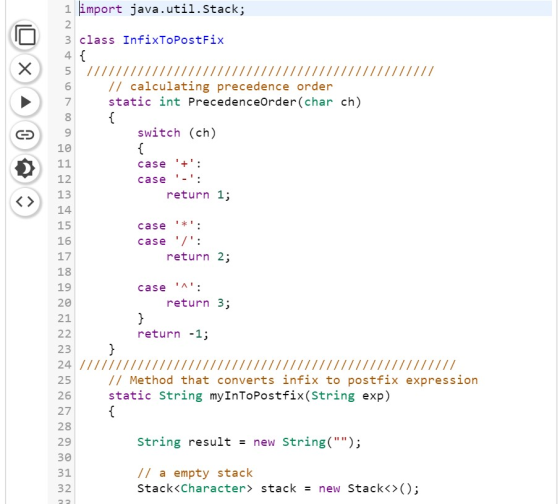
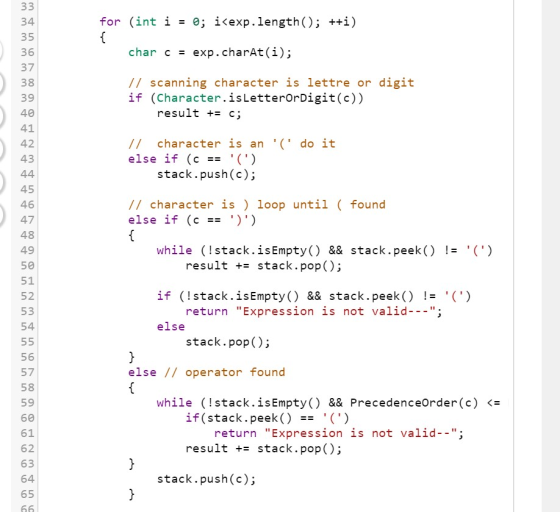
 ================================= end
====================================================
================================= end
====================================================
**************************** Please like the post if you liked it *******************************************************************
Add Answer to:
Using ADT Stack: Evaluating infix expressions by converting them
to postfix expressions Postfix notation: In a...
Stacks are used by compilers to help in the process of evaluating expressions and generating machine...
 Stacks are used by compilers to help in the process of
evaluating expressions and generating machine language code.In this
exercise, we investigate how compilers evaluate arithmetic
expressions consisting only of constants, operators and
parentheses. Humans generally write expressions like 3 + 4and 7 /
9in which the operator (+ or / here) is written between its
operands—this is called infix notation. Computers “prefer” postfix
notation in which the operator is written to the right of its two
operands. The preceding...
Stacks are used by compilers to help in the process of
evaluating expressions and generating machine language code.In this
exercise, we investigate how compilers evaluate arithmetic
expressions consisting only of constants, operators and
parentheses. Humans generally write expressions like 3 + 4and 7 /
9in which the operator (+ or / here) is written between its
operands—this is called infix notation. Computers “prefer” postfix
notation in which the operator is written to the right of its two
operands. The preceding...
In C programming Language Write a version of the infix-to-postfix conversion algorithm. Write a program that converts an...
In C programming Language Write a version of the infix-to-postfix conversion algorithm. Write a program that converts an ordinary infix arithmetic expression (assume a valid expression is entered) with single-digit integers For Example: Infix expression (6 + 2) * 5 - 8 / 4 to a postfix expression is 62+5*84/- The program should read the expression into character array infix and use the stack functions implemented in this chapter to help create the postfix expression in character array postfix. The...
By using PYTHON language Postfix to Infix using Stack Develop a stack application that can convert...
By using PYTHON language Postfix to Infix using Stack Develop a stack application that can convert Postfix notation to Infix notation using the following algorithm. In your stack application, you can use only two stacks, one for a stack that can store Postfix notation, and the other is a stack to store infix notation. Also, it would help if you had a function to distinguish between an operation or an operand. Input A B C * + D E /...
Code should be written in java Write a program to convert an infix expression to postfix...
Code should be written in java Write a program to convert an infix expression to postfix expression using stack. Algorithm: a) Create a stack b) For each character t in the input stream If(t is an operand) append t to the output. Else if (t is a right parenthesis) Pop and append to the output until a left parenthesis is popped (but do not append this parenthesis to the output). Else if(t is an operator or left parenthesis) Pop and...
Given the following C code. Develop a evaluate post fix function that calculates the converted post...
Given the following C code. Develop a evaluate post fix function that calculates the converted post fix. #include <stdio.h> #include <ctype.h> #define max 10 char s[100]; int top=-1; void push(char); char pop(); int precede(char); main(){ char infix[100],postfix[100],ch; int i=0,j=0; // Read infix expression from user printf("Enter infix expression:"); scanf("%s",infix); // evaluate each char in infix expression while((ch=infix[i++])!='\0'){ // if it is number, add it to postfix expression if(isalnum(ch)){ ...
In c++ Section 1. Stack ADT – Overview Data Items The data items in a stack...
In c++ Section 1. Stack ADT – Overview Data Items The data items in a stack are of generic DataType. This means use should use templating and your Node class. Structure The stack data items are linearly ordered from the most recently added (the top) to the least recently added (the bottom). This is a LIFO scheme. Data items are inserted onto (pushed) and removed from (popped) the top of the stack. Operations Constructor. Creates an empty stack. Copy constructor....
EVALUATING GENERAL INFIX EXPRESSIONS INTRODUCTION The notation in which we usually write arithmetic expressions is called infix notation;...
EVALUATING GENERAL INFIX EXPRESSIONS INTRODUCTION The notation in which we usually write arithmetic expressions is called infix notation; in it, operators are written between their operands: X + Y. Such expressions can be ambiguous; do we add or multiply first in the expression 5 + 3 * 2? Parentheses and rules of precedence and association clarify such ambiguities: multiplication and division take precedence over addition and subtraction, and operators associate from left to right. This project implements and exercises a stack-based algorithm that evaluates...
We as humans write math expression in infix notation, e.g. 5 + 2 (the operators are...
We as humans write math expression in infix notation, e.g. 5 + 2 (the operators are written in-between the operands). In a computer’s language, however, it is preferred to have the operators on the right side of the operands, i.e. 5 2 +. For more complex expressions that include parenthesis and multiple operators, a compiler has to convert the expression into postfix first and then evaluate the resulting postfix. Write a program that takes an “infix” expression as input, uses...
a) Show the steps that a stack uses to convert the algebraic expression a*(b+c/d from infix to postfix notation. Indicate each intermediate change in the stack and postfix output. (Be sure to...
 a) Show the steps that a stack uses to convert the algebraic expression a*(b+c/d from infix to postfix notation. Indicate each intermediate change in the stack and postfix output. (Be sure to identify how operator precedence is determined. b) show the steps a stack uses to evaluate the postfix expression from part (a) when (a-6, b-4, c-2, d 5) c) Show the steps a stack uses to produce an expression tree with the postfix expression from part (a).
a) Show...
a) Show the steps that a stack uses to convert the algebraic expression a*(b+c/d from infix to postfix notation. Indicate each intermediate change in the stack and postfix output. (Be sure to identify how operator precedence is determined. b) show the steps a stack uses to evaluate the postfix expression from part (a) when (a-6, b-4, c-2, d 5) c) Show the steps a stack uses to produce an expression tree with the postfix expression from part (a).
a) Show...
Python Issue Postfix notation (also known as Reverse Polish Notation or RPN in short) is a...
Python Issue Postfix notation (also known as Reverse Polish Notation or RPN in short) is a mathematical notation in which operators follow all of its operands. It is different from infix notation in which operators are placed between its operands. The algorithm to evaluate any postfix expression is based on stack and is pretty simple: Initialize empty stack For every token in the postfix expression (scanned from left to right): If the token is an operand (number), push it on...
 Stacks are used by compilers to help in the process of
evaluating expressions and generating machine language code.In this
exercise, we investigate how compilers evaluate arithmetic
expressions consisting only of constants, operators and
parentheses. Humans generally write expressions like 3 + 4and 7 /
9in which the operator (+ or / here) is written between its
operands—this is called infix notation. Computers “prefer” postfix
notation in which the operator is written to the right of its two
operands. The preceding...
Stacks are used by compilers to help in the process of
evaluating expressions and generating machine language code.In this
exercise, we investigate how compilers evaluate arithmetic
expressions consisting only of constants, operators and
parentheses. Humans generally write expressions like 3 + 4and 7 /
9in which the operator (+ or / here) is written between its
operands—this is called infix notation. Computers “prefer” postfix
notation in which the operator is written to the right of its two
operands. The preceding...
 a) Show the steps that a stack uses to convert the algebraic expression a*(b+c/d from infix to postfix notation. Indicate each intermediate change in the stack and postfix output. (Be sure to identify how operator precedence is determined. b) show the steps a stack uses to evaluate the postfix expression from part (a) when (a-6, b-4, c-2, d 5) c) Show the steps a stack uses to produce an expression tree with the postfix expression from part (a).
a) Show...
a) Show the steps that a stack uses to convert the algebraic expression a*(b+c/d from infix to postfix notation. Indicate each intermediate change in the stack and postfix output. (Be sure to identify how operator precedence is determined. b) show the steps a stack uses to evaluate the postfix expression from part (a) when (a-6, b-4, c-2, d 5) c) Show the steps a stack uses to produce an expression tree with the postfix expression from part (a).
a) Show...
Most questions answered within 3 hours.
-
Where is the error in this code sequence?
String s1 = "Hello";
String s2 = "ello";...
asked 11 months ago -
Financial data for Joel de Paris, Inc., for last year
follow:
Joel de Paris, Inc.
Balance...
asked 11 months ago -
Consider this reaction:
Al2(SO4)3 (aq)+ BaCl3
(aq) Al2Cl6 (aq)- +
3BaSO4(s) . What is the...
asked 11 months ago -
Suppose that Savneet is considering increasing her
recent random sample from 20 car rentals to 40...
asked 11 months ago -
Trucks arrive at an unloading terminal at an average rate of 120
per hour.
Trucks arrive...
asked 11 months ago -
Why are methanol and ethanol completely soluble in water while
octanol is not very little soluble....
asked 11 months ago -
A facilities manager at a university reads in a research report
that the mean amount of...
asked 11 months ago -
When the CuSO4 is rehydrated by adding water to the anhydrous
compound, is this an endothermic...
asked 11 months ago -
A ray of sunlight is passing from diamond into crown glass; the
angle of incidence is...
asked 11 months ago -
A block of mass 0.249 kg is placed on top of a light, vertical
spring of...
asked 11 months ago -
how do the kidneys compensate in the presences of acidosis
a) trigger hyperventilate
b) reserve acid...
asked 11 months ago -
Question 501 pts
The rental rate of capital to the firm increases. Which of the
following...
asked 11 months ago