M1 = 550 grams M2 = 560 grams Dropped Distance = 1 Meter 1st Time to...
M1 = 550 grams
M2 = 560 grams
Dropped Distance = 1 Meter
1st Time to drop 1 meter = 4.82 Seconds
2nd Time to drop 1 meter = 4.62 Seconds
What is the Average Time and Acceleration? (m/second^2)
Homework Answers


Add Answer to:
M1 = 550 grams
M2 = 560 grams
Dropped Distance = 1 Meter
1st Time to...
Please fully explain 1) Consider two charged particles (q,--4μC,m1-8 grams; q,-+15pC, m2-3 grams). The first particle...
 Please fully explain
1) Consider two charged particles (q,--4μC,m1-8 grams; q,-+15pC, m2-3 grams). The first particle is 18 cm to the North of the second one. a) What is the magnitude and direction of the electric FORCE on the 1st particle due to the presence of the 2nd particle? [when answering this direction question, answer with North, East, South, West, Up or Down.] 16.7 Nt South b) Is the magnitude of the force on the 2nd particle due to the...
Please fully explain
1) Consider two charged particles (q,--4μC,m1-8 grams; q,-+15pC, m2-3 grams). The first particle is 18 cm to the North of the second one. a) What is the magnitude and direction of the electric FORCE on the 1st particle due to the presence of the 2nd particle? [when answering this direction question, answer with North, East, South, West, Up or Down.] 16.7 Nt South b) Is the magnitude of the force on the 2nd particle due to the...
Please fully explain #2 1) Consider two charged particles (q,--4μC,m1-8 grams; q,-+15pC, m2-3 grams). The first...
 Please fully explain #2
1) Consider two charged particles (q,--4μC,m1-8 grams; q,-+15pC, m2-3 grams). The first particle is 18 cm to the North of the second one. a) What is the magnitude and direction of the electric FORCE on the 1st particle due to the presence of the 2nd particle? [when answering this direction question, answer with North, East, South, West, Up or Down.] 16.7 Nt South b) Is the magnitude of the force on the 2nd particle due to...
Please fully explain #2
1) Consider two charged particles (q,--4μC,m1-8 grams; q,-+15pC, m2-3 grams). The first particle is 18 cm to the North of the second one. a) What is the magnitude and direction of the electric FORCE on the 1st particle due to the presence of the 2nd particle? [when answering this direction question, answer with North, East, South, West, Up or Down.] 16.7 Nt South b) Is the magnitude of the force on the 2nd particle due to...
Think about an arrangement of two masses m1 and m2 associated by a massless slender bar,...
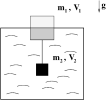 Think about an arrangement of two masses m1 and m2 associated by
a massless slender bar, the volumes of the first and second masses
are V1 = 840 cm3 and V2 = 330 cm3 correspondingly. The framework
drifts in a liquid so that a portion of the primary mass and the
whole second mass are beneath the outside of the liquid. Discover
the total of the majority if the density of the liquid is ρfluid =
1.23 g/cm3
Mtotal =...
Think about an arrangement of two masses m1 and m2 associated by
a massless slender bar, the volumes of the first and second masses
are V1 = 840 cm3 and V2 = 330 cm3 correspondingly. The framework
drifts in a liquid so that a portion of the primary mass and the
whole second mass are beneath the outside of the liquid. Discover
the total of the majority if the density of the liquid is ρfluid =
1.23 g/cm3
Mtotal =...
1. Draw the forces acting on mı and m2 in the diagram below. m2 > m1...
 1. Draw the forces acting on mı and m2 in the diagram below. m2 > m1 Determine the acceleration of the system. Show your work. 2. An accelerating force of 500 N changes an object from 40 m/s to 60 m/s in a distance of 100 m. The mass is 25 kg. Determine the force of friction acting opposite of this force. Draw your free body diagram.
Released from rest a block slides down an inclined plane travelling a distance of 1 meter...
Released from rest a block slides down an inclined plane travelling a distance of 1 meter in a time of 1 second. Statement: If the acceleration of the block is constant then the acceleration of the block must be 1 m s − 2. Question: Is the above statement true or false?
1. Newton's Universal Law of Gravitation can be written as F = G*M1*M2/r^2 where M1 and...
1. Newton's Universal Law of Gravitation can be written as F = G*M1*M2/r^2 where M1 and M2 are masses of objects in kilograms (kg), r is the distance between the objects in meters (m), and F is the magnitude of the force the objects exert on each other in units of kilograms times meters per second squared (kg*m/s^2). Determine the units of the universal gravitational constant, G. In your answer, use only units of kg, m, and s. Write any...
Atwood Machine What would the acceleration of the system be if the masses are equal (m1=m2)?...
Atwood Machine What would the acceleration of the system be if the masses are equal (m1=m2)? What would the tension of the string be in this case? Explain why these values make sense in the context of Newton’s second law. What would the acceleration of the system be if the mass of cylinder 2 is much greater than the mass of cylinder 1 (m2>>m1)? What would the tension of the string be in this case? Why or why not do...
In MKS (SI units), mass is expressed in kilogram (Kg), length in meter (m) and time...
In MKS (SI units), mass is expressed in kilogram (Kg), length in meter (m) and time in second (s). What would be the units for the following? a. Speed = distance/time b. Momentum = mass * speed c. Kinetic energy = (1/2)*mass*speed2 d. Force = mass*acceleration e. Work = Force * distance
Question 1: Consider two different implementations, M1 and M2, of the same instruction set. There are...
Question 1: Consider two different implementations, M1 and M2, of the same instruction set. There are four classes of instructions (A, B, C, and D) in the instruction set. M1 has a clock rate of 500 MHz while M2’s clock rate is 750 MHz. The average number of cycles for each instruction class of M1 and M2 are shown in the following table: Class CPI for this class on M1 CPI for this class on M2 A 1 2 B...
PHY 254H Suppose two masses labelled m1 and m2, are speeding toward each other at time...
PHY 254H Suppose two masses labelled m1 and m2, are speeding toward each other at time t=0s. The first mass 1 has a mass and speed has values of m1=3 kg and v1,i= 2 m/s (to the right). Mass 2 has a mass and speed of m2 = 5kg with an initial speed of v2,I = 5 m/s (to the left). Then at some time t there is an elastic collision between the two masses. What is the final speed...
 Please fully explain
1) Consider two charged particles (q,--4μC,m1-8 grams; q,-+15pC, m2-3 grams). The first particle is 18 cm to the North of the second one. a) What is the magnitude and direction of the electric FORCE on the 1st particle due to the presence of the 2nd particle? [when answering this direction question, answer with North, East, South, West, Up or Down.] 16.7 Nt South b) Is the magnitude of the force on the 2nd particle due to the...
Please fully explain
1) Consider two charged particles (q,--4μC,m1-8 grams; q,-+15pC, m2-3 grams). The first particle is 18 cm to the North of the second one. a) What is the magnitude and direction of the electric FORCE on the 1st particle due to the presence of the 2nd particle? [when answering this direction question, answer with North, East, South, West, Up or Down.] 16.7 Nt South b) Is the magnitude of the force on the 2nd particle due to the...
 Please fully explain #2
1) Consider two charged particles (q,--4μC,m1-8 grams; q,-+15pC, m2-3 grams). The first particle is 18 cm to the North of the second one. a) What is the magnitude and direction of the electric FORCE on the 1st particle due to the presence of the 2nd particle? [when answering this direction question, answer with North, East, South, West, Up or Down.] 16.7 Nt South b) Is the magnitude of the force on the 2nd particle due to...
Please fully explain #2
1) Consider two charged particles (q,--4μC,m1-8 grams; q,-+15pC, m2-3 grams). The first particle is 18 cm to the North of the second one. a) What is the magnitude and direction of the electric FORCE on the 1st particle due to the presence of the 2nd particle? [when answering this direction question, answer with North, East, South, West, Up or Down.] 16.7 Nt South b) Is the magnitude of the force on the 2nd particle due to...
 Think about an arrangement of two masses m1 and m2 associated by
a massless slender bar, the volumes of the first and second masses
are V1 = 840 cm3 and V2 = 330 cm3 correspondingly. The framework
drifts in a liquid so that a portion of the primary mass and the
whole second mass are beneath the outside of the liquid. Discover
the total of the majority if the density of the liquid is ρfluid =
1.23 g/cm3
Mtotal =...
Think about an arrangement of two masses m1 and m2 associated by
a massless slender bar, the volumes of the first and second masses
are V1 = 840 cm3 and V2 = 330 cm3 correspondingly. The framework
drifts in a liquid so that a portion of the primary mass and the
whole second mass are beneath the outside of the liquid. Discover
the total of the majority if the density of the liquid is ρfluid =
1.23 g/cm3
Mtotal =...
 1. Draw the forces acting on mı and m2 in the diagram below. m2 > m1 Determine the acceleration of the system. Show your work. 2. An accelerating force of 500 N changes an object from 40 m/s to 60 m/s in a distance of 100 m. The mass is 25 kg. Determine the force of friction acting opposite of this force. Draw your free body diagram.
Most questions answered within 3 hours.
-
Where is the error in this code sequence?
String s1 = "Hello";
String s2 = "ello";...
asked 11 months ago -
Financial data for Joel de Paris, Inc., for last year
follow:
Joel de Paris, Inc.
Balance...
asked 11 months ago -
Consider this reaction:
Al2(SO4)3 (aq)+ BaCl3
(aq) Al2Cl6 (aq)- +
3BaSO4(s) . What is the...
asked 11 months ago -
Suppose that Savneet is considering increasing her
recent random sample from 20 car rentals to 40...
asked 11 months ago -
Trucks arrive at an unloading terminal at an average rate of 120
per hour.
Trucks arrive...
asked 11 months ago -
Why are methanol and ethanol completely soluble in water while
octanol is not very little soluble....
asked 11 months ago -
A facilities manager at a university reads in a research report
that the mean amount of...
asked 11 months ago -
When the CuSO4 is rehydrated by adding water to the anhydrous
compound, is this an endothermic...
asked 11 months ago -
A ray of sunlight is passing from diamond into crown glass; the
angle of incidence is...
asked 11 months ago -
A block of mass 0.249 kg is placed on top of a light, vertical
spring of...
asked 11 months ago -
how do the kidneys compensate in the presences of acidosis
a) trigger hyperventilate
b) reserve acid...
asked 11 months ago -
Question 501 pts
The rental rate of capital to the firm increases. Which of the
following...
asked 11 months ago