In each of the following questions, assume that there is no volume change when HCl is...
In each of the following questions, assume that there is no volume change when HCl is added to water in part (a) or the phosphate buffer in part (c). (a) Calculate the pH when 0.031 moles of HCl are added to 1.000 liter of water. (b) What is the difference between the pH of pure water (pH 7.00) and the pH of the solution after HCl was added? (c) Calculate the pH when 0.031 moles of HCl are added to 1.000 liters of a buffer containing 0.112 M KH2PO4 and 0.383 M K2HPO4 . (d) The pH before the HCl was added is equal to 7.742. What is the difference between the pH before adding the HCl and after adding the HCl?
Homework Answers
Part a)
First of all we have to see the reaction occurred or the
dissociation of the strong acid HCL in contact with the
water:

and the pH to this solution it would be:

Part b)
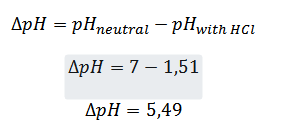
And the decrease in the ph is due to the strong acid HCL, this acid has a dissociation complete , is the entire H + is adding to the solution, decreasing a lot the ph.
Part C)
Part D)
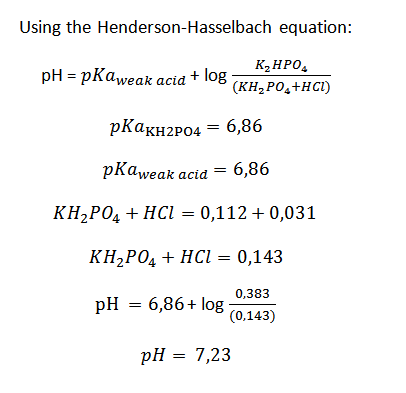
if the pH of the solution before adding the HCl was 7,742, and
after adding it it turned out to be 7.23, it means that the buffer
solution worked correctly and its pH was not greatly affected,
instead when seeing part a and b of the exercise as the pH of the
solution drops considerably due to lack of the buffer, so in this
second part the solution is not drastically affected in its
acidity
Add Answer to:
In each of the following questions, assume that there is no
volume change when HCl is...
In each of the following questions, assume that there is no volume change when HCl is...
In each of the following questions, assume that there is no volume change when HCl is added to water in part (a) or the phosphate buffer in part (c). (a) Calculate the pH when 0.052 moles of HCl are added to 1.000 liter of water. (b) What is the difference between the pH of pure water (pH 7.00) and the pH of the solution after HCl was added? (c) Calculate the pH when 0.052 moles of HCl are added to...
In each of the following questions, assume that there is no volume change when HCl is...
In each of the following questions, assume that there is no volume change when HCl is added to water in part (a) or the phosphate buffer in part (c). (a) Calculate the pH when 0.036 moles of HCl are added to 1.000 liter of water. (b) What is the difference between the pH of pure water (pH 7.00) and the pH of the solution after HCl was added? (c) Calculate the pH when 0.036 moles of HCl are added to...
7. In each of the following questions, assume that there is no volume change when HCl is added to water in part (a) or t...
7. In each of the following questions, assume that there is no volume change when HCl is added to water in part (a) or the phosphate buffer in part (c). (a) Calculate the pH when 0.021 moles of HCl are added to 1.000 liter of water. (b) What is the difference between the pH of pure water (pH 7.00) and the pH of the solution after HCl was added? (c) Calculate the pH when 0.021 moles of HCl are added...
1. Write the equations for the reaction of the following Bronsted acids with water: (a) H2S...
1. Write the equations for the reaction of the following Bronsted acids with water: (a) H2S (b) HC2O4- (c) HSO3- 2. Write equations for the reactions of the following Bronsted bases with water: (a) PO4 3- (b) N2H4 (c) H2C6H5O7- 3. In each of the following questions, assume that there is no volume change when HCl is added to water in part (a) or the phosphate buffer in part (c). (a) Calculate the pH when 0.129 moles of HCl are added...
8) A buffer solution is formed by adding 0.0100 moles of potassium dihydrogen phosphate (KH2PO4) and...
 8) A buffer solution is formed by adding 0.0100 moles of potassium dihydrogen phosphate (KH2PO4) and 0.0100 moles of potassium hydrogen phosphate (K2HPO4) into 1.000 liters of water. When 0.0010 moles of NaOH is added to this solution, what will happen? a) The pH of the solution will decrease by a large amount ( > 0.10 pH units) b) The pH of the solution will decrease by a small amount (< 0.10 pH units) c) The pH of the solution...
8) A buffer solution is formed by adding 0.0100 moles of potassium dihydrogen phosphate (KH2PO4) and...
 8) A buffer solution is formed by adding 0.0100 moles of potassium dihydrogen phosphate (KH2PO4) and 0.0100 moles of potassium hydrogen phosphate (K2HPO4) into 1.000 liters of water. When 0.0010 moles of NaOH is added to this solution, what will happen? The pH of the solution will decrease by a large amount ( > 0.10 pH units) The pH of the solution will decrease by a small amount (< 0.10 pH units) The pH of the solution will be exactly...
Calculate the change in pH when 7.00 mL of 0.100 M HCl(aq) is added to 100.0...
 Calculate the change in pH when 7.00 mL of 0.100 M HCl(aq) is added to 100.0 mL of a buffer solution that is 0.100 M in NH, (aq) and 0.100 M in NH, Cl(aq). Consult the table of ionization constants as needed. ApH = Calculate the change in pH when 7.00 mL of 0.100 M NaOH is added to the original buffer solution. ApH =
What volume (to the nearest 0.1 mL) of 7.50-M HCl must be added to 0.300 L...
What volume (to the nearest 0.1 mL) of 7.50-M HCl must be added to 0.300 L of 0.150-M K2HPO4 to prepare a pH = 7.50 buffer? (pKa of hydrogen phosphate ion = 12.32)
urgent 8) A buffer solution is formed by adding 0.0100 moles of potassium dihydrogen phosphate (KH,PO)...
 urgent
8) A buffer solution is formed by adding 0.0100 moles of potassium dihydrogen phosphate (KH,PO) and 6-0100 moles of potassium hydrogen phosphate (K_HPO.) into 1.000 liters of water. When 0.0010 moles of NaOH is added to this solution, what will happen? a) The pH of the solution will decrease by a large amount (>0.10 pH units) b) The pH of the solution will decrease by a small amount (<0.10 pH units) c) The pH of the solution will be...
urgent
8) A buffer solution is formed by adding 0.0100 moles of potassium dihydrogen phosphate (KH,PO) and 6-0100 moles of potassium hydrogen phosphate (K_HPO.) into 1.000 liters of water. When 0.0010 moles of NaOH is added to this solution, what will happen? a) The pH of the solution will decrease by a large amount (>0.10 pH units) b) The pH of the solution will decrease by a small amount (<0.10 pH units) c) The pH of the solution will be...
7) A buffer solution is formed by adding 0.0100 moles of potassium dihydrogen phosphate (KH PO4)...
 7) A buffer solution is formed by adding 0.0100 moles of potassium dihydrogen phosphate (KH PO4) and 0.0100 moles of potassium hydrogen phosphate (K,HPO4) into 1.000 liters of water. When 0.0010 moles of NaOH is added to this solution, what will happen? a) The pH of the solution will increase by a small amount (< 0.10 pH units) b) The pH of the solution will increase by a large amount (> 0.10 pH units) c) The pH of the solution...
 8) A buffer solution is formed by adding 0.0100 moles of potassium dihydrogen phosphate (KH2PO4) and 0.0100 moles of potassium hydrogen phosphate (K2HPO4) into 1.000 liters of water. When 0.0010 moles of NaOH is added to this solution, what will happen? a) The pH of the solution will decrease by a large amount ( > 0.10 pH units) b) The pH of the solution will decrease by a small amount (< 0.10 pH units) c) The pH of the solution...
 8) A buffer solution is formed by adding 0.0100 moles of potassium dihydrogen phosphate (KH2PO4) and 0.0100 moles of potassium hydrogen phosphate (K2HPO4) into 1.000 liters of water. When 0.0010 moles of NaOH is added to this solution, what will happen? The pH of the solution will decrease by a large amount ( > 0.10 pH units) The pH of the solution will decrease by a small amount (< 0.10 pH units) The pH of the solution will be exactly...
 Calculate the change in pH when 7.00 mL of 0.100 M HCl(aq) is added to 100.0 mL of a buffer solution that is 0.100 M in NH, (aq) and 0.100 M in NH, Cl(aq). Consult the table of ionization constants as needed. ApH = Calculate the change in pH when 7.00 mL of 0.100 M NaOH is added to the original buffer solution. ApH =
 urgent
8) A buffer solution is formed by adding 0.0100 moles of potassium dihydrogen phosphate (KH,PO) and 6-0100 moles of potassium hydrogen phosphate (K_HPO.) into 1.000 liters of water. When 0.0010 moles of NaOH is added to this solution, what will happen? a) The pH of the solution will decrease by a large amount (>0.10 pH units) b) The pH of the solution will decrease by a small amount (<0.10 pH units) c) The pH of the solution will be...
urgent
8) A buffer solution is formed by adding 0.0100 moles of potassium dihydrogen phosphate (KH,PO) and 6-0100 moles of potassium hydrogen phosphate (K_HPO.) into 1.000 liters of water. When 0.0010 moles of NaOH is added to this solution, what will happen? a) The pH of the solution will decrease by a large amount (>0.10 pH units) b) The pH of the solution will decrease by a small amount (<0.10 pH units) c) The pH of the solution will be...
 7) A buffer solution is formed by adding 0.0100 moles of potassium dihydrogen phosphate (KH PO4) and 0.0100 moles of potassium hydrogen phosphate (K,HPO4) into 1.000 liters of water. When 0.0010 moles of NaOH is added to this solution, what will happen? a) The pH of the solution will increase by a small amount (< 0.10 pH units) b) The pH of the solution will increase by a large amount (> 0.10 pH units) c) The pH of the solution...
Most questions answered within 3 hours.
-
Where is the error in this code sequence?
String s1 = "Hello";
String s2 = "ello";...
asked 11 months ago -
Financial data for Joel de Paris, Inc., for last year
follow:
Joel de Paris, Inc.
Balance...
asked 11 months ago -
Consider this reaction:
Al2(SO4)3 (aq)+ BaCl3
(aq) Al2Cl6 (aq)- +
3BaSO4(s) . What is the...
asked 11 months ago -
Suppose that Savneet is considering increasing her
recent random sample from 20 car rentals to 40...
asked 11 months ago -
Trucks arrive at an unloading terminal at an average rate of 120
per hour.
Trucks arrive...
asked 11 months ago -
Why are methanol and ethanol completely soluble in water while
octanol is not very little soluble....
asked 11 months ago -
A facilities manager at a university reads in a research report
that the mean amount of...
asked 11 months ago -
When the CuSO4 is rehydrated by adding water to the anhydrous
compound, is this an endothermic...
asked 11 months ago -
A ray of sunlight is passing from diamond into crown glass; the
angle of incidence is...
asked 11 months ago -
A block of mass 0.249 kg is placed on top of a light, vertical
spring of...
asked 11 months ago -
how do the kidneys compensate in the presences of acidosis
a) trigger hyperventilate
b) reserve acid...
asked 11 months ago -
Question 501 pts
The rental rate of capital to the firm increases. Which of the
following...
asked 11 months ago