A hot plate consists of a flat electrical resistor, which is adiabatically insulated on one side...
A hot plate consists of a flat electrical resistor, which is adiabatically insulated on one side and on the other side is in contact with a ceramic layer of 1 cm thickness and 30 W/mK thermal conductivity. The hot plate is operated inside a fume hood, where air at 20 C flows over producing convective cooling on the top surface of the heater with a heat transfer coefficient of 15 W/mK The plate generate a total heat transfer rate of 100 W and has an area of 30 cm x 30 cm. What is the temperature at the interface between the plate and the ceramic layer? Find the answer WITHOUT using the resistance model. Instead, you may only use conservation of energy and Fourier law. You may have to consider multiple control volumes to arrive at a solution, for instance the resistor, the ceramic, and some of the interfaces. You cannot assume that q=q=kA ∆T/L, unless you prove mathematically that dT/dx=∆T/L Plot the temperature variation in the ceramic layer as function of the ceramic layer thickness. What is the heat transfer rate at the midplane of the ceramic layer thickness? How is that compared with the heat transfer rate at the surface of the layer? Express this heat transfer rate in terms of temperature across the ceramic layer and a thermal resistance. Plot the temperature variation in the resistor as function of the resistor layer thickness. Assume the resistor has a thermal conductivity of 80 W/mK and a thickness of 5 mm. What is the heat transfer rate in the resistor at the bottom (interface between the resistor and adiabatic insulation), at the midplane of the resistor and at the top (interface between the ceramic layer and the resistor). Can you express the heat transfer rate as the ratio between the temperature difference between the top and bottom of the resistor and a thermal resistance? Why not?
To the commenter asking for more data, I was not given any more data by my professor.
Homework Answers


Add Answer to:
A hot plate consists of a flat electrical resistor, which is
adiabatically insulated on one side...
pts.) Consider a long resistance wire of radius ri-1.5 cm and thermal conductivity m'к in which...
 pts.) Consider a long resistance wire of radius ri-1.5 cm and thermal conductivity m'к in which heat is generated uniformly as a result of resistance heating at a e wire is embedded in a 1.0-cm-thick layer of ceramic whose thermal bTeam. W/m K. If the outer surface temperature of the ceramic layer is nstant rate. The nductivity is keramic-1.5 to be T,-45°C and the maximum temperature at the center is 375°C. Determine the ar generated per unit volume in (W/em)...
Exercise 2 Air at 20 °C and 1 atm flows over a flat plate at 50...
 Exercise 2 Air at 20 °C and 1 atm flows over a flat plate at 50 m/s. The plate is 300 cm long and is maintained at 60C. The width of the plate is 2 m. The critical Rec = 5 x 10⁵ The properties are Conductivity k = 0.0263 W/mK, kinematic viscosity nu = v = 15.89 x 10⁻⁶ m²/s, Prandtl number is Pr=0.707 Density rho = p = 1.128 kg/m3 1. Determine the critical length Xc 2. Determine...
(2 pts) Heat is transferred from a hot fluid (temperature T1 and heat transfer coefficient h2)...
 (2 pts) Heat is transferred from a hot fluid (temperature T1 and heat transfer coefficient h2) through a plane wall of thickness 8, surface area A and the thermal conductivity k. The thermal resistance for the set up is + (a) AC ) (b) A (i + + ) (c) 2 (na + + n2) (d) A (na + b +h2) (2 pts) An increase in convective heat transfer coefficient over a fin will (a) increase effectiveness (b) decrease effectiveness...
The upper surface of a 60-cm-thick solid plate (k = 237 W/m.K) is being cooled by...
 The upper surface of a 60-cm-thick solid plate (k = 237 W/m.K) is being cooled by water with temperature of 20°C. The upper and lower surfaces of the solid plate maintained at constant temperatures of 60°C and 120°C, respectively. Given: The thermal conductivity of the solid plate is given as k = 237 W/ mK. (T..+) The thermal conductivity of water at the film temperature of T, = =(60°C + 20°C)/2 = 40°C is kfluid = 0.631 W/mK. 1. value...
A cylindrical hot water tank has thermal insulation between an inner and an outer wall of...
A cylindrical hot water tank has thermal insulation between an inner and an outer wall of thin metal sheets, both on the sidewalls and the end walls. The inner diameter and height is 0.95 m and 2.6 m respectively. The insulation thickness is 64 mm and its thermal conductivity is λ = 0.051 [W/mK]. The inner wall consists of 3.0 mm stainless steel with λ = 25 [W/mK], and the outer wall consists of 1.3 mm steel sheet with λ...
1. 1.08x10⁶ grams/h of a superheated fluid flows through a pipe in a power plant. The...
1. 1.08x10⁶ grams/h of a superheated fluid flows through a pipe in a power plant. The pipe is 1000 cm long, has an inner diameter of 0.05m and a wall thickness of 0.6 cm. The pipe has a thermal conductivity of 0.0017 kW/mK, and the inner pipe surface is at a uniform temperature of 393K. The temperature drop between the inlet and exit of the pipe is 7K, and the constant pressure specific heat of vapor is 2190 J/kgK. If...
13.15 The base plate of an ironi (provided by resistance over a base plate cros plate...
 13.15 The base plate of an ironi (provided by resistance over a base plate cros plate of an iron is 0.6 cm thick. The plate is subjected to 100 W of power ded by resistance heaters inside the iron, as shown in Figure P13-15). base plate cross-sectional area of 250 cm, resulting in a uniform flux rated on the inside surface. The thermal conductivity of the metal base generated on th is k = 20 W/m- C. The outside ambient...
2-157 A long electrical resistance wire of radius r.-0.25 cm has a thermal conductivity kwire-15 W/m-K. Heat is gene...
 2-157 A long electrical resistance wire of radius r.-0.25 cm has a thermal conductivity kwire-15 W/m-K. Heat is generated uniformly in the wire as a result of resistance heating at a constant rate of 0.5 W/cm3. The wire is covered with polyethylene insulation with a thickness of 0.25 cm and thermal conductivity of ks 0.4 W/m K. The outer surface of the insulation is subjected to free convection in air at 20°C and a convection heat transfer coefficient of 2...
Problem 4: Consider the heat exchanger design illustrated. Hot air flows at speed of r0.6 m/s thr...
 Problem 4: Consider the heat exchanger design illustrated. Hot air flows at speed of r0.6 m/s through the center pipe. The center pipe has an outer diameter of D=7 cm and length 4-2 m Cold water flows at 20-25 cm3/s through a smaller helical pipe having an outer diameter d = 1 cm and wall thickness of mm. The helical pipe is wrapped around the center pipe to form a heat exchanger. The center pipe has a thermal conductivity of...
The image below is of an aluminium plate that will be heated from the bottom. If...
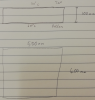 The image below is of an aluminium plate that will be heated
from the bottom. If the temperature at the bottom of the plate is
600 degrees Celsius and 20 degrees at the top, how long will it
take for the top of the plate to reach 200 degrees Celsius?
Thermal conductivity = 200 W/mK
Specific heat = 921.096 J/kgK
mass of plate = 70kg
ToP 100 Battom 5 00 mm
ToP 100 Battom 5 00 mm
The image below is of an aluminium plate that will be heated
from the bottom. If the temperature at the bottom of the plate is
600 degrees Celsius and 20 degrees at the top, how long will it
take for the top of the plate to reach 200 degrees Celsius?
Thermal conductivity = 200 W/mK
Specific heat = 921.096 J/kgK
mass of plate = 70kg
ToP 100 Battom 5 00 mm
ToP 100 Battom 5 00 mm
 pts.) Consider a long resistance wire of radius ri-1.5 cm and thermal conductivity m'к in which heat is generated uniformly as a result of resistance heating at a e wire is embedded in a 1.0-cm-thick layer of ceramic whose thermal bTeam. W/m K. If the outer surface temperature of the ceramic layer is nstant rate. The nductivity is keramic-1.5 to be T,-45°C and the maximum temperature at the center is 375°C. Determine the ar generated per unit volume in (W/em)...
 Exercise 2 Air at 20 °C and 1 atm flows over a flat plate at 50 m/s. The plate is 300 cm long and is maintained at 60C. The width of the plate is 2 m. The critical Rec = 5 x 10⁵ The properties are Conductivity k = 0.0263 W/mK, kinematic viscosity nu = v = 15.89 x 10⁻⁶ m²/s, Prandtl number is Pr=0.707 Density rho = p = 1.128 kg/m3 1. Determine the critical length Xc 2. Determine...
 (2 pts) Heat is transferred from a hot fluid (temperature T1 and heat transfer coefficient h2) through a plane wall of thickness 8, surface area A and the thermal conductivity k. The thermal resistance for the set up is + (a) AC ) (b) A (i + + ) (c) 2 (na + + n2) (d) A (na + b +h2) (2 pts) An increase in convective heat transfer coefficient over a fin will (a) increase effectiveness (b) decrease effectiveness...
 The upper surface of a 60-cm-thick solid plate (k = 237 W/m.K) is being cooled by water with temperature of 20°C. The upper and lower surfaces of the solid plate maintained at constant temperatures of 60°C and 120°C, respectively. Given: The thermal conductivity of the solid plate is given as k = 237 W/ mK. (T..+) The thermal conductivity of water at the film temperature of T, = =(60°C + 20°C)/2 = 40°C is kfluid = 0.631 W/mK. 1. value...
 13.15 The base plate of an ironi (provided by resistance over a base plate cros plate of an iron is 0.6 cm thick. The plate is subjected to 100 W of power ded by resistance heaters inside the iron, as shown in Figure P13-15). base plate cross-sectional area of 250 cm, resulting in a uniform flux rated on the inside surface. The thermal conductivity of the metal base generated on th is k = 20 W/m- C. The outside ambient...
 2-157 A long electrical resistance wire of radius r.-0.25 cm has a thermal conductivity kwire-15 W/m-K. Heat is generated uniformly in the wire as a result of resistance heating at a constant rate of 0.5 W/cm3. The wire is covered with polyethylene insulation with a thickness of 0.25 cm and thermal conductivity of ks 0.4 W/m K. The outer surface of the insulation is subjected to free convection in air at 20°C and a convection heat transfer coefficient of 2...
 Problem 4: Consider the heat exchanger design illustrated. Hot air flows at speed of r0.6 m/s through the center pipe. The center pipe has an outer diameter of D=7 cm and length 4-2 m Cold water flows at 20-25 cm3/s through a smaller helical pipe having an outer diameter d = 1 cm and wall thickness of mm. The helical pipe is wrapped around the center pipe to form a heat exchanger. The center pipe has a thermal conductivity of...
 The image below is of an aluminium plate that will be heated
from the bottom. If the temperature at the bottom of the plate is
600 degrees Celsius and 20 degrees at the top, how long will it
take for the top of the plate to reach 200 degrees Celsius?
Thermal conductivity = 200 W/mK
Specific heat = 921.096 J/kgK
mass of plate = 70kg
ToP 100 Battom 5 00 mm
ToP 100 Battom 5 00 mm
The image below is of an aluminium plate that will be heated
from the bottom. If the temperature at the bottom of the plate is
600 degrees Celsius and 20 degrees at the top, how long will it
take for the top of the plate to reach 200 degrees Celsius?
Thermal conductivity = 200 W/mK
Specific heat = 921.096 J/kgK
mass of plate = 70kg
ToP 100 Battom 5 00 mm
ToP 100 Battom 5 00 mm
Most questions answered within 3 hours.
-
Where is the error in this code sequence?
String s1 = "Hello";
String s2 = "ello";...
asked 11 months ago -
Financial data for Joel de Paris, Inc., for last year
follow:
Joel de Paris, Inc.
Balance...
asked 11 months ago -
Consider this reaction:
Al2(SO4)3 (aq)+ BaCl3
(aq) Al2Cl6 (aq)- +
3BaSO4(s) . What is the...
asked 11 months ago -
Suppose that Savneet is considering increasing her
recent random sample from 20 car rentals to 40...
asked 11 months ago -
Trucks arrive at an unloading terminal at an average rate of 120
per hour.
Trucks arrive...
asked 11 months ago -
Why are methanol and ethanol completely soluble in water while
octanol is not very little soluble....
asked 11 months ago -
A facilities manager at a university reads in a research report
that the mean amount of...
asked 11 months ago -
When the CuSO4 is rehydrated by adding water to the anhydrous
compound, is this an endothermic...
asked 11 months ago -
A ray of sunlight is passing from diamond into crown glass; the
angle of incidence is...
asked 11 months ago -
A block of mass 0.249 kg is placed on top of a light, vertical
spring of...
asked 11 months ago -
how do the kidneys compensate in the presences of acidosis
a) trigger hyperventilate
b) reserve acid...
asked 11 months ago -
Question 501 pts
The rental rate of capital to the firm increases. Which of the
following...
asked 11 months ago