Excluding an important explanatory variable from a regression will lead to biased coefficient estimates, incorrect coefficient...
Excluding an important explanatory variable from a regression will lead to biased coefficient estimates, incorrect coefficient standard errors, and invalid hypothesis tests.
|
Homework Answers
Excluding an important explanatory variable from a regression will lead to biased coefficient estimates, incorrect coefficient standard errors, and invalid hypothesis tests.
TRUE'
As we will not be able to estimate the true picture
Add Answer to:
Excluding an important explanatory variable from a regression
will lead to biased coefficient estimates, incorrect coefficient...
Suppose that you estimate a multiple regression model, but that you inadvertently omit an explanatory variable...
Suppose that you estimate a multiple regression model, but that you inadvertently omit an explanatory variable that is correlated with the dependent variable. In this case, the coefficients on the included variables will always be unbiased, but the standard errors and test statistics will be biased. the coefficients on the included variables will always be biased. there is no effect on the coefficients of the included variables since the omitted variable has been omitted. the coefficients on the included variables...
Consider the following statement: "Omitting an important explanatory variable can cause the usual OLS t statistics...
Consider the following statement: "Omitting an important explanatory variable can cause the usual OLS t statistics to be invalid" Is this statement true or false? True or False?
When two explanatory variables are highly correlated, should you remove one of the correlated explanatory variables...
When two explanatory variables are highly correlated, should you remove one of the correlated explanatory variables to reduce the multicollinearity problem. A. Yes, it will reduce the standard errors on the coefficients and increase the t statistics. B. No, it will not affect the t statistics on the coefficients. C. No, it will cause the coefficient on the remaining variable to be biased. D. Yes, it will improve the fit of the regression model.
A linear regression of a variable Y against the explanatory variables X1 and X2 produced the...
A linear regression of a variable Y against the explanatory variables X1 and X2 produced the following estimation model: Y = 1615.495 + 9.957 X1 + 0.081 X2 + e (527.96) (6.32) (0.024) The number in parentheses are the standard errors of each coefficients i. State the null and alternative hypothesis for the coefficients Select the appropriate test, compute the test statistic based on the information above, and test the null hypothesis for each coefficient by using a level of...
When calculating the correlation coefficient, it is important to specify which variable is the explanatory, and...
When calculating the correlation coefficient, it is important to specify which variable is the explanatory, and which is the response variable, because it affects the interpretation.
A qualitative variable with 4 levels used as an explanatory variable in a regression model can...
A qualitative variable with 4 levels used as an explanatory variable in a regression model can be represented by a single X column with values of 1,2,3, or 4. True False
1. Carefully go through each statement. Answer true or false with explanation (only answers with an...
 1. Carefully go through each statement. Answer true or false with explanation (only answers with an explanation will gain credit). (a) In a regression model, a stochastic regressor is an explanatory variable that has a random component (4 marks] (b) When a stochastic regressor is used in a regression model, OLS regression estimates will be biased. [4 marks] (c) Heteroscedasticity occurs when the disturbance term in a regression model is correlated with one of the explanatory variables. [4 marks] (d)...
1. For each of the following, explain whether (a) the coefficients are biased or unbiased, and...
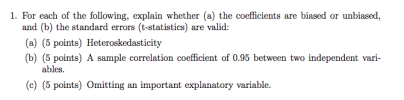 1. For each of the following, explain whether (a) the coefficients are biased or unbiased, and (b) the standard errors (t-statistics) are valid: (a) (5 points) Heteroskedasticity (b) (5 points) A sample correlation coefficient of 0.95 between two independent vari- ables. (c) (5 points) Omitting an important explanatory variable.
Use the following linear regression equation to answer the questions. x1 = 1.5 + 3.4x2 – 8.3x3 + 2.3x4 (a) Which variable is the response variable? Which variables are the explanatory variables? (b...
Use the following linear regression equation to answer the questions. x1 = 1.5 + 3.4x2 – 8.3x3 + 2.3x4 (a) Which variable is the response variable? Which variables are the explanatory variables? (b) Which number is the constant term? List the coefficients with their corresponding explanatory variables. constant? x2 coefficient? x3 coefficient? x4 coefficient? (c) If x2 = 1, x3 = 8, and x4 = 6, what is the predicted value for x1? (Use 1 decimal place.) (d) Explain how...
Question 1 (1 point) Assume that you have estimated the slope coefficient (b) for the explanatory...
 Question 1 (1 point) Assume that you have estimated the slope coefficient (b) for the explanatory variable X for a SLR of the form y-a+bX +ei. Assume further that the p-value for b-0.0267. If the level of significance is 1%, then the null hypothesis is rejected the null hypothesis is not rejected the null hypothesis is possibly rejected the null hypothesis could be rejected or not rejected Question 2 (1 point) Assume that you have estimated the slope coefficient (b)...
 1. Carefully go through each statement. Answer true or false with explanation (only answers with an explanation will gain credit). (a) In a regression model, a stochastic regressor is an explanatory variable that has a random component (4 marks] (b) When a stochastic regressor is used in a regression model, OLS regression estimates will be biased. [4 marks] (c) Heteroscedasticity occurs when the disturbance term in a regression model is correlated with one of the explanatory variables. [4 marks] (d)...
 1. For each of the following, explain whether (a) the coefficients are biased or unbiased, and (b) the standard errors (t-statistics) are valid: (a) (5 points) Heteroskedasticity (b) (5 points) A sample correlation coefficient of 0.95 between two independent vari- ables. (c) (5 points) Omitting an important explanatory variable.
 Question 1 (1 point) Assume that you have estimated the slope coefficient (b) for the explanatory variable X for a SLR of the form y-a+bX +ei. Assume further that the p-value for b-0.0267. If the level of significance is 1%, then the null hypothesis is rejected the null hypothesis is not rejected the null hypothesis is possibly rejected the null hypothesis could be rejected or not rejected Question 2 (1 point) Assume that you have estimated the slope coefficient (b)...
Most questions answered within 3 hours.
-
Where is the error in this code sequence?
String s1 = "Hello";
String s2 = "ello";...
asked 10 months ago -
Financial data for Joel de Paris, Inc., for last year
follow:
Joel de Paris, Inc.
Balance...
asked 10 months ago -
Consider this reaction:
Al2(SO4)3 (aq)+ BaCl3
(aq) Al2Cl6 (aq)- +
3BaSO4(s) . What is the...
asked 10 months ago -
Suppose that Savneet is considering increasing her
recent random sample from 20 car rentals to 40...
asked 10 months ago -
Trucks arrive at an unloading terminal at an average rate of 120
per hour.
Trucks arrive...
asked 10 months ago -
Why are methanol and ethanol completely soluble in water while
octanol is not very little soluble....
asked 10 months ago -
A facilities manager at a university reads in a research report
that the mean amount of...
asked 10 months ago -
When the CuSO4 is rehydrated by adding water to the anhydrous
compound, is this an endothermic...
asked 10 months ago -
A ray of sunlight is passing from diamond into crown glass; the
angle of incidence is...
asked 10 months ago -
A block of mass 0.249 kg is placed on top of a light, vertical
spring of...
asked 10 months ago -
how do the kidneys compensate in the presences of acidosis
a) trigger hyperventilate
b) reserve acid...
asked 10 months ago -
Question 501 pts
The rental rate of capital to the firm increases. Which of the
following...
asked 10 months ago