Estimate the rate at which heat can be conducted from the interior of the body to...
Estimate the rate at which heat can be conducted from the interior of the body to the surface. Assume that the thickness of tissue is 4.0 cm, that the skin is at 34 ∘C and the interior at 37 ∘C, and that the surface area is 1.5 m2
Answer Q/t = ________W
Homework Answers
 Please do comment for any
further assistance. Do rate if you like the answer. Thanks
Please do comment for any
further assistance. Do rate if you like the answer. Thanks
Note : I have taken thermal conductivity of human tissue value as k= 0.3 W/m °C from sources.
Add Answer to:
Estimate the rate at which heat can be conducted from the
interior of the body to...
Calculate the rate of heat conduction (in W) out of the human body, assuming that the...
Calculate the rate of heat conduction (in W) out of the human body, assuming that the core internal temperature is 37.0°C, the skin temperature is 34.0°C, the thickness of the tissues between averages 1.06 cm, and the surface area is 1.45 m2.
please solve these questions (a) Calculate the rate of heat transfer by radiation from a car...
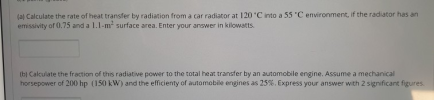 please solve these questions
(a) Calculate the rate of heat transfer by radiation from a car radiator at 120 °C into a 55 °C environment, if the radiator has an emissivity of 0.75 and a 1.1-m surface area. Enter your answer in kilowatts. (b) Calculate the fraction of this radiative power to the total heat transfer by an automobile engine. Assume a mechanical horsepower of 200 hp (150 kW) and the efficienty of automobile engines as 25 %. Express your...
please solve these questions
(a) Calculate the rate of heat transfer by radiation from a car radiator at 120 °C into a 55 °C environment, if the radiator has an emissivity of 0.75 and a 1.1-m surface area. Enter your answer in kilowatts. (b) Calculate the fraction of this radiative power to the total heat transfer by an automobile engine. Assume a mechanical horsepower of 200 hp (150 kW) and the efficienty of automobile engines as 25 %. Express your...
Chapter 13, Problem 01 The amount of heat per second conducted from the blood capillaries beneath...
Chapter 13, Problem 01 The amount of heat per second conducted from the blood capillaries beneath the skin to the surface is 280 J/s. The energy is transferred a distance of 2.1 × 10⁻³ m through a body whose surface area is 1.8 m2. Assuming that the thermal conductivity is that of body fat, determine the temperature difference between the capillaries and the surface of the skin. Chapter 13, Problem 02 In an electrically heated home, the temperature of the...
The heat that is conducted through a body must frequently be removed by other heat transfer...
 The heat that is conducted through a body must frequently be removed by other heat transfer processes. For example, the heat generated in an electronic device must be dissipated to the surroundings through convection by means of fins. Consider the one-dimensional aluminum fin (thickness t 3.0 mm, width 20 cm, length L) shown in Figure 1, that is exposed to a surrounding fluid at a temperature T. The conductivity of the aluminum fin (k) and coefficient of heat convection of...
Can someone answer number one? Thanks. Heat is convected away from an object at the rate...
 Can someone answer number one? Thanks.
Heat is convected away from an object at the rate given by the following formula h is a coefficient that depends on the shape and the orientation of the object. Calculate the rate of convective heat loss in watts for an unclothed person standing in air at 23 deg C. Assume that the skin temperature is 34 deg C and that body surface area is 1.5 m sq.. Calculate for all three air speeds...
Can someone answer number one? Thanks.
Heat is convected away from an object at the rate given by the following formula h is a coefficient that depends on the shape and the orientation of the object. Calculate the rate of convective heat loss in watts for an unclothed person standing in air at 23 deg C. Assume that the skin temperature is 34 deg C and that body surface area is 1.5 m sq.. Calculate for all three air speeds...
In addition to producing images, ultrasound can be used to heat tissues of the body for...
In addition to producing images, ultrasound can be used to heat tissues of the body for therapeutic purposes. An emitter is placed against the surface of the skin; the amplitude of the ultrasound wave at this point is quite large. When a sound wave hits the boundary between soft tissue and bone, most of the energy is reflected. The boundary acts like the closed end of a tube, which can lead to standing waves. Suppose 0.70 MHz ultrasound is directed...
The heat that is conducted through a body must frequently be removed by other heat transfer processes. For example, the...
The heat that is conducted through a body must frequently be removed by other heat transfer processes. For example, the heat generated in an electronic device must be dissipated to the surroundings through convection by means of fins. Consider the one-dimensional aluminum fin (thickness t = 3.0 mm, width Z = 20 cm, length L) shown in Figure 1, that is exposed to a surrounding fluid at a temperature T. The conductivity of the aluminum fin (k) and coefficient of...
P1. Consider treating severely burned humans by cooling their body in an air or water bath...
 P1. Consider treating severely burned humans by cooling their body in an air or water bath at 15 °C for 12-20 hours. An estimate of the heat transfer rate from the patient to such a bath is q,-125 kcal/(m2 hr) with a skin temperature of 25 °C, while the normal rate is q,-50 kcal/(m hr) when the skin temperature is 34 °C. Since more heat will be lost to the surroundings than under normal conditions, there will need to be...
Heat flows at a rate of Q/t from a hot object to a cold object through...
Heat flows at a rate of Q/t from a hot object to a cold object through some material that has a thickness of d and a surface area of A. If the surface area of the material is increased to 2A and the thickness is increased to 4d then what rate does the heat flow from the hot object to the cold object now? [You may assume that the hot and cold object are unchanging in temperature.]
Blood can carry excess energy from the interior to the surface of the body, where the...
Blood can carry excess energy from the interior to the surface of the body, where the energy is dispersed in a number of ways. While a person is exercising, 0.8 kg of blood flows to the body's surface and releases 1945 J of energy. The blood arriving at the surface has the temperature of the body's interior, 37.1 °C. Assuming that blood has the same specific heat capacity as water, determine the temperature of the blood that leaves the surface...
 please solve these questions
(a) Calculate the rate of heat transfer by radiation from a car radiator at 120 °C into a 55 °C environment, if the radiator has an emissivity of 0.75 and a 1.1-m surface area. Enter your answer in kilowatts. (b) Calculate the fraction of this radiative power to the total heat transfer by an automobile engine. Assume a mechanical horsepower of 200 hp (150 kW) and the efficienty of automobile engines as 25 %. Express your...
please solve these questions
(a) Calculate the rate of heat transfer by radiation from a car radiator at 120 °C into a 55 °C environment, if the radiator has an emissivity of 0.75 and a 1.1-m surface area. Enter your answer in kilowatts. (b) Calculate the fraction of this radiative power to the total heat transfer by an automobile engine. Assume a mechanical horsepower of 200 hp (150 kW) and the efficienty of automobile engines as 25 %. Express your...
 The heat that is conducted through a body must frequently be removed by other heat transfer processes. For example, the heat generated in an electronic device must be dissipated to the surroundings through convection by means of fins. Consider the one-dimensional aluminum fin (thickness t 3.0 mm, width 20 cm, length L) shown in Figure 1, that is exposed to a surrounding fluid at a temperature T. The conductivity of the aluminum fin (k) and coefficient of heat convection of...
 Can someone answer number one? Thanks.
Heat is convected away from an object at the rate given by the following formula h is a coefficient that depends on the shape and the orientation of the object. Calculate the rate of convective heat loss in watts for an unclothed person standing in air at 23 deg C. Assume that the skin temperature is 34 deg C and that body surface area is 1.5 m sq.. Calculate for all three air speeds...
Can someone answer number one? Thanks.
Heat is convected away from an object at the rate given by the following formula h is a coefficient that depends on the shape and the orientation of the object. Calculate the rate of convective heat loss in watts for an unclothed person standing in air at 23 deg C. Assume that the skin temperature is 34 deg C and that body surface area is 1.5 m sq.. Calculate for all three air speeds...
 P1. Consider treating severely burned humans by cooling their body in an air or water bath at 15 °C for 12-20 hours. An estimate of the heat transfer rate from the patient to such a bath is q,-125 kcal/(m2 hr) with a skin temperature of 25 °C, while the normal rate is q,-50 kcal/(m hr) when the skin temperature is 34 °C. Since more heat will be lost to the surroundings than under normal conditions, there will need to be...
Most questions answered within 3 hours.
-
Where is the error in this code sequence?
String s1 = "Hello";
String s2 = "ello";...
asked 10 months ago -
Financial data for Joel de Paris, Inc., for last year
follow:
Joel de Paris, Inc.
Balance...
asked 10 months ago -
Consider this reaction:
Al2(SO4)3 (aq)+ BaCl3
(aq) Al2Cl6 (aq)- +
3BaSO4(s) . What is the...
asked 10 months ago -
Suppose that Savneet is considering increasing her
recent random sample from 20 car rentals to 40...
asked 10 months ago -
Trucks arrive at an unloading terminal at an average rate of 120
per hour.
Trucks arrive...
asked 10 months ago -
Why are methanol and ethanol completely soluble in water while
octanol is not very little soluble....
asked 10 months ago -
A facilities manager at a university reads in a research report
that the mean amount of...
asked 10 months ago -
When the CuSO4 is rehydrated by adding water to the anhydrous
compound, is this an endothermic...
asked 10 months ago -
A ray of sunlight is passing from diamond into crown glass; the
angle of incidence is...
asked 10 months ago -
A block of mass 0.249 kg is placed on top of a light, vertical
spring of...
asked 10 months ago -
how do the kidneys compensate in the presences of acidosis
a) trigger hyperventilate
b) reserve acid...
asked 10 months ago -
Question 501 pts
The rental rate of capital to the firm increases. Which of the
following...
asked 10 months ago