Suppose we have a production function Q = 5.4L^2+4. What is the marginal product when there...
Suppose we have a production function Q = 5.4L^2+4. What is the marginal product when there are five units of labor.
Homework Answers
Answer
marginal product is a change in the total product because of the change in input
the change in production function is found by differentiation
MPL=dQ/dL=10.8L ............... differentiating production function concerning L by power rule
L=5
MPL=10.8*5
MPL=54
the marginal product of labor is 54 units at 5 units of inputs of labor
Add Answer to:
Suppose we have a production function Q = 5.4L^2+4. What is the
marginal product when there...
Suppose we have a production function Q = 16.7K - K^2. If marginal revenue is $10,...
Suppose we have a production function Q = 16.7K - K^2. If marginal revenue is $10, what is the marginal revenue product of capital when K=4. Hint: Round your answer to two decimal places.
Suppose the linear production function is given by Q= 4K + 8L What is the marginal...
Suppose the linear production function is given by Q= 4K + 8L What is the marginal product of capital when the firm uses 10 units of capital and 10 units of labor? What is the AP of labor if 3 units of capital and 5 units of labor are used?
Suppose a firm’s production function is given by Q = L1/2*K1/2. The Marginal Product of Labor...
Suppose a firm’s production function is given by Q = L1/2*K1/2. The Marginal Product of Labor and the Marginal Product of Capital are given by: MPL = ½ L-1/2K1/2and MPK = ½ L1/2K-1/2 a) Suppose the price of labor is w = 18, and the price of capital is r = 2. Derive the firm’s total cost function. b) What is the firm’s marginal cost? c) For this problem, you will sketch the graph of the firm’s isoquant for Q...
Suppose a firm has the following production function: Q = 2K L. The marginal product of...
 Suppose a firm has the following production function: Q = 2K L. The marginal product of capital is 2L, and the marginal product of labor is 2K. Assume that capital rents for $100 per unit per day, that labor can be hired for $200 per unit per day, and that the firm is minimizing costs. a. The firm will hire units of labor and - units of capital. b. What is the total cost of producing 60 units of output?...
Question 4 O out of 10 points Suppose we have a production function Q = 5.2K-K2....
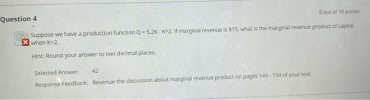 Question 4 O out of 10 points Suppose we have a production function Q = 5.2K-K2. If marginal revenue is $15, what is the marginal revenue product of capital x when K=2 Hint: Round your answer to two decimal places. 42 Selected Answer: Response Feedback: Revenue the discussion about marginal revenue product on pages 149 - 154 of your text.
(a) Consider the production function, q = 100K2L1.5 Calculate the marginal product of labor, MPL, and...
(a) Consider the production function, q = 100K2L1.5 Calculate the marginal product of labor, MPL, and the marginal product of capital,MPK. (c) Suppose that in the short run, the level of capital is fixed at K = 15. Write out the total product of labor curve. What is the marginal product of labor when L = 100? (d) Now consider two input combinations, (K = 5, L = 100) and (K = 20, L = 25). Which of the two...
Suppose the firm's production function is Q = 2KL where Q is units of output, K...
Suppose the firm's production function is Q = 2KL where Q is units of output, K is units of capital (which are fixed at 2), and L is units of labor. a. What is the firm’s short-run production function? b. Over the labor input usage range of 0 to 5, that is L ranging from 0 to 5, graph the firm’s Total Product curve. c. Derive and graph the firm’s Average Product curve and the Marginal Product curve. Graph/plot them...
Suppose in the short run a firm’s production function is given by Q = L1/2*K1/2, and...
Suppose in the short run a firm’s production function is given by Q = L1/2*K1/2, and that K is fixed at K = 49. If the price of Labor, w = $6 per unit of Labor, what is the firm’s Marginal Cost of production when the firm is producing 28 units of output?
Suppose in the short run a firm’s production function is given by Q = L1/2*K1/2, and...
Suppose in the short run a firm’s production function is given by Q = L1/2*K1/2, and that K is fixed at K = 36. If the price of Labor, w = $12 per unit of Labor, what is the firm’s Marginal Cost of production when the firm is producing 48 units of output? MC = ________________________
2. Suppose a firm's short run production function is q = 600L-L. a. At what level...
 2. Suppose a firm's short run production function is q = 600L-L. a. At what level of labor does the firm maximize output (total product)? What is the value of total product at this point? b. Does this frim experience increasing marginal product of labor. If so, over what range of output? What happens to total product over this range? c. Over what range of output does this firm experience diminishing marginal product of labor? What is the value of...
 Suppose a firm has the following production function: Q = 2K L. The marginal product of capital is 2L, and the marginal product of labor is 2K. Assume that capital rents for $100 per unit per day, that labor can be hired for $200 per unit per day, and that the firm is minimizing costs. a. The firm will hire units of labor and - units of capital. b. What is the total cost of producing 60 units of output?...
 Question 4 O out of 10 points Suppose we have a production function Q = 5.2K-K2. If marginal revenue is $15, what is the marginal revenue product of capital x when K=2 Hint: Round your answer to two decimal places. 42 Selected Answer: Response Feedback: Revenue the discussion about marginal revenue product on pages 149 - 154 of your text.
 2. Suppose a firm's short run production function is q = 600L-L. a. At what level of labor does the firm maximize output (total product)? What is the value of total product at this point? b. Does this frim experience increasing marginal product of labor. If so, over what range of output? What happens to total product over this range? c. Over what range of output does this firm experience diminishing marginal product of labor? What is the value of...
Most questions answered within 3 hours.
-
Where is the error in this code sequence?
String s1 = "Hello";
String s2 = "ello";...
asked 10 months ago -
Financial data for Joel de Paris, Inc., for last year
follow:
Joel de Paris, Inc.
Balance...
asked 10 months ago -
Consider this reaction:
Al2(SO4)3 (aq)+ BaCl3
(aq) Al2Cl6 (aq)- +
3BaSO4(s) . What is the...
asked 10 months ago -
Suppose that Savneet is considering increasing her
recent random sample from 20 car rentals to 40...
asked 10 months ago -
Trucks arrive at an unloading terminal at an average rate of 120
per hour.
Trucks arrive...
asked 10 months ago -
Why are methanol and ethanol completely soluble in water while
octanol is not very little soluble....
asked 10 months ago -
A facilities manager at a university reads in a research report
that the mean amount of...
asked 10 months ago -
When the CuSO4 is rehydrated by adding water to the anhydrous
compound, is this an endothermic...
asked 10 months ago -
A ray of sunlight is passing from diamond into crown glass; the
angle of incidence is...
asked 10 months ago -
A block of mass 0.249 kg is placed on top of a light, vertical
spring of...
asked 10 months ago -
how do the kidneys compensate in the presences of acidosis
a) trigger hyperventilate
b) reserve acid...
asked 10 months ago -
Question 501 pts
The rental rate of capital to the firm increases. Which of the
following...
asked 10 months ago