The following data were obtained: 525 nm Concentration Absorbance 0.000008 0.005 0.000016 0.010 0.00004 0.040 0.00008...
The following data were obtained: 525 nm
| Concentration | Absorbance |
| 0.000008 | 0.005 |
| 0.000016 | 0.010 |
| 0.00004 | 0.040 |
| 0.00008 | 0.070 |
Plot the data and determine the trendline (slope and y-intercept)
Use Beer's law to calculate molar absorptivity for KMnO4 given the cell width to be 1 cm
Homework Answers
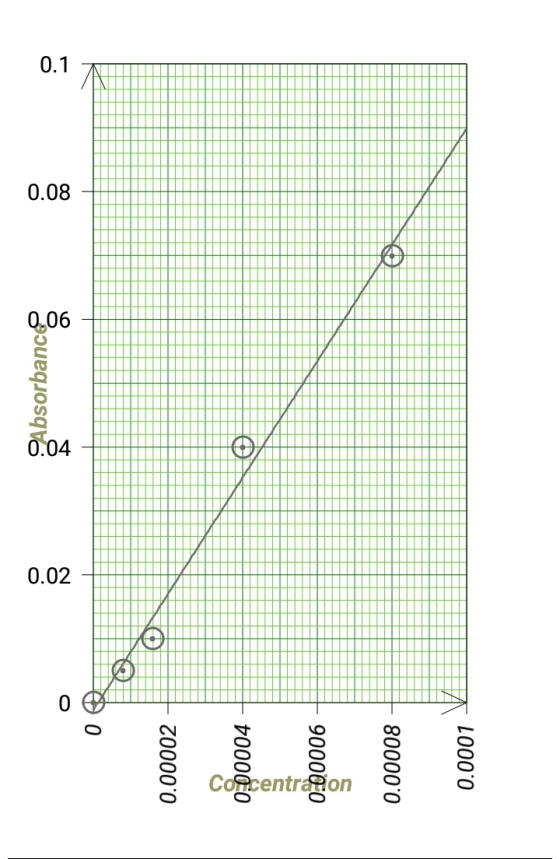
From the graph we can see that at, y= 0.028 x= 0.000032 and at y=0.048 x=0.000054 and when x=0 y=0 as well.
So the y intercept is 0.
And the slope, dy/dx= (0.048-0.028)/(0.000054-0.000032) = 0.020/0.000022 = 909
According to Beer's law, A = εcl
Where ε is the molar absorptivity, c is the concentration of the sample, l is the path length in which light travels and A is the light absorbed.
From graph we can see that,
At c= 0.000054 the absorbance A= 0.048
Let, for a cell of c=1cm the Molar absorptivity ε=a.
So, 0.048=0.000054x1xa
or, a= 0.048/0.000054
or, a= 889
So the molar absorptivity of the sample is 889 mole-1Lcm-1
Add Answer to:
The following data were obtained: 525 nm
Concentration
Absorbance
0.000008
0.005
0.000016
0.010
0.00004
0.040
0.00008...
gesi - Show ALL work 311 NAME "1. The following data were obtained for KMnO, at...
 gesi - Show ALL work 311 NAME "1. The following data were obtained for KMnO, at 540 nm with a 1 cm cell: KMnO4 Molarity Absorbance .101 0.000005 0.000010 0.000020 0.000030 0.000040 0.1010 0.202 0.405 0.606 0.809 (a) Prepare a caliberation plot (use graph paper). (b) Calculate the molar absorptivity at this wavelength (C) using the plot, find the concentration of an unknown that has absorbance of 0.300
Question 8 Status: Tries remaining: 21 Points possible: 1.00 Suppose you measure the absorbance of a...
 Question 8 Status: Tries remaining: 21 Points possible: 1.00 Suppose you measure the absorbance of a yellow dye solution in a 1.00 cm cuvette. cm what is The absorbance of the solution at 427 nm is 0.46. If the molar absorptivity of yellow dye at 427 nm is 27400 M the concentration of the solution? Answer: Question 9 Status: Tries remaining: 2 Points possible: 1.00 If you plot the absorbance measurements of solutions vs. their concentrations, what is the slope...
2. The absorbance of a 2.31 x 10 a wavelength of 266 nm in a 1.00...
 2. The absorbance of a 2.31 x 10 a wavelength of 266 nm in a 1.00 cm cell. absorptivity at 266 nm. M solution of a compound is 0.822 at Calculate the molar The following absorption data were calculated in-an experiment: 3. Absorbance 0.000 0.090 0.181 0.271 0.361 0.450 0.539 0.627 0.7 Concentration (м) 0.000 1x10⁻³ 2x10⁻³ 3x10 3 4x10⁻³ 5x10~3 6x10⁻³ 7x10⁻³ 8x1 Plot Absorbance vs. Concentration and calculate the molar absorptivity coefficient from the slope if the a)...
Since there is a direct relationship between absorbance and concentration of Beer's law, the units for...
Since there is a direct relationship between absorbance and concentration of Beer's law, the units for the slope (product of molar absorptivity and path length) are: Question 4 options: (I chose number 1 because the molar absorvity of a solute is in units of M^-1cm^-1. Is this correct?) 1) M-1cm-1 2) M-1cm 3) M-1 4) cm-1 5) unitless
#4-5 beer's law 4. Using the data below find the concentration of a 1.10 cm (path...
 #4-5 beer's law
4. Using the data below find the concentration of a 1.10 cm (path length) sample that has an absorbance of 0.592 Concentration (M) 0.20 0.30 Absorbances 0.27 0.41 0.40 0.50 0.55 0.69 The molar absorptivity constant of a particular chemical is 1.3/M cm. What is the concentration of a solution made from this chemical that has an absorbance of 0.66 with a cell path length of 1.1 cm?
#4-5 beer's law
4. Using the data below find the concentration of a 1.10 cm (path length) sample that has an absorbance of 0.592 Concentration (M) 0.20 0.30 Absorbances 0.27 0.41 0.40 0.50 0.55 0.69 The molar absorptivity constant of a particular chemical is 1.3/M cm. What is the concentration of a solution made from this chemical that has an absorbance of 0.66 with a cell path length of 1.1 cm?
A student measures the absorbance of a solution at some point during the reaction and records...
A student measures the absorbance of a solution at some point during the reaction and records a value of 0.335 . (Note that absorbance has no units.) Use Beer's Law and the constants given on page 5 to calculate the concentration of crystal violet in this solution. *The relationship between the solution absorbance and the CV+ concentration can be written as shown in Equation 7 below (Beer’s Law). At = ε∙b∙ct [7] In Equation 7, At is the reaction solution...
Two analytes, X and Y, have overlapping absorbance spectra for 200 nm <^ < 800 nm....
 Two analytes, X and Y, have overlapping absorbance spectra for 200 nm <^ < 800 nm. None the less, determine the concentration of each analyte in an unknown mixture, using the information from absorbance measurements at two a’s. For calibration, individual standards of X and Y were analyzed at a concentration of 2.0 x 10⁻⁴M. A 1.0 cm pathlength cell was used. The following data were obtained: Sample Absorbance at 22 Absorbance at 2#1 350 nm 650 nm Unknown Mixture...
2. The absorbance of a 2.31 % 10 M solution of a compound is 0.822 at...
 2. The absorbance of a 2.31 % 10 M solution of a compound is 0.822 at a wavelength of 266 nm in a 1.00 cm cell. Calculate the molar absorptivity at 266 nm. The following absorption data were calculated in an experiment: Absorbance 0.000 0.00 0.181 0.271 0.361 0.450 0.539 0.627 0.7 Concentration 0.000 1x10⁻³ 2x10⁻³ 3x10⁻³ 4x10- 5x10- 6x10 3 7x10- 8x1 (M) Plot Absorbance vs. Concentration and a) calculate the molar absorptivity coefficient from the slope if the...
1) A graph of the Absorbance vs Concentration of BSA at 545 nm has a linear...
1) A graph of the Absorbance vs Concentration of BSA at 545 nm has a linear trendline with the equation y = 0.6587x + 0.0001. Please calculate the concentration of an unknown sample with an absorbance of 0.330. 0.0001 mg/mL 0.217 mg/mL 0.6587 mg/mL 0.501 mg/mL 2) Please review the “Absorbance Assay at 280 nm” portion of your lab. Please calculate the concentration of an unknown sample with an absorbance of 0.330, path length 1.00 cm, and a molar absorption...
Chem 162 Experiment 2 Spectrophotometric Determination of Ion Concentration by Beer's Law Pre-Lab Questions a. A...
 Chem 162 Experiment 2 Spectrophotometric Determination of Ion Concentration by Beer's Law Pre-Lab Questions a. A sample absorbs 80% of the light passed through it at a certain wavelength. What is the absorbance of the sample at this wavelength? b. What would the absorbance be at the same wavelength if the sample were diluted by half? Assume the same size sample cell was used. 2, A 0.070 M solution has an absorbance ofA = 0.689. If a 1.00 cm path...
 gesi - Show ALL work 311 NAME "1. The following data were obtained for KMnO, at 540 nm with a 1 cm cell: KMnO4 Molarity Absorbance .101 0.000005 0.000010 0.000020 0.000030 0.000040 0.1010 0.202 0.405 0.606 0.809 (a) Prepare a caliberation plot (use graph paper). (b) Calculate the molar absorptivity at this wavelength (C) using the plot, find the concentration of an unknown that has absorbance of 0.300
 Question 8 Status: Tries remaining: 21 Points possible: 1.00 Suppose you measure the absorbance of a yellow dye solution in a 1.00 cm cuvette. cm what is The absorbance of the solution at 427 nm is 0.46. If the molar absorptivity of yellow dye at 427 nm is 27400 M the concentration of the solution? Answer: Question 9 Status: Tries remaining: 2 Points possible: 1.00 If you plot the absorbance measurements of solutions vs. their concentrations, what is the slope...
 2. The absorbance of a 2.31 x 10 a wavelength of 266 nm in a 1.00 cm cell. absorptivity at 266 nm. M solution of a compound is 0.822 at Calculate the molar The following absorption data were calculated in-an experiment: 3. Absorbance 0.000 0.090 0.181 0.271 0.361 0.450 0.539 0.627 0.7 Concentration (м) 0.000 1x10⁻³ 2x10⁻³ 3x10 3 4x10⁻³ 5x10~3 6x10⁻³ 7x10⁻³ 8x1 Plot Absorbance vs. Concentration and calculate the molar absorptivity coefficient from the slope if the a)...
 #4-5 beer's law
4. Using the data below find the concentration of a 1.10 cm (path length) sample that has an absorbance of 0.592 Concentration (M) 0.20 0.30 Absorbances 0.27 0.41 0.40 0.50 0.55 0.69 The molar absorptivity constant of a particular chemical is 1.3/M cm. What is the concentration of a solution made from this chemical that has an absorbance of 0.66 with a cell path length of 1.1 cm?
#4-5 beer's law
4. Using the data below find the concentration of a 1.10 cm (path length) sample that has an absorbance of 0.592 Concentration (M) 0.20 0.30 Absorbances 0.27 0.41 0.40 0.50 0.55 0.69 The molar absorptivity constant of a particular chemical is 1.3/M cm. What is the concentration of a solution made from this chemical that has an absorbance of 0.66 with a cell path length of 1.1 cm?
 Two analytes, X and Y, have overlapping absorbance spectra for 200 nm <^ < 800 nm. None the less, determine the concentration of each analyte in an unknown mixture, using the information from absorbance measurements at two a’s. For calibration, individual standards of X and Y were analyzed at a concentration of 2.0 x 10⁻⁴M. A 1.0 cm pathlength cell was used. The following data were obtained: Sample Absorbance at 22 Absorbance at 2#1 350 nm 650 nm Unknown Mixture...
 2. The absorbance of a 2.31 % 10 M solution of a compound is 0.822 at a wavelength of 266 nm in a 1.00 cm cell. Calculate the molar absorptivity at 266 nm. The following absorption data were calculated in an experiment: Absorbance 0.000 0.00 0.181 0.271 0.361 0.450 0.539 0.627 0.7 Concentration 0.000 1x10⁻³ 2x10⁻³ 3x10⁻³ 4x10- 5x10- 6x10 3 7x10- 8x1 (M) Plot Absorbance vs. Concentration and a) calculate the molar absorptivity coefficient from the slope if the...
 Chem 162 Experiment 2 Spectrophotometric Determination of Ion Concentration by Beer's Law Pre-Lab Questions a. A sample absorbs 80% of the light passed through it at a certain wavelength. What is the absorbance of the sample at this wavelength? b. What would the absorbance be at the same wavelength if the sample were diluted by half? Assume the same size sample cell was used. 2, A 0.070 M solution has an absorbance ofA = 0.689. If a 1.00 cm path...
Most questions answered within 3 hours.
-
Where is the error in this code sequence?
String s1 = "Hello";
String s2 = "ello";...
asked 10 months ago -
Financial data for Joel de Paris, Inc., for last year
follow:
Joel de Paris, Inc.
Balance...
asked 10 months ago -
Consider this reaction:
Al2(SO4)3 (aq)+ BaCl3
(aq) Al2Cl6 (aq)- +
3BaSO4(s) . What is the...
asked 10 months ago -
Suppose that Savneet is considering increasing her
recent random sample from 20 car rentals to 40...
asked 10 months ago -
Trucks arrive at an unloading terminal at an average rate of 120
per hour.
Trucks arrive...
asked 10 months ago -
Why are methanol and ethanol completely soluble in water while
octanol is not very little soluble....
asked 10 months ago -
A facilities manager at a university reads in a research report
that the mean amount of...
asked 10 months ago -
When the CuSO4 is rehydrated by adding water to the anhydrous
compound, is this an endothermic...
asked 10 months ago -
A ray of sunlight is passing from diamond into crown glass; the
angle of incidence is...
asked 10 months ago -
A block of mass 0.249 kg is placed on top of a light, vertical
spring of...
asked 10 months ago -
how do the kidneys compensate in the presences of acidosis
a) trigger hyperventilate
b) reserve acid...
asked 10 months ago -
Question 501 pts
The rental rate of capital to the firm increases. Which of the
following...
asked 10 months ago