1. show the reaction of 2,5-hexanedione and aniline under acid catalysis. 2. show the reaction of...
Homework Answers


Add Answer to:
1.
show the reaction of 2,5-hexanedione and aniline under acid
catalysis.
2. show the reaction of...
1. Under acid catalysis, an alcohol reacts with the dihydropyran to give the tetrahydropyranyl de...
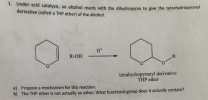 1. Under acid catalysis, an alcohol reacts with the dihydropyran to give the tetrahydropyranyl derivative (called a THP ether) of the alcohol. Ht tetrahydropyranyl derivative THP ether a) b) Propose a mechanism for this reaction. The THP ether is not
1. Under acid catalysis, an alcohol reacts with the dihydropyran to give the tetrahydropyranyl derivative (called a THP ether) of the alcohol. Ht tetrahydropyranyl derivative THP ether a) b) Propose a mechanism for this reaction. The THP ether is not
1. Under acid catalysis, an alcohol reacts with the dihydropyran to give the tetrahydropyranyl derivative (called a THP ether) of the alcohol. Ht tetrahydropyranyl derivative THP ether a) b) Propose a mechanism for this reaction. The THP ether is not
please be clear and show the necessary steps. please use a legible writing. I really want...
 please be clear and show the necessary steps. please use a legible
writing. I really want to understand the process and
mechanisms
2. Write the mechanism for the following reactions: a. the reaction of acetyl chloride with water to form acetic acid b. the reaction of acetyl bromide with methylamine to form N-methylacetamide 3. Write the mechanism in acid catalysis of the trans-esterification reaction of "methyl acetate" and ethanol.
please be clear and show the necessary steps. please use a legible
writing. I really want to understand the process and
mechanisms
2. Write the mechanism for the following reactions: a. the reaction of acetyl chloride with water to form acetic acid b. the reaction of acetyl bromide with methylamine to form N-methylacetamide 3. Write the mechanism in acid catalysis of the trans-esterification reaction of "methyl acetate" and ethanol.
h. Draw the El mechanism for the reaction of 2,5-dimethyl-2,5-hexanediol and hydrochloric acid (excess). Show lone...
 h. Draw the El mechanism for the reaction of 2,5-dimethyl-2,5-hexanediol and hydrochloric acid (excess). Show lone pairs, electron pushing arrows, 3-D view to reflect appropriate stereochemistry, reactants, transition states, and products. Name the product. Draw and completely label a reaction energy diagram corresponding to the mechanism you have drawn.
g. Draw the Snl mechanism of the reaction between 2,5-dimethyl-2,5-hexanediol and hydrochloric acid (excess). Show lone...
 g. Draw the Snl mechanism of the reaction between 2,5-dimethyl-2,5-hexanediol and hydrochloric acid (excess). Show lone pairs, electron pushing arrows, 3-D view to reflect appropriate stereochemistry, reactants, intermediates, and products. You do not have to show transition states. Name the product. Draw and completely label a reaction energy diagram corresponding to the mechanism you have drawn.
In principle, aldehyde 1 can trimerize under acid catalysis to furnish the trioxane product 2. Estimate...
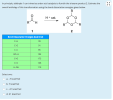 In principle, aldehyde 1 can trimerize under acid catalysis to furnish the trioxane product 2. Estimate the overall enthalpy of this transformation using the bond dissociation energies given below. Select one: -7 kcal/mol 7 kcal/mol -21 kcal/mol 21 kcal/mol
Provide a mechanism for the entire reaction of 1,4-dimethoxybenzene + 3-methyl-2-butanol + Sulfuric Acid --> 1,4-dimethoxy-2,5-di-tert-pentylbenzene.
Provide a mechanism for the entire reaction of 1,4-dimethoxybenzene + 3-methyl-2-butanol + Sulfuric Acid --> 1,4-dimethoxy-2,5-di-tert-pentylbenzene.
Provide the detailed mechanism of the aldol condensation reaction between 2 mols of benzaldehyde and 1...
Provide the detailed mechanism of the aldol condensation reaction between 2 mols of benzaldehyde and 1 mol of acetone under basic conditions. Show all intermediates and steps for full credit. There are 10 steps to the complete mechanism. Please help me with this one.
Please show all steps . Thank you Provide a detailed, wise mechanism for the acid-catalyzed condensation...
 Please show all steps .
Thank you
Provide a detailed, wise mechanism for the acid-catalyzed condensation reaction between step benzaldehyde and methylamine
Please show all steps .
Thank you
Provide a detailed, wise mechanism for the acid-catalyzed condensation reaction between step benzaldehyde and methylamine
Draw the mechanism and label products and reactants for the synthesis of aniline to 4-Bromo-2-Chloroacetanilide: Aniline...
Draw the mechanism and label products and reactants for the synthesis of aniline to 4-Bromo-2-Chloroacetanilide: Aniline + Acetic Anhydride --> Acetanilide + Acetic Acid Acetanilide + Bromine --> 4-Bromoacetanilide STEP 1: Hydrochloric Acid + Sodium Chlorate --> Chlorine + Water + Sodium Chloride STEP 2: 4-Bromoacetanilide + Chlorine --> 4-Bromo-2-Chloroacetanilide 4-Bromo-2-Chloroacetanilide + Ethanol --> 4-Bromo-2-Chloroaniline + Ethyl Acetate Show all lone pairs or formal charges.
Provide the detailed mechanism of the aldol condensation reaction between 2 mols of benzaldehyde and 1...
Provide the detailed mechanism of the aldol condensation reaction between 2 mols of benzaldehyde and 1 mole of acetone under basic conditions. Show all intermediates and steps. There are 10 steps to complete the mechanism.
 1. Under acid catalysis, an alcohol reacts with the dihydropyran to give the tetrahydropyranyl derivative (called a THP ether) of the alcohol. Ht tetrahydropyranyl derivative THP ether a) b) Propose a mechanism for this reaction. The THP ether is not
1. Under acid catalysis, an alcohol reacts with the dihydropyran to give the tetrahydropyranyl derivative (called a THP ether) of the alcohol. Ht tetrahydropyranyl derivative THP ether a) b) Propose a mechanism for this reaction. The THP ether is not
1. Under acid catalysis, an alcohol reacts with the dihydropyran to give the tetrahydropyranyl derivative (called a THP ether) of the alcohol. Ht tetrahydropyranyl derivative THP ether a) b) Propose a mechanism for this reaction. The THP ether is not
 please be clear and show the necessary steps. please use a legible
writing. I really want to understand the process and
mechanisms
2. Write the mechanism for the following reactions: a. the reaction of acetyl chloride with water to form acetic acid b. the reaction of acetyl bromide with methylamine to form N-methylacetamide 3. Write the mechanism in acid catalysis of the trans-esterification reaction of "methyl acetate" and ethanol.
please be clear and show the necessary steps. please use a legible
writing. I really want to understand the process and
mechanisms
2. Write the mechanism for the following reactions: a. the reaction of acetyl chloride with water to form acetic acid b. the reaction of acetyl bromide with methylamine to form N-methylacetamide 3. Write the mechanism in acid catalysis of the trans-esterification reaction of "methyl acetate" and ethanol.
 h. Draw the El mechanism for the reaction of 2,5-dimethyl-2,5-hexanediol and hydrochloric acid (excess). Show lone pairs, electron pushing arrows, 3-D view to reflect appropriate stereochemistry, reactants, transition states, and products. Name the product. Draw and completely label a reaction energy diagram corresponding to the mechanism you have drawn.
 g. Draw the Snl mechanism of the reaction between 2,5-dimethyl-2,5-hexanediol and hydrochloric acid (excess). Show lone pairs, electron pushing arrows, 3-D view to reflect appropriate stereochemistry, reactants, intermediates, and products. You do not have to show transition states. Name the product. Draw and completely label a reaction energy diagram corresponding to the mechanism you have drawn.
 In principle, aldehyde 1 can trimerize under acid catalysis to furnish the trioxane product 2. Estimate the overall enthalpy of this transformation using the bond dissociation energies given below. Select one: -7 kcal/mol 7 kcal/mol -21 kcal/mol 21 kcal/mol
 Please show all steps .
Thank you
Provide a detailed, wise mechanism for the acid-catalyzed condensation reaction between step benzaldehyde and methylamine
Please show all steps .
Thank you
Provide a detailed, wise mechanism for the acid-catalyzed condensation reaction between step benzaldehyde and methylamine
Most questions answered within 3 hours.
-
Where is the error in this code sequence?
String s1 = "Hello";
String s2 = "ello";...
asked 11 months ago -
Financial data for Joel de Paris, Inc., for last year
follow:
Joel de Paris, Inc.
Balance...
asked 11 months ago -
Consider this reaction:
Al2(SO4)3 (aq)+ BaCl3
(aq) Al2Cl6 (aq)- +
3BaSO4(s) . What is the...
asked 11 months ago -
Suppose that Savneet is considering increasing her
recent random sample from 20 car rentals to 40...
asked 11 months ago -
Trucks arrive at an unloading terminal at an average rate of 120
per hour.
Trucks arrive...
asked 11 months ago -
Why are methanol and ethanol completely soluble in water while
octanol is not very little soluble....
asked 11 months ago -
A facilities manager at a university reads in a research report
that the mean amount of...
asked 11 months ago -
When the CuSO4 is rehydrated by adding water to the anhydrous
compound, is this an endothermic...
asked 11 months ago -
A ray of sunlight is passing from diamond into crown glass; the
angle of incidence is...
asked 11 months ago -
A block of mass 0.249 kg is placed on top of a light, vertical
spring of...
asked 11 months ago -
how do the kidneys compensate in the presences of acidosis
a) trigger hyperventilate
b) reserve acid...
asked 11 months ago -
Question 501 pts
The rental rate of capital to the firm increases. Which of the
following...
asked 11 months ago