Design a nested loop that displays 10 rows of # characters. There should be 15 #...
Design a nested loop that displays 10 rows of # characters. There should be 15 # characters in each row.
Homework Answers
CODE:
#include <iostream>
using namespace std;
int main()
{
//to print for 10 rows, iterating i from 1 to 10
for(int i=1;i<=10;i++){
//to print for 15 columns, iterating j from 1 to 15
for(int j=1;j<=15;j++){
cout<<'#';
}
//to change row
cout<<endl;
}
return 0;
}
OUTPUT:
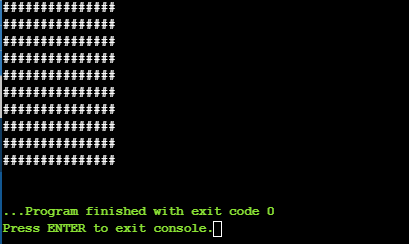
Add Answer to:
Design a nested loop that displays 10 rows of # characters.
There should be 15 #...
convert nested for loop into nested while loop please: int[][] sol = new int[rows + 2][columns...
convert nested for loop into nested while loop please: int[][] sol = new int[rows + 2][columns + 2]; for (i = 1 ; i <= rows ; i++) { for (j = 1 ; j <= columns ; j++) { // (ii, jj) indexes neighboring cells for (int ii = i - 1 ; ii <= i + 1 ; ii++) { for (int jj = j - 1 ; jj <=...
C++ any help is appreciated Program Pattern#2: Write a program that uses nested loop or for...
C++ any help is appreciated Program Pattern#2: Write a program that uses nested loop or for statements to display Pattern A below, followed by an empty line and then another set of loops that displays Pattern B. Once again no setw implementation is allowed here but you must use nested loop or for statements with proper indentation to generate these patterns. Use meaningful variable identifier names, good prompting messages and appropriate comments for each loop segment as well as other...
Design a For loop that displays the following set of numbers: 0, 10, 20, 30, 40,...
Design a For loop that displays the following set of numbers: 0, 10, 20, 30, 40, 50,..., 1000
QUESTION 8 What is the exact output of the following nested loop? for (int row =...
 QUESTION 8 What is the exact output of the following nested loop? for (int row = 2; row<10; row += 4){ int column=1; while (column <= 4){ System.out.print(row - column + ""); column += 2; System.out.println(); wo- 1-153 1-1 53 All of these are correct.
Using Python programming, create a 2-by-3 list, then use a nested loop to: 1) Set each...
Using Python programming, create a 2-by-3 list, then use a nested loop to: 1) Set each element's value to an integer indicating the order in which it was processed by the nested loop (1, 2, 3, 4, 5, 6). 2) Display the elements in tabular format. Use the column indices as headings across the top, and the row indices to the left of each row.
Programming in C: Using a nested for loop create the pattern below. Prompt the user for...
Programming in C: Using a nested for loop create the pattern below. Prompt the user for the height (number of rows) and width (number of characters per line) for pattern A. You may use any number for height and width, just as long as the basic pattern is preserved. Call a function to print the pattern. This function receives the height and width as inputs (parameters) but does not return a value. Make use of an if structure to instruct...
Create a square array and fill out as shown below. Use a nested loop for this...
Create a square array and fill out as shown below. Use a nested loop for this step. 1 3 5 7 9 2 4 6 8 10 3 5 7 9 11 4 6 8 10 12 5 7 9 11 13 Then create two 1D arrays to with row and column sum of the items. You have then 15 25 35 45 55 for the column sum, and 25 30 35 40 45 for the row sum. Print row...
Create a square array and fill out as shown below. Use nested loop for this step....
Create a square array and fill out as shown below. Use nested loop for this step. 1 3 5 7 9 2 4 6 8 10 3 5 7 9 11 4 6 8 10 12 5 7 9 11 13 Then create two 1D arrays to with row and column sum of the items. You have then 15 25 35 45 55 for the column sum, and 25 30 35 40 45 for the row sum. Print row and...
Turtle Graphics with nested loop: Write a turtle graphics python program repeat_squares.py that uses nested loops...
Turtle Graphics with nested loop: Write a turtle graphics python program repeat_squares.py that uses nested loops to draw 100 squares, to create this design: Turtle-squares.png starting with the smallest square in the bottom right-hand corner. Start at position (-4,4). At each step increase the length of each side by 4 pixels. Draw 100 squares. Please submit with an animation speed of 0 and the turtle hidden turtle.hideturtle()
Java use for loop (nested for loop) if/else possible on blue J. (row *col)%2 for 0's and 1's.
 Java use for loop (nested for loop) if/else possible
on blue J.
(row *col)%2 for 0's and 1's.
Write a program to generate the below table: . The table should be able to vary in size based on a class constant called SIZE; minimum of 1, maximum of 9. . The O's and 1's can and should be generated by evaluating a mathematical expression using the row and column numbers Think about the operators: +-* / % . The output...
Java use for loop (nested for loop) if/else possible
on blue J.
(row *col)%2 for 0's and 1's.
Write a program to generate the below table: . The table should be able to vary in size based on a class constant called SIZE; minimum of 1, maximum of 9. . The O's and 1's can and should be generated by evaluating a mathematical expression using the row and column numbers Think about the operators: +-* / % . The output...
 QUESTION 8 What is the exact output of the following nested loop? for (int row = 2; row<10; row += 4){ int column=1; while (column <= 4){ System.out.print(row - column + ""); column += 2; System.out.println(); wo- 1-153 1-1 53 All of these are correct.
 Java use for loop (nested for loop) if/else possible
on blue J.
(row *col)%2 for 0's and 1's.
Write a program to generate the below table: . The table should be able to vary in size based on a class constant called SIZE; minimum of 1, maximum of 9. . The O's and 1's can and should be generated by evaluating a mathematical expression using the row and column numbers Think about the operators: +-* / % . The output...
Java use for loop (nested for loop) if/else possible
on blue J.
(row *col)%2 for 0's and 1's.
Write a program to generate the below table: . The table should be able to vary in size based on a class constant called SIZE; minimum of 1, maximum of 9. . The O's and 1's can and should be generated by evaluating a mathematical expression using the row and column numbers Think about the operators: +-* / % . The output...
Most questions answered within 3 hours.
-
Where is the error in this code sequence?
String s1 = "Hello";
String s2 = "ello";...
asked 10 months ago -
Financial data for Joel de Paris, Inc., for last year
follow:
Joel de Paris, Inc.
Balance...
asked 10 months ago -
Consider this reaction:
Al2(SO4)3 (aq)+ BaCl3
(aq) Al2Cl6 (aq)- +
3BaSO4(s) . What is the...
asked 10 months ago -
Suppose that Savneet is considering increasing her
recent random sample from 20 car rentals to 40...
asked 10 months ago -
Trucks arrive at an unloading terminal at an average rate of 120
per hour.
Trucks arrive...
asked 10 months ago -
Why are methanol and ethanol completely soluble in water while
octanol is not very little soluble....
asked 10 months ago -
A facilities manager at a university reads in a research report
that the mean amount of...
asked 10 months ago -
When the CuSO4 is rehydrated by adding water to the anhydrous
compound, is this an endothermic...
asked 10 months ago -
A ray of sunlight is passing from diamond into crown glass; the
angle of incidence is...
asked 10 months ago -
A block of mass 0.249 kg is placed on top of a light, vertical
spring of...
asked 10 months ago -
how do the kidneys compensate in the presences of acidosis
a) trigger hyperventilate
b) reserve acid...
asked 10 months ago -
Question 501 pts
The rental rate of capital to the firm increases. Which of the
following...
asked 10 months ago