What is the output of the following code: void forkexample() { int x = 1; ...
Homework Answers
#include <stdio.h>
void forkexample()
{
int x = 1;

if (fork()==0)
printf(“ Child has x = %d\n”, ++x);

else
printf(“ Parent has x = %d\n”, --x);
}
int main ()
{
forkexample();
return 0;
}
Output :
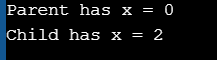
Add Answer to:
What is the output of the following code:
void forkexample()
{
int x = 1;
...
QUESTION 6 What is the output of following C code? struct numbers { int x...
QUESTION 6 What is the output of following C code? struct numbers { int x = 2; int y = 3; } int main() { struct numbers nums; nums.x = 110; nums.y = 100; printf("%d\n%d", nums.x, nums.y); return 0; } A. Compile-time Error B. 110 100 C. 2 3 D. Run-time Error 2 points QUESTION 7 What is the output of following C code? typedef struct student { char *stud; }s1; int main() { s1 s; s.stud...
I have the following code in C: void sighandler(int sig) { printf("exiting child..."); } int...
I have the following code in C: void sighandler(int sig) { printf("exiting child..."); } int main(int argc,char* argv[]) { if(argc > 1) { char* commandName; for(int i=2;i { forkChild = fork(); signal(SIGINT,sighandler); if(forkChild == 0) { execlp(commandName,commandName,argv[i],NULL); exit(0); } else { wait(NULL); } } My problem is that I would like to kill the child with ^C but leave the parent running....
What is the functionality of the following code? #include #include mainO <stdio.h> <unistd.h> int i,j; j-0:...
 What is the functionality of the following code? #include #include mainO <stdio.h> <unistd.h> int i,j; j-0: printf ("Ready to fork.n) i-fork; if 0) this code.\n"); printf "The child executes for (i-0; i?5; i++) printf("Child j-dn".j); else j-vaito printf("The parent executes this code. Ln" printf ("Parent j-dn",j);
What is the output of the following code segment and why? int main(void) { // Find...
What is the output of the following code segment and why? int main(void) { // Find the output of the following and explain it: char name[] = "Hello"; name[2] = '\0'; printf("%s\n", name); return 0; } why answer is he?
Consider the following pseudo code. What are the possible outputs (.e., the complete output from each...
 Consider the following pseudo code. What are the possible outputs (.e., the complete output from each execution run of this program)? Explain in less than 50 words. Note: keep in mind that fork) may fail in that case no child process is created int main(int arge, char argvt int X- int CwO; re - fork(); 15 tre > 0) X=S; else x-rc +2: printf(" \n", x); return 0;
Three is 3 questions please answer them all Question 1 int main(void) { int x =...
 Three is 3 questions please answer them all
Question 1 int main(void) { int x = 10, y = 20; if (x == y); printf ("\n%d %d",x,y); } Output as you would see on the compiler: Question 2 int main(void) { int x = 3, y = 5; if (x == 3) printf ("\n%d",x); else ; printf("%d", y); return 0; Output as you would see on the compiler: Question 3 int main(void) { int x = 3; float y =...
Three is 3 questions please answer them all
Question 1 int main(void) { int x = 10, y = 20; if (x == y); printf ("\n%d %d",x,y); } Output as you would see on the compiler: Question 2 int main(void) { int x = 3, y = 5; if (x == 3) printf ("\n%d",x); else ; printf("%d", y); return 0; Output as you would see on the compiler: Question 3 int main(void) { int x = 3; float y =...
20) What is the output of the following segment of C code: int avg(int n, int*...
20) What is the output of the following segment of C code: int avg(int n, int* a); int main () { int array[4]={1,0,6,9}; printf("%d", avg(4, array)+ 1); system("pause"); return 0; } int avg(int n, int* a) { int i, sum=0; for (i=0;i<n;i++) { sum+=a[i]; } return sum/n; } a) 16 b) 5 c) 4 d) 8 21) What is the output of the following segment of C code: int x = 2; int y = 3;...
OPERATING SYSTEMS QUESTION: Given the code below: int main() { pid_t pid; int value = 10;...
OPERATING SYSTEMS QUESTION: Given the code below: int main() { pid_t pid; int value = 10; pid = fork(); if (pid == 0) { /* child */ value += 8; printf(“CHILD: value = %d\n”, value); /* Line A */ exit(0); } else { /* parent */ value += 5; wait(NULL); \ printf(“PARENT: value = %d\n”, value); /* Line B */ exit(0); } } What is printed at Line B? Explain why in a few sentences.
What is the output, to the console, once the following code has executed? int collatz(int value)...
What is the output, to the console, once the following code has executed? int collatz(int value) { if(value % 2 ==0) return value /2; else return value * 3+1; } int main() { int currentValue=1; int i; for (i=0; i<5; i++) { printf("%d\n", currentValue); currentValue= collatz(currentValue); } return 0; }
Please help me debug the following code #include int main(void){ int a = 11, b =...
 Please help me debug the following code
#include
int main(void){
int a = 11, b = 5;
int *ptr1 = &a, *ptr2 = &b;
printf("%d %d\n", *ptr1, *ptr2);
swap(&ptr1, &ptr2);
printf("%d %d\n", *ptr1, *ptr2);
minimum(ptr1, ptr2);
printf("%d %d\n", a, b);
return 0;
}
// Part A
void swap(int **ptr1, int **ptr2){
int *temp = *ptr1;
*ptr1 = *ptr2;
*ptr2 = temp;
return;
}
// Part B
void minimum(int *ptr1, int *ptr2){
if(*ptr1 > *ptr2){
*ptr1 = *ptr2;
}else{
*ptr2 =...
Please help me debug the following code
#include
int main(void){
int a = 11, b = 5;
int *ptr1 = &a, *ptr2 = &b;
printf("%d %d\n", *ptr1, *ptr2);
swap(&ptr1, &ptr2);
printf("%d %d\n", *ptr1, *ptr2);
minimum(ptr1, ptr2);
printf("%d %d\n", a, b);
return 0;
}
// Part A
void swap(int **ptr1, int **ptr2){
int *temp = *ptr1;
*ptr1 = *ptr2;
*ptr2 = temp;
return;
}
// Part B
void minimum(int *ptr1, int *ptr2){
if(*ptr1 > *ptr2){
*ptr1 = *ptr2;
}else{
*ptr2 =...
 What is the functionality of the following code? #include #include mainO <stdio.h> <unistd.h> int i,j; j-0: printf ("Ready to fork.n) i-fork; if 0) this code.\n"); printf "The child executes for (i-0; i?5; i++) printf("Child j-dn".j); else j-vaito printf("The parent executes this code. Ln" printf ("Parent j-dn",j);
 Consider the following pseudo code. What are the possible outputs (.e., the complete output from each execution run of this program)? Explain in less than 50 words. Note: keep in mind that fork) may fail in that case no child process is created int main(int arge, char argvt int X- int CwO; re - fork(); 15 tre > 0) X=S; else x-rc +2: printf(" \n", x); return 0;
 Three is 3 questions please answer them all
Question 1 int main(void) { int x = 10, y = 20; if (x == y); printf ("\n%d %d",x,y); } Output as you would see on the compiler: Question 2 int main(void) { int x = 3, y = 5; if (x == 3) printf ("\n%d",x); else ; printf("%d", y); return 0; Output as you would see on the compiler: Question 3 int main(void) { int x = 3; float y =...
Three is 3 questions please answer them all
Question 1 int main(void) { int x = 10, y = 20; if (x == y); printf ("\n%d %d",x,y); } Output as you would see on the compiler: Question 2 int main(void) { int x = 3, y = 5; if (x == 3) printf ("\n%d",x); else ; printf("%d", y); return 0; Output as you would see on the compiler: Question 3 int main(void) { int x = 3; float y =...
 Please help me debug the following code
#include
int main(void){
int a = 11, b = 5;
int *ptr1 = &a, *ptr2 = &b;
printf("%d %d\n", *ptr1, *ptr2);
swap(&ptr1, &ptr2);
printf("%d %d\n", *ptr1, *ptr2);
minimum(ptr1, ptr2);
printf("%d %d\n", a, b);
return 0;
}
// Part A
void swap(int **ptr1, int **ptr2){
int *temp = *ptr1;
*ptr1 = *ptr2;
*ptr2 = temp;
return;
}
// Part B
void minimum(int *ptr1, int *ptr2){
if(*ptr1 > *ptr2){
*ptr1 = *ptr2;
}else{
*ptr2 =...
Please help me debug the following code
#include
int main(void){
int a = 11, b = 5;
int *ptr1 = &a, *ptr2 = &b;
printf("%d %d\n", *ptr1, *ptr2);
swap(&ptr1, &ptr2);
printf("%d %d\n", *ptr1, *ptr2);
minimum(ptr1, ptr2);
printf("%d %d\n", a, b);
return 0;
}
// Part A
void swap(int **ptr1, int **ptr2){
int *temp = *ptr1;
*ptr1 = *ptr2;
*ptr2 = temp;
return;
}
// Part B
void minimum(int *ptr1, int *ptr2){
if(*ptr1 > *ptr2){
*ptr1 = *ptr2;
}else{
*ptr2 =...
Most questions answered within 3 hours.
-
Where is the error in this code sequence?
String s1 = "Hello";
String s2 = "ello";...
asked 10 months ago -
Financial data for Joel de Paris, Inc., for last year
follow:
Joel de Paris, Inc.
Balance...
asked 10 months ago -
Consider this reaction:
Al2(SO4)3 (aq)+ BaCl3
(aq) Al2Cl6 (aq)- +
3BaSO4(s) . What is the...
asked 10 months ago -
Suppose that Savneet is considering increasing her
recent random sample from 20 car rentals to 40...
asked 10 months ago -
Trucks arrive at an unloading terminal at an average rate of 120
per hour.
Trucks arrive...
asked 10 months ago -
Why are methanol and ethanol completely soluble in water while
octanol is not very little soluble....
asked 10 months ago -
A facilities manager at a university reads in a research report
that the mean amount of...
asked 10 months ago -
When the CuSO4 is rehydrated by adding water to the anhydrous
compound, is this an endothermic...
asked 10 months ago -
A ray of sunlight is passing from diamond into crown glass; the
angle of incidence is...
asked 10 months ago -
A block of mass 0.249 kg is placed on top of a light, vertical
spring of...
asked 10 months ago -
how do the kidneys compensate in the presences of acidosis
a) trigger hyperventilate
b) reserve acid...
asked 10 months ago -
Question 501 pts
The rental rate of capital to the firm increases. Which of the
following...
asked 10 months ago