Day 1: 1. What is Oil wintergreen? Name the plant source for Oil of Wintergreen. 2....
Day 1:
1. What is Oil wintergreen? Name the plant source for Oil of
Wintergreen.
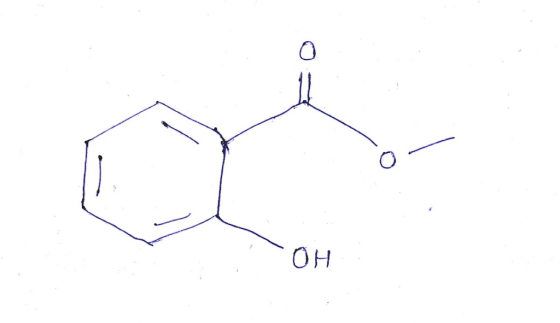
2. Draw the structure of the major component in Oil of
Wintergreen.
3. Mention three biological activities of Oil of winter
green.
4. Using REAXYS tool, find a synthetic protocol for the synthesis
of ether derivative of Oil of Winter green.
5. List the starting materials and their quantities required to
prepare the given ether derivative.
6. Write the mechanism involved in the proposed reaction.
7. Document the search including screen shots / pictures and submit
for grading.
Homework Answers
Answer:
1.
Wintergreen oil is a pale yellow or pinkish fluid liquid that's strongly aromatic with sweet, woody odor (components: methyl salicylate (about 98%), α-pinene, myrcene, delta-3-carene, limonene, 3,7-guaiadiene, & delta-cadinene) that gives such plants distinctive "medicinal" smell whenever bruised.
This oil comes from a big plant source of methyl salicylate – wintergreen plants. Easily distilled from plant leaves, oil of wintergreen is 96-99% methyl salicylate & very pungent. Besides smelling minty, methyl salicylate also tastes minty, but wintergreens aren’t mints. These plants are members of the genus Gaultheria, while mint plants like peppermint & spearmint, are of the genus Mentha.
2. Methyl Salicylate:
3.
Wintergreen oil acts in a similar way as aspirin in that it can produce analgesic effect when topically applied on skin. It also shows antipyretic actions when the essence of wintergreen is mixed with alcohol. Is very effectual against intermittent fever. This can also be used to treat sexually trans mitted disease as gonorrhea & in gonorrheal & other rheumatism. Wintergreen oil can be used for trigeminal neuralgia, & in subcutaneous & chronic cystitis.This oil is used as liniments & ointments for reliving pains in above mentioned cases.
4.
Aspirin is a group of drugs called Salicylates. It is also known to treat mild to moderate pain, & to reduce fever or inflammation. It is sometimes used to treat or prevent heart attacks, strokes, & angina. On the other hand, the oil of wintergreen or methyl salicylate & also came from the same active ingredient, Salicylic acid. Commercially, it is used as a flavoring for candies & chewing gum & in the treatment of muscular aches & pains. When synthesized & sold as the oil of wintergreen itself, it can be sold as beverage.The 2 compounds indicated are both organic esters. An ester is a compound that is formed when an acid (containing the COOH group) reacts with an alcohol (containing an -OHgroup). In this experiment the experimenters will prepare two esters of o-hydroxy benzoic acid, more commonly known as salicylic acid. One of the esters, acetyl salicylic acid, is aspirin, common analgesic. They will synthesize aspirin by mixing salicylic acid with acetic anhydride. The second ester product is oil of wintergreen, or methyl salicylate, which we prepare by allowing salicylic acid to react with methyl alcohol. This compound, which has a familiar odor, is used as a flavoring agent in rubbing ointments.
 Salicylic acid and acetic
anhydride reacts to form acetylsalicylic acid and acetic acid.
Salicylic acid and acetic
anhydride reacts to form acetylsalicylic acid and acetic acid.
 Salicylic acid and methanol
reacts to form methylsalicylate.
Salicylic acid and methanol
reacts to form methylsalicylate.
Add Answer to:
Day 1:
1. What is Oil wintergreen? Name the plant source for Oil of
Wintergreen.
2....
Day 1: 1. What is Oil wintergreen? Name the plant source for Oil of Wintergreen. 2....
Day 1: 1. What is Oil wintergreen? Name the plant source for Oil of Wintergreen. 2. Draw the structure of the major component in Oil of Wintergreen. 3. Mention three biological activities of Oil of winter green. 4. Using REAXYS tool, find a synthetic protocol for the synthesis of ether derivative of Oil of Winter green. 5. List the starting materials and their quantities required to prepare the given ether derivative. 6. Write the mechanism involved in the proposed reaction....
Most questions answered within 3 hours.
-
Where is the error in this code sequence?
String s1 = "Hello";
String s2 = "ello";...
asked 11 months ago -
Financial data for Joel de Paris, Inc., for last year
follow:
Joel de Paris, Inc.
Balance...
asked 11 months ago -
Consider this reaction:
Al2(SO4)3 (aq)+ BaCl3
(aq) Al2Cl6 (aq)- +
3BaSO4(s) . What is the...
asked 11 months ago -
Suppose that Savneet is considering increasing her
recent random sample from 20 car rentals to 40...
asked 11 months ago -
Trucks arrive at an unloading terminal at an average rate of 120
per hour.
Trucks arrive...
asked 11 months ago -
Why are methanol and ethanol completely soluble in water while
octanol is not very little soluble....
asked 11 months ago -
A facilities manager at a university reads in a research report
that the mean amount of...
asked 11 months ago -
When the CuSO4 is rehydrated by adding water to the anhydrous
compound, is this an endothermic...
asked 11 months ago -
A ray of sunlight is passing from diamond into crown glass; the
angle of incidence is...
asked 11 months ago -
A block of mass 0.249 kg is placed on top of a light, vertical
spring of...
asked 11 months ago -
how do the kidneys compensate in the presences of acidosis
a) trigger hyperventilate
b) reserve acid...
asked 11 months ago -
Question 501 pts
The rental rate of capital to the firm increases. Which of the
following...
asked 11 months ago