Which of the following best describes what you will do in this lab? Question 1 options:...
Which of the following best describes what you will do in this lab?
Question 1 options:
|
determine the concentration of nickel ions in an unknown solution. |
|
|
Construct a calibration curve. |
|
|
Be able to use a spectrophotometer. |
|
|
determine the concentration of nickel ions in a known solid. |
|
|
Be able to apply beer's law in order to observe how spectrophotometry works |
|
|
Be able to derive beer's law |
|
|
carry out solution preparation and dilutions. |
Question 2 (1 point)
Which of the following best describes how to prepare a 25.0 mL of a stock solution of nickel (II) nitrate at a concentration of approximately 0.034 M.
Question 2 options:
|
weigh out the exact amount of grams of nickel(II) nitrate hexahydrate using a medium-sized weigh boat, funnel it into a 25 mL volumetric flask, fill the flask with distilled water until you reach the volumetric mark on the flask. |
|
|
weigh out the exact amount of grams of nickel(II) nitrate hexahydrate using a medium-sized weigh boat, funnel it into a 25 mL volumetric flask, fill the flask about 1/2 way with distilled water to dissolve the solid, swirl the flask and then fill up the flask with more distilled water until you reach the volumetric mark on the flask. |
|
|
weigh out the exact amount of grams of nickel(II) nitrate hexahydrate using a medium-sized weigh boat, funnel it into a 25 mL beaker, fill the beaker about 1/2 way with distilled water to dissolve the solid, swirl the flask and then fill up the beaker with more distilled water until you reach the volumetric mark on the beaker. |
|
|
weigh out the exact amount of grams of nickel(II) nitrate hexahydrate using a medium-sized weigh boat and dissolve in 25 mL of distilled water. |
Question 3 (1 point)
Which of the following glassware will you be using for dilutions?
Question 3 options:
|
A Mohr Pipette |
|
|
A burette |
|
|
10 mL volumetric flasks |
|
|
beakers |
Homework Answers
Request Answer!
We need at least 10 more requests to produce the answer.
0 / 10 have requested this problem solution
The more requests, the faster the answer.
Add Answer to:
Which of the following best describes what you will do in this
lab?
Question 1 options:...
How do I calculate the concentrations for my data sheet lab. I have not started my...
 How do I calculate the concentrations for my data sheet lab. I
have not started my lab yet but I just need to see how i would
calculate it with absorbance. Do i just use Beer's law or is there
any other method of solving the concentrations.
7. Weigh 1.45-1.55 g of copper(I) sulfate pentahydrate in a 50 mL beaker. 8. Dissolve the copper(II) sulfate pentahydrate in -15 mL of water 9. Add the aqueous solution of copper(II) to a...
How do I calculate the concentrations for my data sheet lab. I
have not started my lab yet but I just need to see how i would
calculate it with absorbance. Do i just use Beer's law or is there
any other method of solving the concentrations.
7. Weigh 1.45-1.55 g of copper(I) sulfate pentahydrate in a 50 mL beaker. 8. Dissolve the copper(II) sulfate pentahydrate in -15 mL of water 9. Add the aqueous solution of copper(II) to a...
Please answer within 40 minutes for when the question is due, thank you! |-/0.5 points GVSUCHEM116V2...
 Please answer within 40 minutes for when the question
is due, thank you!
|-/0.5 points GVSUCHEM116V2 14.6.3.P004. My Notes Calculating the pH of a Buffer Solution To prepare a buffer you weigh out 9.00 grams of KNO2 and place it into a 500.00 mL volumetric flask. To this flask you add 18.0 mL of 3.80 M HNO, and then fill it about halfway with distilled water, swirling to dissolve the contents. Finally, the flask is filled the rest of the...
Please answer within 40 minutes for when the question
is due, thank you!
|-/0.5 points GVSUCHEM116V2 14.6.3.P004. My Notes Calculating the pH of a Buffer Solution To prepare a buffer you weigh out 9.00 grams of KNO2 and place it into a 500.00 mL volumetric flask. To this flask you add 18.0 mL of 3.80 M HNO, and then fill it about halfway with distilled water, swirling to dissolve the contents. Finally, the flask is filled the rest of the...
Heres are the steps that were followed... Please help. Let me know if their is any...
 Heres are the steps that were followed...
Please help. Let me know if their is any missing
information.
ii) Nickel analysis - Prepare three standard nickel solutions using the following procedure. Accurately weigh approximately 1.0 g of [Ni(H20)6]504 into a 50 mL volumetric flask. Add 10 mL of D.I. water followed by 10 mL of 1 M H2SO4(aq) to dissolve the salt and then dilute to the mark with deionized water. Pipet 10 mL of the solution into one 25...
Heres are the steps that were followed...
Please help. Let me know if their is any missing
information.
ii) Nickel analysis - Prepare three standard nickel solutions using the following procedure. Accurately weigh approximately 1.0 g of [Ni(H20)6]504 into a 50 mL volumetric flask. Add 10 mL of D.I. water followed by 10 mL of 1 M H2SO4(aq) to dissolve the salt and then dilute to the mark with deionized water. Pipet 10 mL of the solution into one 25...
Use the References to access important values if needed for this question A student wishes to...
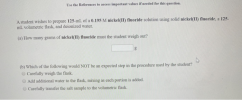 Use the References to access important values if needed for this question A student wishes to prepare 125-mL of a 0.195 M nickel(II) fluoride solution using solid nickel(II) Nuoride, a 125- mL volumetric flask, and deionized water. (a) How many grams of nickel(II) fluoride must the student weigh out? (b) Which of the following would NOT be an expected step in the procedure used by the student? Carefully weigh the flask. Add additional water to the flask, mixing as each...
Objective Knowledge Check Question 14 A chemist must prepare 500.0 mL of potassium hydroxide solution with...
 Objective Knowledge Check Question 14 A chemist must prepare 500.0 mL of potassium hydroxide solution with a pH of 12.10 at 25 °C. She will do this in three steps: Fill a 500.0 mlL volumetric flask about halfway with distilled water Weigh out a small amount of solid potassium hydroxide and add it to the flask. Fill the flask to the mark with distilled water. Calculate the mass of potassium hydroxide that the chemist must weigh out in the second...
you weigh out 7.25 grams of NaCl and dissolve this sample in 50 mL of deionized...
you weigh out 7.25 grams of NaCl and dissolve this sample in 50 mL of deionized water, and then you put it in an empty volumetric flask weighing 57.221 g. After the whole thing has dissolved, you add water all the way up to the 100.0 mL mark of the volumetric flask (flask and solution together weighs 162.9145 g.) what’s the mass % of NaCl in this solution?
A student weighs out 14.6 g of AlBrz, transfers it to a 300 mL volumetric flask,...
 A student weighs out 14.6 g of AlBrz, transfers it to a 300 mL volumetric flask, adds enough water to dissolve the solid and then adds water to the 300 mL mark on the neck of the flask. Calculate the concentration (in molarity units) of aluminum bromide in the resulting solution? Calculate the mass, in grams of sodium iodide that must be added to a 250 mL volumetric flask in order to prepare 250 mL of a 0.138 M aqueous...
titration lab report additional images of lab report QUESTIONS 1. A student masse 0878 of an...
 titration lab report
additional images of lab report
QUESTIONS 1. A student masse 0878 of an unknown acid follows the titration procedure required to reach the endpoint on a 10.0 ml Calculate the molar mass of the acid. masses out 0.878 of die in 100 ml volume and titration procedure of Partsherds th the average volume of Non to reach the endpoint on 100 ml aliquot of the acid solution is 18.3 m . 2. In the vinegar titrations (Part...
titration lab report
additional images of lab report
QUESTIONS 1. A student masse 0878 of an unknown acid follows the titration procedure required to reach the endpoint on a 10.0 ml Calculate the molar mass of the acid. masses out 0.878 of die in 100 ml volume and titration procedure of Partsherds th the average volume of Non to reach the endpoint on 100 ml aliquot of the acid solution is 18.3 m . 2. In the vinegar titrations (Part...
based on data please help fill out chart and questions 1,2,3 Part II: Neutralization of the...
 based on data please help fill out chart and questions
1,2,3
Part II: Neutralization of the Tablet 1. Obtain one of the commercial antacid tablets that your Lab Instructor has assigned you. 2. Weigh and record the weight of the tablet. 3. Crush the tablet using mortar and pestle. 4. Transfer as much of the crushed tablet as you can onto a weigh boat. 5. Weigh the tablet and weigh boat, and record this value. 6. Pour the entire contents...
based on data please help fill out chart and questions
1,2,3
Part II: Neutralization of the Tablet 1. Obtain one of the commercial antacid tablets that your Lab Instructor has assigned you. 2. Weigh and record the weight of the tablet. 3. Crush the tablet using mortar and pestle. 4. Transfer as much of the crushed tablet as you can onto a weigh boat. 5. Weigh the tablet and weigh boat, and record this value. 6. Pour the entire contents...
Can you please tell me the grams i need for these 2 solutions? Thank You Weigh...
 Can you please tell me the grams i need for these 2 solutions?
Thank You
Weigh out the necessary mass of KNO3 to make 50 mL of 1.0 M supporting electrolyte solution. Transfer the KNO3 to a 50- mL volumetric flask and dilute to the mark with deionized Analyte motion water. Ensure the solid is dissolved completely before using the solution. Transfer to a small beaker. This is your supporting electrolyte solution. Weigh out the necessary mass of K3Fe(CN)6 to...
Can you please tell me the grams i need for these 2 solutions?
Thank You
Weigh out the necessary mass of KNO3 to make 50 mL of 1.0 M supporting electrolyte solution. Transfer the KNO3 to a 50- mL volumetric flask and dilute to the mark with deionized Analyte motion water. Ensure the solid is dissolved completely before using the solution. Transfer to a small beaker. This is your supporting electrolyte solution. Weigh out the necessary mass of K3Fe(CN)6 to...
 How do I calculate the concentrations for my data sheet lab. I
have not started my lab yet but I just need to see how i would
calculate it with absorbance. Do i just use Beer's law or is there
any other method of solving the concentrations.
7. Weigh 1.45-1.55 g of copper(I) sulfate pentahydrate in a 50 mL beaker. 8. Dissolve the copper(II) sulfate pentahydrate in -15 mL of water 9. Add the aqueous solution of copper(II) to a...
How do I calculate the concentrations for my data sheet lab. I
have not started my lab yet but I just need to see how i would
calculate it with absorbance. Do i just use Beer's law or is there
any other method of solving the concentrations.
7. Weigh 1.45-1.55 g of copper(I) sulfate pentahydrate in a 50 mL beaker. 8. Dissolve the copper(II) sulfate pentahydrate in -15 mL of water 9. Add the aqueous solution of copper(II) to a...
 Please answer within 40 minutes for when the question
is due, thank you!
|-/0.5 points GVSUCHEM116V2 14.6.3.P004. My Notes Calculating the pH of a Buffer Solution To prepare a buffer you weigh out 9.00 grams of KNO2 and place it into a 500.00 mL volumetric flask. To this flask you add 18.0 mL of 3.80 M HNO, and then fill it about halfway with distilled water, swirling to dissolve the contents. Finally, the flask is filled the rest of the...
Please answer within 40 minutes for when the question
is due, thank you!
|-/0.5 points GVSUCHEM116V2 14.6.3.P004. My Notes Calculating the pH of a Buffer Solution To prepare a buffer you weigh out 9.00 grams of KNO2 and place it into a 500.00 mL volumetric flask. To this flask you add 18.0 mL of 3.80 M HNO, and then fill it about halfway with distilled water, swirling to dissolve the contents. Finally, the flask is filled the rest of the...
 Heres are the steps that were followed...
Please help. Let me know if their is any missing
information.
ii) Nickel analysis - Prepare three standard nickel solutions using the following procedure. Accurately weigh approximately 1.0 g of [Ni(H20)6]504 into a 50 mL volumetric flask. Add 10 mL of D.I. water followed by 10 mL of 1 M H2SO4(aq) to dissolve the salt and then dilute to the mark with deionized water. Pipet 10 mL of the solution into one 25...
Heres are the steps that were followed...
Please help. Let me know if their is any missing
information.
ii) Nickel analysis - Prepare three standard nickel solutions using the following procedure. Accurately weigh approximately 1.0 g of [Ni(H20)6]504 into a 50 mL volumetric flask. Add 10 mL of D.I. water followed by 10 mL of 1 M H2SO4(aq) to dissolve the salt and then dilute to the mark with deionized water. Pipet 10 mL of the solution into one 25...
 Use the References to access important values if needed for this question A student wishes to prepare 125-mL of a 0.195 M nickel(II) fluoride solution using solid nickel(II) Nuoride, a 125- mL volumetric flask, and deionized water. (a) How many grams of nickel(II) fluoride must the student weigh out? (b) Which of the following would NOT be an expected step in the procedure used by the student? Carefully weigh the flask. Add additional water to the flask, mixing as each...
 Objective Knowledge Check Question 14 A chemist must prepare 500.0 mL of potassium hydroxide solution with a pH of 12.10 at 25 °C. She will do this in three steps: Fill a 500.0 mlL volumetric flask about halfway with distilled water Weigh out a small amount of solid potassium hydroxide and add it to the flask. Fill the flask to the mark with distilled water. Calculate the mass of potassium hydroxide that the chemist must weigh out in the second...
 A student weighs out 14.6 g of AlBrz, transfers it to a 300 mL volumetric flask, adds enough water to dissolve the solid and then adds water to the 300 mL mark on the neck of the flask. Calculate the concentration (in molarity units) of aluminum bromide in the resulting solution? Calculate the mass, in grams of sodium iodide that must be added to a 250 mL volumetric flask in order to prepare 250 mL of a 0.138 M aqueous...
 titration lab report
additional images of lab report
QUESTIONS 1. A student masse 0878 of an unknown acid follows the titration procedure required to reach the endpoint on a 10.0 ml Calculate the molar mass of the acid. masses out 0.878 of die in 100 ml volume and titration procedure of Partsherds th the average volume of Non to reach the endpoint on 100 ml aliquot of the acid solution is 18.3 m . 2. In the vinegar titrations (Part...
titration lab report
additional images of lab report
QUESTIONS 1. A student masse 0878 of an unknown acid follows the titration procedure required to reach the endpoint on a 10.0 ml Calculate the molar mass of the acid. masses out 0.878 of die in 100 ml volume and titration procedure of Partsherds th the average volume of Non to reach the endpoint on 100 ml aliquot of the acid solution is 18.3 m . 2. In the vinegar titrations (Part...
 based on data please help fill out chart and questions
1,2,3
Part II: Neutralization of the Tablet 1. Obtain one of the commercial antacid tablets that your Lab Instructor has assigned you. 2. Weigh and record the weight of the tablet. 3. Crush the tablet using mortar and pestle. 4. Transfer as much of the crushed tablet as you can onto a weigh boat. 5. Weigh the tablet and weigh boat, and record this value. 6. Pour the entire contents...
based on data please help fill out chart and questions
1,2,3
Part II: Neutralization of the Tablet 1. Obtain one of the commercial antacid tablets that your Lab Instructor has assigned you. 2. Weigh and record the weight of the tablet. 3. Crush the tablet using mortar and pestle. 4. Transfer as much of the crushed tablet as you can onto a weigh boat. 5. Weigh the tablet and weigh boat, and record this value. 6. Pour the entire contents...
 Can you please tell me the grams i need for these 2 solutions?
Thank You
Weigh out the necessary mass of KNO3 to make 50 mL of 1.0 M supporting electrolyte solution. Transfer the KNO3 to a 50- mL volumetric flask and dilute to the mark with deionized Analyte motion water. Ensure the solid is dissolved completely before using the solution. Transfer to a small beaker. This is your supporting electrolyte solution. Weigh out the necessary mass of K3Fe(CN)6 to...
Can you please tell me the grams i need for these 2 solutions?
Thank You
Weigh out the necessary mass of KNO3 to make 50 mL of 1.0 M supporting electrolyte solution. Transfer the KNO3 to a 50- mL volumetric flask and dilute to the mark with deionized Analyte motion water. Ensure the solid is dissolved completely before using the solution. Transfer to a small beaker. This is your supporting electrolyte solution. Weigh out the necessary mass of K3Fe(CN)6 to...
Most questions answered within 3 hours.
-
Where is the error in this code sequence?
String s1 = "Hello";
String s2 = "ello";...
asked 11 months ago -
Financial data for Joel de Paris, Inc., for last year
follow:
Joel de Paris, Inc.
Balance...
asked 11 months ago -
Consider this reaction:
Al2(SO4)3 (aq)+ BaCl3
(aq) Al2Cl6 (aq)- +
3BaSO4(s) . What is the...
asked 11 months ago -
Suppose that Savneet is considering increasing her
recent random sample from 20 car rentals to 40...
asked 11 months ago -
Trucks arrive at an unloading terminal at an average rate of 120
per hour.
Trucks arrive...
asked 11 months ago -
Why are methanol and ethanol completely soluble in water while
octanol is not very little soluble....
asked 11 months ago -
A facilities manager at a university reads in a research report
that the mean amount of...
asked 11 months ago -
When the CuSO4 is rehydrated by adding water to the anhydrous
compound, is this an endothermic...
asked 11 months ago -
A ray of sunlight is passing from diamond into crown glass; the
angle of incidence is...
asked 11 months ago -
A block of mass 0.249 kg is placed on top of a light, vertical
spring of...
asked 11 months ago -
how do the kidneys compensate in the presences of acidosis
a) trigger hyperventilate
b) reserve acid...
asked 11 months ago -
Question 501 pts
The rental rate of capital to the firm increases. Which of the
following...
asked 11 months ago