You have the following utility function in two arguments: u(c1, c2) = ln(c1) + 4*ln(c2) Derive...
You have the following utility function in two arguments: u(c1, c2) = ln(c1) + 4*ln(c2)
Derive this function with respect to c1 and c2. Do not add any unnecessary parenthesis to your answer.
Homework Answers
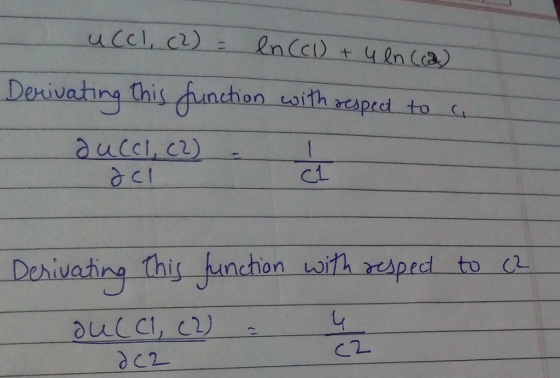
With respect to c1 it will be 1/c1
With respect to c2 it will be 4/c2.
As shown in the image below
Add Answer to:
You have the following utility function in two arguments: u(c1,
c2) = ln(c1) + 4*ln(c2)
Derive...
Which of the following utility functions have the expected utility property ?(a) u( c1,c2,pi1,pi2) =a( pi1.c1+pi2.c2)...
Which of the following utility functions have the expected utility property ?(a) u( c1,c2,pi1,pi2) =a( pi1.c1+pi2.c2) (b)u(c1,c2,pi1,pi2)= pi1c1+ pi2.(c2)^2 (c) u(c1, c2,pi1, pi2)= pi1.ln c1 + pi 2. ln c2+17
Consider the endowment economy. Jason has a utility function of uJ (c1, c2) = ln(c1) +...
Consider the endowment economy. Jason has a utility function of uJ (c1, c2) = ln(c1) + 1 2 ln(c2). Tahani has a utility function of uT (c1, c2) = min {c1, c2} . The endowments are eJ = (1, 2) and eT = (2, 1). a. Define the competitive equilibrium for this economy. b. Calculate the market clearing prices and the equilibrium allocation
Consider a generic decisionmaker with preferences for two goods, U=Ln(c1)+βLn(c2) and constraints c1= w1-s and c2=...
Consider a generic decisionmaker with preferences for two goods, U=Ln(c1)+βLn(c2) and constraints c1= w1-s and c2= w2 + (1+r)s. A. Solve the agents decision problem for savings, s=Aw1+ Bw2. (Show Work) B. What is A? C. What is B?
Mortimer lives for two period and has utility function U = C1*C2. He earns no income...
Mortimer lives for two period and has utility function U = C1*C2. He earns no income in period two and his income in period 1 is $80,000. The interest rate at which he can borrow and lend is 10%. Calculate his optimal consumption in each period.
1. Harvey Habit's utility function is U (C1, C2) = min {c1, c2}, where ci is...
 1. Harvey Habit's utility function is U (C1, C2) = min {c1, c2}, where ci is his consumption of bread in period 1 and ca is his consumption of bread in period 2. The price of bread is $1 per loaf in period 1. The interest rate is 21%. Harvey earns $2,000 in period 1 and he will earn $1,100 in period 2. (a) Write Harvey's budget constraint in terms of future value. (b) How much bread does Harvey consume...
Let the consumer’s utility function be given by U(x1,x2)=(x1-c1)α(x2-c2)1-α, where c1,c2>0 and 0<α<1. Let the prices...
Let the consumer’s utility function be given by U(x1,x2)=(x1-c1)α(x2-c2)1-α, where c1,c2>0 and 0<α<1. Let the prices of the two goods be p1 and p2 and consumer’s income be M. solve for the optimal quantity of x1 and x2
2. Consider the following four consumers (C1,C2,C3,C4) with the following utility functions: Consumer Utility Function C1...
2. Consider the following four consumers (C1,C2,C3,C4) with the following utility functions: Consumer Utility Function C1 u(x,y) = 2x+2y C2 u(x,y) = x^3/4y^1/4 C3 u(x,y) = min(x,y) C4 u(x,y) = min(4x,3y) On the appropriate graph, draw each consumer’s indifference curves through the following points: (2,2), (4,4), (6,6) and (8,8), AND label the utility level of each curve. Hint: Each grid should have 4 curves on it representing the same preferences but with different utility levels. 3. In the following parts,...
Suppose that a household has a utility function and intertemporal budget constraint as follows: U(C1,C,) - (cº:" + Bc2:...
 Suppose that a household has a utility function and intertemporal budget constraint as follows: U(C1,C,) - (cº:" + Bc2:5)1-y U(C1,C2) = - 1- ITBC: C1 + = yı + 1+1 a) Determine the marginal rate of substitution for this utility function and derive the Euler equation faced by this consumer (define the Lagrangian and then obtain first order conditions as we did it in the lecture). Explain the intuition of the Euler equation. b) Find a solution for optimal consumption...
Utility Function: U = ln (x) + ln (z) Budget Constraint: 120 = 2x + 3z...
Utility Function: U = ln (x) + ln (z) Budget Constraint: 120 = 2x + 3z (a) Find the optimal values of x and z (b) Explain in words the idea of a compensating variation for the case where the budget constraint changed to 120 = 2x + 5z Problem 4 (a) Derive the demand functions for the utility function (b) Let a = 2, b = 5, px = 1, pz = 3, and Y = 75. Find the...
1. Harvey Habit's utility function is U (C1, C2) = min {c1, c2}, where cı is his consumption of bread in period 1 and c...
 1. Harvey Habit's utility function is U (C1, C2) = min {c1, c2}, where cı is his consumption of bread in period 1 and c2 is his consumption of bread in period 2. The price of bread is $1 per loaf in period 1. The interest rate is 21%. Harvey earns $2,000 in period 1 and he will earn $1,100 in period 2. (a) Write Harvey's budget constraint in terms of future value. (b) How much bread does Harvey consume...
 1. Harvey Habit's utility function is U (C1, C2) = min {c1, c2}, where ci is his consumption of bread in period 1 and ca is his consumption of bread in period 2. The price of bread is $1 per loaf in period 1. The interest rate is 21%. Harvey earns $2,000 in period 1 and he will earn $1,100 in period 2. (a) Write Harvey's budget constraint in terms of future value. (b) How much bread does Harvey consume...
 Suppose that a household has a utility function and intertemporal budget constraint as follows: U(C1,C,) - (cº:" + Bc2:5)1-y U(C1,C2) = - 1- ITBC: C1 + = yı + 1+1 a) Determine the marginal rate of substitution for this utility function and derive the Euler equation faced by this consumer (define the Lagrangian and then obtain first order conditions as we did it in the lecture). Explain the intuition of the Euler equation. b) Find a solution for optimal consumption...
 1. Harvey Habit's utility function is U (C1, C2) = min {c1, c2}, where cı is his consumption of bread in period 1 and c2 is his consumption of bread in period 2. The price of bread is $1 per loaf in period 1. The interest rate is 21%. Harvey earns $2,000 in period 1 and he will earn $1,100 in period 2. (a) Write Harvey's budget constraint in terms of future value. (b) How much bread does Harvey consume...
Most questions answered within 3 hours.
-
Where is the error in this code sequence?
String s1 = "Hello";
String s2 = "ello";...
asked 10 months ago -
Financial data for Joel de Paris, Inc., for last year
follow:
Joel de Paris, Inc.
Balance...
asked 10 months ago -
Consider this reaction:
Al2(SO4)3 (aq)+ BaCl3
(aq) Al2Cl6 (aq)- +
3BaSO4(s) . What is the...
asked 10 months ago -
Suppose that Savneet is considering increasing her
recent random sample from 20 car rentals to 40...
asked 10 months ago -
Trucks arrive at an unloading terminal at an average rate of 120
per hour.
Trucks arrive...
asked 10 months ago -
Why are methanol and ethanol completely soluble in water while
octanol is not very little soluble....
asked 10 months ago -
A facilities manager at a university reads in a research report
that the mean amount of...
asked 10 months ago -
When the CuSO4 is rehydrated by adding water to the anhydrous
compound, is this an endothermic...
asked 10 months ago -
A ray of sunlight is passing from diamond into crown glass; the
angle of incidence is...
asked 10 months ago -
A block of mass 0.249 kg is placed on top of a light, vertical
spring of...
asked 10 months ago -
how do the kidneys compensate in the presences of acidosis
a) trigger hyperventilate
b) reserve acid...
asked 10 months ago -
Question 501 pts
The rental rate of capital to the firm increases. Which of the
following...
asked 10 months ago