Suppose you have a charged piece of tape with a net positive or net negative charge....
Suppose you have a charged piece of tape with a net positive or net negative charge.
a. What effect will a magnet have on the tape?
b. If the tape is attracted to both a magnetic rod and a non-magnetic rod in the same way, can you conclude that there is any special interaction or force between either of the magnetic poles and the tape?
c. Are magnetic attractions the same as electrostatic attractions? Explain.
Homework Answers
a) A magnet will not have any effect on the tape. The tape is stationary and static charge is not influenced by a magnet. Either the charge or the magnetic field must be in motion to have some kind of interaction between the two.
b) There is no special interaction between the tap and the magnetic poles.
c) They are not same but similar . Both the forces are inversely proportional to square of distance 1/d2 . We can have isolated +ve or -ve charges but not isolated magnetic poles. There are no magnetic mono poles either S or N.
Add Answer to:
Suppose you have a charged piece of tape with a net positive or
net negative charge....
You’d like to know the sign (positive or negative) of your piece of charged tape. How...
You’d like to know the sign (positive or negative) of your piece of charged tape. How might you determine the sign of charge on your tape? Keep in mind that neutral uncharged matter is attracted to both positive and negative charge. How do you think one would make two OPPOSITELY charged pieces of tape? Describe a process that would allow you to make two pieces of oppositely charged tapes and how you know that they would be oppositely charged.
A glass rod with a net charge of 0.443 μC and a small square of silk...
 A glass rod with a net charge of 0.443 μC and a small square of silk cloth with a net charge of-0.637 μC are separated by 12.0 cm charged objects? You may approximate both objects as point charges what is the magnitude of the attractive force between the two Enter answer here EN Common transparent tape can becomes charged when pulled from a dispenser. If two identical pieces of tape are pulled from two freshly loaded tape dispensers so that...
Common transparent tape can becomes charged when pulled from a dispenser. If two identical pieces of...
Common transparent tape can becomes charged when pulled from a dispenser. If two identical pieces of tape are pulled from two freshly loaded tape dispensers so that they have the same charge and one piece is placed above another, the repulsive force can be great enough to support the top piece’s weight. Calculate the magnitude of the charge on each piece of tape if electrostatic force is great enough to support the weight of a 6.17 mg piece of tape...
Wrap up question 1: You hold a “Top” piece of charged tape near an uncharged soda...
Wrap up question 1: You hold a “Top” piece of charged tape near an uncharged soda can. Describe the behavior of the tape. Would the behavior be different if you used a “Bottom” piece of tape instead? Explain. Wrap up question 2: Suppose there exists a third type of charge in addition to the two types we associate with glass and plastic. Call this third type X charge. What experiment(s) could you use to test whether an object has X...
A charged particle moving through a magnetic field at right angles to the field with a...
 A charged particle moving through a magnetic field at right angles to the field with a speed of 24.7 m/s experiences a magnetic force of 2.38 x 10* N. Determine the magnetic force on an identical particle when it travels through the same magnetic field with a speed of 5.44 m/s at an angle of 26.2° relative to the magnetic field. N What is the maximum force on a rod with a 0.100 C charge that you pass between the...
Will a penny be slightly more massive if it has a negative or a positive net...
 Will a penny be slightly more massive if it has a negative or a positive net charge? (Think very small!!) (a) It will be just as massive either way. (b) More massive if negative. (c) More massive if positive. A charged conducting object is brought close to a neutral insulating object. Which of the following is true? (a) The objects will repel. (b) The objects will attract. (c) Nothing will happen, no attraction, no repulsion. (d) The objects will repel...
A beam of electrons (which have negative charge) is coming straight toward you. You place a...
A beam of electrons (which have negative charge) is coming straight toward you. You place a magnet as shown directly above the beam. The magnetic field from the magnet points straight down. Which way will the electron beam deflect? ANSWER is to the LEFT, but when I do the right hand rule - I keep getting right. Please explain using the right hand rule, not mathematically
a. Predict A paper clip will be suspended from a string inside a Styrofoam cup surrounded...
a. Predict A paper clip will be suspended from a string inside a Styrofoam cup surrounded by aluminum foil. Predict what will happen to the paperclip when a charged rod is brought near the cup. b. Predict what will happen when one of the poles of the magnet is brought near the cup? c. Experimental setup Carry out the experiments described in a and b. Describe your observations. Were your predictions correct? Do you know why? d. Interpret Based on...
a) Suppose you have a thin slab of charged material. It has a positive charge uniformly...
 a) Suppose you have a thin slab of charged material. It has a positive charge uniformly distributed on it, and it is very large. Use Gauss's Law to determine the electric field around the slab. b) Repeat, but for a conducting slab that has the same surface charge density as in a), but distributed on one side of its surface. (You can assume the charges have been pulled to a single side due to a negatively charged slab placed above...
4. (10 pts.) A piece of p-type semiconductor (in which the charge carriers have a positive...
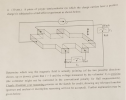 4. (10 pts.) A piece of p-type semiconductor (in which the charge carriers have a positive charge) is subjected to a Hall effect experiment as shown below: Red Black . Red Determine which way the magnetic field is actually pointing of the two possible directions shown, up or down), given that /> 0 and the voltage measured by the voltmeter VA is positive (the voltmeter might not be corrected in the conventional polarity for Hall measurements). Clearly illustrate your reasoning...
 A glass rod with a net charge of 0.443 μC and a small square of silk cloth with a net charge of-0.637 μC are separated by 12.0 cm charged objects? You may approximate both objects as point charges what is the magnitude of the attractive force between the two Enter answer here EN Common transparent tape can becomes charged when pulled from a dispenser. If two identical pieces of tape are pulled from two freshly loaded tape dispensers so that...
 A charged particle moving through a magnetic field at right angles to the field with a speed of 24.7 m/s experiences a magnetic force of 2.38 x 10* N. Determine the magnetic force on an identical particle when it travels through the same magnetic field with a speed of 5.44 m/s at an angle of 26.2° relative to the magnetic field. N What is the maximum force on a rod with a 0.100 C charge that you pass between the...
 Will a penny be slightly more massive if it has a negative or a positive net charge? (Think very small!!) (a) It will be just as massive either way. (b) More massive if negative. (c) More massive if positive. A charged conducting object is brought close to a neutral insulating object. Which of the following is true? (a) The objects will repel. (b) The objects will attract. (c) Nothing will happen, no attraction, no repulsion. (d) The objects will repel...
 a) Suppose you have a thin slab of charged material. It has a positive charge uniformly distributed on it, and it is very large. Use Gauss's Law to determine the electric field around the slab. b) Repeat, but for a conducting slab that has the same surface charge density as in a), but distributed on one side of its surface. (You can assume the charges have been pulled to a single side due to a negatively charged slab placed above...
 4. (10 pts.) A piece of p-type semiconductor (in which the charge carriers have a positive charge) is subjected to a Hall effect experiment as shown below: Red Black . Red Determine which way the magnetic field is actually pointing of the two possible directions shown, up or down), given that /> 0 and the voltage measured by the voltmeter VA is positive (the voltmeter might not be corrected in the conventional polarity for Hall measurements). Clearly illustrate your reasoning...
Most questions answered within 3 hours.
-
Where is the error in this code sequence?
String s1 = "Hello";
String s2 = "ello";...
asked 11 months ago -
Financial data for Joel de Paris, Inc., for last year
follow:
Joel de Paris, Inc.
Balance...
asked 11 months ago -
Consider this reaction:
Al2(SO4)3 (aq)+ BaCl3
(aq) Al2Cl6 (aq)- +
3BaSO4(s) . What is the...
asked 11 months ago -
Suppose that Savneet is considering increasing her
recent random sample from 20 car rentals to 40...
asked 11 months ago -
Trucks arrive at an unloading terminal at an average rate of 120
per hour.
Trucks arrive...
asked 11 months ago -
Why are methanol and ethanol completely soluble in water while
octanol is not very little soluble....
asked 11 months ago -
A facilities manager at a university reads in a research report
that the mean amount of...
asked 11 months ago -
When the CuSO4 is rehydrated by adding water to the anhydrous
compound, is this an endothermic...
asked 11 months ago -
A ray of sunlight is passing from diamond into crown glass; the
angle of incidence is...
asked 11 months ago -
A block of mass 0.249 kg is placed on top of a light, vertical
spring of...
asked 11 months ago -
how do the kidneys compensate in the presences of acidosis
a) trigger hyperventilate
b) reserve acid...
asked 11 months ago -
Question 501 pts
The rental rate of capital to the firm increases. Which of the
following...
asked 11 months ago