Describe phenomena that depend on the presence of an energy gap.
Homework Answers
CLASSIFICATIONS OF MATERIAL IS BASED ON ENERGY GAP THEORY
Based on the ability of various materials to conduct current, the materials are classified as conductors, insulators and the semiconductors.
A metal which is very good carrier of electricity is called conductor. The copper and aluminium are good examples of a conductor .
A very poor conductor of electricity is termed as insulator. The glass, wood, mica, diamond are the examples of an insulator.
A metal having conductivity which is between conductor and an insulator is called semiconductor. The silicon and germanium are the examples of a semiconductor. This does not conduct current at low temperatures but as temperature increases these materials behave as good conductors.
ENERGY BAND DIAGRAMS
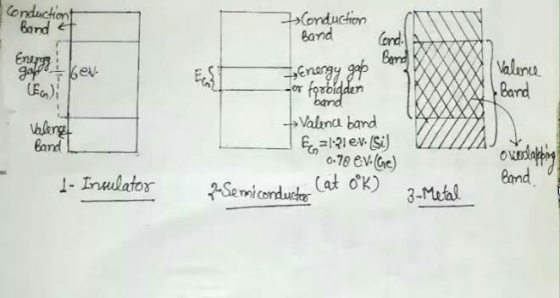
INSULATORS
In case of such insulating material, there exists a large forbidden gap in between the conduction band and the valence band.
Practically it is impossible for an electron to jump from the valence band to the conduction band.
Hence such materials cannot conduct and called insulators.
The forbidden gap is very wide, approximately of about 7 eV is present in insulators. For a diamond, which is an insulator, the forbidden gap is about 6 eV.
Such materials may conduct only at very high temperatures or if they are subjected to high voltage. Such conduction is rare and is called breakdown of an insulator.
The other insulating materials are glass, wood, mica, paper etc.
SEMICONDUCTORS
The forbidden gap in such materials is very narrow as shown in Fig. Such materials are called semiconductors.
The forbidden gap is about 1 eV.
In such materials, the energy provided by the heat at room temperature is sufficient to lift the electrons from the valence band to the conduction band.
CONDUCTORS/METALS
In the metals like copper, aluminium there is no forbidden gap between valence band and conduction band. The two bands overlap.
Hence even at room temperature, a large number of electrons are available for conduction.
So without any additional energy, such metals contain a large number of free electrons and hence called good conductors.
1. Describe the process of extracting energy from a molecule of glucose in the presence of...
 1. Describe the process of extracting energy from a molecule of glucose in the presence of oxygen via cellular respiration. Make sure to mention where in the cell the reactions involved in extracting energy from glucose are occurring and what the chemical inputs and outputs are for each of those reaction processes.
Chemistry help! Describe the following atomic phenomena as primarily a function of the potential or kinetic...
 Chemistry help!
Describe the following atomic phenomena as primarily a function of the potential or kinetic energy of the system. The attraction of a hydrogen atom's electron to oxygen in water. The repulsion of a hydrogen atom's electron from the other hydrogen electron in H_2. The collision of two molecules as they react to generate a product.
Chemistry help!
Describe the following atomic phenomena as primarily a function of the potential or kinetic energy of the system. The attraction of a hydrogen atom's electron to oxygen in water. The repulsion of a hydrogen atom's electron from the other hydrogen electron in H_2. The collision of two molecules as they react to generate a product.
14-5. Diamond has an energy gap of 5.5 eV and is transparent. Silicon has an energy gap of 1.1 eV and reflects all...
 14-5. Diamond has an energy gap of 5.5 eV and is transparent. Silicon has an energy gap of 1.1 eV and reflects all visible light, making it look much like a metal. What optical properties would you expect of an insulator with an energy gap of about 2.5 eV?
14-5. Diamond has an energy gap of 5.5 eV and is transparent. Silicon has an energy gap of 1.1 eV and reflects all visible light, making it look much like a...
14-5. Diamond has an energy gap of 5.5 eV and is transparent. Silicon has an energy gap of 1.1 eV and reflects all visible light, making it look much like a metal. What optical properties would you expect of an insulator with an energy gap of about 2.5 eV?
14-5. Diamond has an energy gap of 5.5 eV and is transparent. Silicon has an energy gap of 1.1 eV and reflects all visible light, making it look much like a...
Describe the similarities and differences in the phenomena of Luders band formation in low-carbon steels and...
Describe the similarities and differences in the phenomena of Luders band formation in low-carbon steels and tensile drawing of a polymer.
Describe two phenomena that may occur during non-equilibrium cooling on the evolution of new phases of...
Describe two phenomena that may occur during non-equilibrium cooling on the evolution of new phases of a material.
Conduction band Energy gap, Valence band The energy gap between the valence band and the conduction...
 Conduction band Energy gap, Valence band The energy gap between the valence band and the conduction band in the widely-used semiconductor gallium arsenide (GaAs) is A - 1.424 eV. Suppose that we consider a small piece of GaAs with 1020 available electrons, and use the equilibrium condition derived in the prelecture. 1) On average, how many electrons will be in the conduction band if T-282.15 K? electrons Submit 2) How many holes (the white dots in the figure) will be...
5. (io points) Describe the effects of the following phenomena in both the short run and...
 5. (io points) Describe the effects of the following phenomena in both the short run and the long run: (a) (s points) A temporary negative supply shock. 0b) (s points) A permanent negative supply shock.
Consider another element ‘Ge’. Is Energy Gap EG of ‘Ge’ larger or smaller than the Energy...
Consider another element ‘Ge’. Is Energy Gap EG of ‘Ge’ larger or smaller than the Energy Gap EG of ‘Si’
1) Describe the Keynesian prescription to cure a recessionary gap. 2) Describe the Keynesian prescription to...
1) Describe the Keynesian prescription to cure a recessionary gap. 2) Describe the Keynesian prescription to cure an inflationary gap. 3) What is the difference between discretionary & automatic fiscal policy? 4) Explain the difference between zero, incomplete, & complete crowding out. If crowding out is complete, does it call into question the effectiveness of a rise in government purchases in order to remove an economy from a recessionary gap?
Describe how the presence of possible outliers might be identified on the following. (a) histograms higher...
 Describe how the presence of possible outliers might be identified on the following. (a) histograms higher center bar than surrounding bars gap between the first bar and the rest of bars or between the last bar and the rest of bars gap around the center of the histogram O large group of bars to the left or right of a gap higher far left or right bar than surrounding bars (b) dotplots large groups of data to the left or...
 1. Describe the process of extracting energy from a molecule of glucose in the presence of oxygen via cellular respiration. Make sure to mention where in the cell the reactions involved in extracting energy from glucose are occurring and what the chemical inputs and outputs are for each of those reaction processes.
 Chemistry help!
Describe the following atomic phenomena as primarily a function of the potential or kinetic energy of the system. The attraction of a hydrogen atom's electron to oxygen in water. The repulsion of a hydrogen atom's electron from the other hydrogen electron in H_2. The collision of two molecules as they react to generate a product.
Chemistry help!
Describe the following atomic phenomena as primarily a function of the potential or kinetic energy of the system. The attraction of a hydrogen atom's electron to oxygen in water. The repulsion of a hydrogen atom's electron from the other hydrogen electron in H_2. The collision of two molecules as they react to generate a product.
 14-5. Diamond has an energy gap of 5.5 eV and is transparent. Silicon has an energy gap of 1.1 eV and reflects all visible light, making it look much like a metal. What optical properties would you expect of an insulator with an energy gap of about 2.5 eV?
14-5. Diamond has an energy gap of 5.5 eV and is transparent. Silicon has an energy gap of 1.1 eV and reflects all visible light, making it look much like a...
14-5. Diamond has an energy gap of 5.5 eV and is transparent. Silicon has an energy gap of 1.1 eV and reflects all visible light, making it look much like a metal. What optical properties would you expect of an insulator with an energy gap of about 2.5 eV?
14-5. Diamond has an energy gap of 5.5 eV and is transparent. Silicon has an energy gap of 1.1 eV and reflects all visible light, making it look much like a...
 Conduction band Energy gap, Valence band The energy gap between the valence band and the conduction band in the widely-used semiconductor gallium arsenide (GaAs) is A - 1.424 eV. Suppose that we consider a small piece of GaAs with 1020 available electrons, and use the equilibrium condition derived in the prelecture. 1) On average, how many electrons will be in the conduction band if T-282.15 K? electrons Submit 2) How many holes (the white dots in the figure) will be...
 5. (io points) Describe the effects of the following phenomena in both the short run and the long run: (a) (s points) A temporary negative supply shock. 0b) (s points) A permanent negative supply shock.
 Describe how the presence of possible outliers might be identified on the following. (a) histograms higher center bar than surrounding bars gap between the first bar and the rest of bars or between the last bar and the rest of bars gap around the center of the histogram O large group of bars to the left or right of a gap higher far left or right bar than surrounding bars (b) dotplots large groups of data to the left or...
Most questions answered within 3 hours.
-
Where is the error in this code sequence?
String s1 = "Hello";
String s2 = "ello";...
asked 10 months ago -
Financial data for Joel de Paris, Inc., for last year
follow:
Joel de Paris, Inc.
Balance...
asked 10 months ago -
Consider this reaction:
Al2(SO4)3 (aq)+ BaCl3
(aq) Al2Cl6 (aq)- +
3BaSO4(s) . What is the...
asked 10 months ago -
Suppose that Savneet is considering increasing her
recent random sample from 20 car rentals to 40...
asked 10 months ago -
Trucks arrive at an unloading terminal at an average rate of 120
per hour.
Trucks arrive...
asked 10 months ago -
Why are methanol and ethanol completely soluble in water while
octanol is not very little soluble....
asked 10 months ago -
A facilities manager at a university reads in a research report
that the mean amount of...
asked 10 months ago -
When the CuSO4 is rehydrated by adding water to the anhydrous
compound, is this an endothermic...
asked 10 months ago -
A ray of sunlight is passing from diamond into crown glass; the
angle of incidence is...
asked 10 months ago -
A block of mass 0.249 kg is placed on top of a light, vertical
spring of...
asked 10 months ago -
how do the kidneys compensate in the presences of acidosis
a) trigger hyperventilate
b) reserve acid...
asked 10 months ago -
Question 501 pts
The rental rate of capital to the firm increases. Which of the
following...
asked 10 months ago