Write a function occupy(n), which shows how birds are going to occupy n nests, assuming that...
Write a function occupy(n), which shows how birds are going to occupy n nests, assuming that each new bird will choose the nest in the middle of the largest unoccupied run of nests.For example, if there were 10 nests, occupy(10) would print out the following sequence, where underscore indicates an unoccupied nest, and X indicates an occupied nest. The first line of the printout is just 10 underscores showing that all the nests are unoccupied. The second line shows that a bird came to nest in position 5, since that is one the first middle positions of the unoccupied run from 0 to 9. In the third line a bird came to occupy the middle position for the longest open run of nests, from 0 to index 4.
_ _ _ _ _ _ _ _ _ _
_ _ _ _ _ X_ _ _ _
_ _ X _ _ X _ _ _ _
_ _X _ _ X _ _ X _
and so on until
XXXXXXXXXX
programming language: python
Homework Answers
Here is the completed code for this problem. Comments are included, go through it, learn how things work and let me know if you have any doubts or if you need anything to change. If you are satisfied with the solution, please rate the answer. Thanks
Note: Please maintain proper code spacing (indentation), just copy the code part and paste it in your compiler/IDE directly, no modifications required.
Note: There are different approaches to solve this problem, and you have to understand that after a few steps, the process of finding middle free position become irrelevant as there will be a lot of spaces (obviously shorter run of nests) with same possibility of placing the next bird. So whatever algorithm we use, only the first few placements will be relevant. If you have any unit testing code or if you expect a specific set of sequences from start to end, just let me know.
#code
''' required method '''
def occupy(n):
    #creating a list of n number of underscores
    nests=['_']*n
    #creating a list of n number of 'X' chars
    target=['X']*n
    #printing initial status of nests (underscores separated by space)
    print(' '.join(nests))
    #recording first and last indices
    front=0
    rear=n-1
    #creating another list, to act like a queue, adding a tuple containing front and
    #rear indices
    queue=[(front,rear)]
    #loops until nests become all 'X's
    while nests!=target:
        #removing first element from queue, into front and rear variables
        front,rear=queue.pop(0)
        #finding number of elements between front and rear
        count=rear-front+1
        #if count is event, finding index of middle right element as the mid index
        if count % 2 == 0:
            mid = (front+rear)//2 +1
        #otherwise, middle of front and rear as mid index
        else:
            mid = (front+rear)//2
        #if the position is already filled by an 'X', moving to next iteration
        #skipping further steps
        if nests[mid]=='X':
            continue
        #otherwise assigning 'X' to mid pos
        nests[mid]='X'
        #printing status of nests
        print(' '.join(nests))
        #appending a tuple containing front and mid-1 indices to queue
        queue.append((front,mid-1))
        # appending a tuple containing mid+1 and rear indices to queue
        queue.append((mid + 1, rear))


#testing
occupy(10)
#OUTPUT
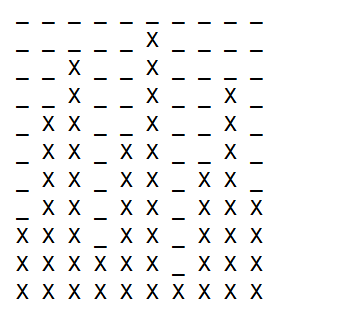
Add Answer to:
Write a function occupy(n), which shows how birds are going to
occupy n nests, assuming that...
JAVA PROGRAMMING It is a well-researched fact that men in a restroom generally prefer to maximize...
JAVA PROGRAMMING It is a well-researched fact that men in a restroom generally prefer to maximize their distance from already occupied stalls, by occupying the middle of the longest sequence of unoccupied places. For example, consider the situation where ten stalls are empty. _ _ _ _ _ _ _ _ _ _ The first visitor will occupy a middle position: _ _ _ _ _ X _ _ _ _ The next visitor will be in the middle...
I need help with java It is a well-researched fact that men in a restroom generally...
I need help with java It is a well-researched fact that men in a restroom generally prefer to maximize their distance from already occupied stalls, by occupying the middle of the longest sequence of unoccupied places. For example, consider the situation where ten stalls are empty. __________ The first visitor will occupy a middle position: _____X____ The next visitor will be in the middle of the empty area at the left. __X__X____ Write a program that reads the number of...
Most questions answered within 3 hours.
-
Where is the error in this code sequence?
String s1 = "Hello";
String s2 = "ello";...
asked 10 months ago -
Financial data for Joel de Paris, Inc., for last year
follow:
Joel de Paris, Inc.
Balance...
asked 10 months ago -
Consider this reaction:
Al2(SO4)3 (aq)+ BaCl3
(aq) Al2Cl6 (aq)- +
3BaSO4(s) . What is the...
asked 10 months ago -
Suppose that Savneet is considering increasing her
recent random sample from 20 car rentals to 40...
asked 10 months ago -
Trucks arrive at an unloading terminal at an average rate of 120
per hour.
Trucks arrive...
asked 10 months ago -
Why are methanol and ethanol completely soluble in water while
octanol is not very little soluble....
asked 10 months ago -
A facilities manager at a university reads in a research report
that the mean amount of...
asked 10 months ago -
When the CuSO4 is rehydrated by adding water to the anhydrous
compound, is this an endothermic...
asked 10 months ago -
A ray of sunlight is passing from diamond into crown glass; the
angle of incidence is...
asked 10 months ago -
A block of mass 0.249 kg is placed on top of a light, vertical
spring of...
asked 10 months ago -
how do the kidneys compensate in the presences of acidosis
a) trigger hyperventilate
b) reserve acid...
asked 10 months ago -
Question 501 pts
The rental rate of capital to the firm increases. Which of the
following...
asked 10 months ago