For CH4 y CCl4, Find the substance that will evaporate more quickly based on intermolecular forces....
Homework Answers
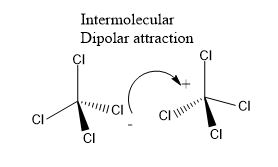
CCl4 has strong intermolecular dipolar interactions . This is generated by induced dipoles contributed by cl atoms . Thus , CCl4 cannot evaporate quickly .
On the other hand , CH4 has carbon and hydrogen , none of these are known for good dipoles . Thus CH4 has respectively quick evaporation process .
Add Answer to:
For
CH4 y CCl4, Find the substance that will evaporate more quickly
based on intermolecular forces....
Based on the predominant intermolecular forces, identify if the following should be soluble or insoluble. CCl4...
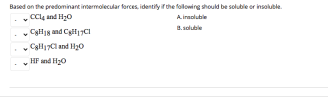 Based on the predominant intermolecular forces, identify if the following should be soluble or insoluble. CCl4 and H20 A. insoluble CgH18 and C3H17C1 B. soluble CgH17Cl and H20 V HF and H20
Classify each substance based on the intermolecular forces present in that substance.
Classify each substance based on the intermolecular forces present in that substance. Hydrogen bonding, dipole-dipole, and dispersion Dipole-dipole and dispersion only . Dispersion only Answer Bank HF CO2 CO CH3CI
Classify each substance based on the intermolecular forces present in that substance. Dispersion only Dipole-dipole and...
 Classify each substance based on the intermolecular forces present in that substance. Dispersion only Dipole-dipole and dispersion only Hydrogen bonding, dipole-dipole, and dispersion Answer Bank CH,C H2o CH co Match each property of a liquid to what it indicates about the relative strength of the intermolecular forces in that liquid. Weak intermolecular forces Strong intermolecular forces high surface tension high vapor pressure high boiling point high viscosity Answer Bank
Classify each substance based on the intermolecular forces present in that substance. Hydrogen bonding, dipole-dipole, and...
 Classify each substance based on the intermolecular forces present in that substance. Hydrogen bonding, dipole-dipole, and dispersion Dipole dipole and dispersion only Dispersion only Answer Bank CH.
Classify each substance based on the intermolecular forces present in that substance. Hydrogen bonding, dipole-dipole, and...
Classify each substance based on the intermolecular forces present in that substance. Hydrogen bonding, dipole-dipole, and dispersion Dipole-dipole and dispersion only Dispersion only Answer Bank CH3CI ΝΗ3 H2 CO
Classify each substance based on the intermolecular forces present in that substance. Dipole-dipole and dispersion only...
 Classify each substance based on the intermolecular forces present in that substance. Dipole-dipole and dispersion only Dispersion only Hydrogen bonding, dipole-dipole, and dispersion Answer Bank | Ha Ho | CH | CO .
What are the strongest intermolecular forces for mercury? What are the strongest intermolecular forces for water?...
What are the strongest intermolecular forces for mercury? What are the strongest intermolecular forces for water? Based on the shape of the meniscus, which substance is more attracted to the glass? Since "like attracts like", do you think the glass is made from a polar or nonpolar substance?
What Intermolecular Forces act on the following: O2 CH4 C2H5OH
What Intermolecular Forces act on the following: O2 CH4 C2H5OH
rank based on decreasing boiling point and explain briefly based on all types of intermolecular forces...
 rank based on decreasing boiling point and explain
briefly based on all types of intermolecular forces that appear in
each substance
CH3CH Br CH3CH CH Br CH CHF CH3CH2CH2OH IT 1.11
rank based on decreasing boiling point and explain
briefly based on all types of intermolecular forces that appear in
each substance
CH3CH Br CH3CH CH Br CH CHF CH3CH2CH2OH IT 1.11
Explain (based on intermolecular forces) why salicylic acid (structure at right; pKa = 3.0) is more...
Explain (based on intermolecular forces) why salicylic acid (structure at right; pKa = 3.0) is more soluble at pH 6.0 than at pH 2.0.
 Based on the predominant intermolecular forces, identify if the following should be soluble or insoluble. CCl4 and H20 A. insoluble CgH18 and C3H17C1 B. soluble CgH17Cl and H20 V HF and H20
 Classify each substance based on the intermolecular forces present in that substance. Dispersion only Dipole-dipole and dispersion only Hydrogen bonding, dipole-dipole, and dispersion Answer Bank CH,C H2o CH co Match each property of a liquid to what it indicates about the relative strength of the intermolecular forces in that liquid. Weak intermolecular forces Strong intermolecular forces high surface tension high vapor pressure high boiling point high viscosity Answer Bank
 Classify each substance based on the intermolecular forces present in that substance. Hydrogen bonding, dipole-dipole, and dispersion Dipole dipole and dispersion only Dispersion only Answer Bank CH.
 Classify each substance based on the intermolecular forces present in that substance. Dipole-dipole and dispersion only Dispersion only Hydrogen bonding, dipole-dipole, and dispersion Answer Bank | Ha Ho | CH | CO .
 rank based on decreasing boiling point and explain
briefly based on all types of intermolecular forces that appear in
each substance
CH3CH Br CH3CH CH Br CH CHF CH3CH2CH2OH IT 1.11
rank based on decreasing boiling point and explain
briefly based on all types of intermolecular forces that appear in
each substance
CH3CH Br CH3CH CH Br CH CHF CH3CH2CH2OH IT 1.11
Most questions answered within 3 hours.
-
Where is the error in this code sequence?
String s1 = "Hello";
String s2 = "ello";...
asked 10 months ago -
Financial data for Joel de Paris, Inc., for last year
follow:
Joel de Paris, Inc.
Balance...
asked 10 months ago -
Consider this reaction:
Al2(SO4)3 (aq)+ BaCl3
(aq) Al2Cl6 (aq)- +
3BaSO4(s) . What is the...
asked 10 months ago -
Suppose that Savneet is considering increasing her
recent random sample from 20 car rentals to 40...
asked 10 months ago -
Trucks arrive at an unloading terminal at an average rate of 120
per hour.
Trucks arrive...
asked 10 months ago -
Why are methanol and ethanol completely soluble in water while
octanol is not very little soluble....
asked 10 months ago -
A facilities manager at a university reads in a research report
that the mean amount of...
asked 10 months ago -
When the CuSO4 is rehydrated by adding water to the anhydrous
compound, is this an endothermic...
asked 10 months ago -
A ray of sunlight is passing from diamond into crown glass; the
angle of incidence is...
asked 10 months ago -
A block of mass 0.249 kg is placed on top of a light, vertical
spring of...
asked 10 months ago -
how do the kidneys compensate in the presences of acidosis
a) trigger hyperventilate
b) reserve acid...
asked 10 months ago -
Question 501 pts
The rental rate of capital to the firm increases. Which of the
following...
asked 10 months ago