Physics Assignment Questions 1. A 180 kg car drags a 500 kg sled. The car exerts...
Physics Assignment Questions
1. A 180 kg car drags a 500 kg sled. The car exerts a horizontal
force of 4010 N against the ground in order to accelerate.
The kinetic coefficient of friction for the sled is 0.285.
a) What force does the car exert on the sled?
b) What is the acceleration of the car and sled?
2. Calculate the acceleration of a skier heading down a 12.3° slope, assuming the coefficient of friction for waxed wood on wet snow. Using published value of coefficient.
Find the angle of the slope down which this skier could coast at a constant velocity. You can neglect air resistance in both parts, and you will find the result of Exercise 5.1 to be useful. Explicitly show how you follow the steps in the Problem-Solving Strategies.
3. Calculate the deceleration of a snow boarder going up a 10.9°, slope assuming the coefficient of friction for waxed wood on wet snow.
4. A nylon string has a diameter of 2.00 mm, and an unstretched
length of 34.5 cm.
The string is stretched with a force of 300 N.
What is the new length of the string?
5. A 4.00 meter cord stretches 6.03 mm when pulled with a force
of 550 N.
The diameter of the cord is 1.50 cm.
Determine Young’s Modulus (Y) for this cord.
6. A Race car tires are designed to have high values for the
coefficient of static friction.
A 900 kg race car starts at rest and travels a distance of 900
meters in 10.55 seconds.
Calculate the minimum value of static friction the car tires would
need.
(assume constant acceleration and ignore drag and downforce)
Homework Answers

Add Answer to:
Physics Assignment Questions
1. A 180 kg car drags a 500 kg sled. The car exerts...
A 900-kg race car can drive around an unbanked turn at a maximum speed of 42...
A 900-kg race car can drive around an unbanked turn at a maximum speed of 42 m/s without slipping. The turn has a radius of 170 m. Air flowing over the car's wing exerts a downward-pointing force (called the downforce) of 10000 N on the car. (a) What is the coefficient of static friction between the track and the car's tires? (b) What would be the maximum speed if no downforce acted on the car?
A 960-kg race car can drive around an unbanked turn at a maximum speed of 45...
A 960-kg race car can drive around an unbanked turn at a maximum speed of 45 m/s without slipping. The turn has a radius of 160 m. Air flowing over the car's wing exerts a downward-pointing force (called the downforce) of 13000 N on the car. (a) What is the coefficient of static friction between the track and the car's tires? (b) What would be the maximum speed if no downforce acted on the car?
A 810-kg race car can drive around an unbanked turn at a maximum speed of 40...
 A 810-kg race car can drive around an unbanked turn at a maximum speed of 40 m/s without slipping. The turn has a radius of 120 m. Air flowing over the car's wing exerts a downward-pointing force (called the downforce) of 9200 N on the car. What is the coefficient of static friction between the track and the car's tires? What would be the maximum speed if no downforce acted on the car?
A 860-kg race car can drive around an unbanked turn at a maximum speed of 44...
A 860-kg race car can drive around an unbanked turn at a maximum speed of 44 m/s without slipping. The turn has a radius of 140 m. Air flowing over the car's wing exerts a downward-pointing force (called the downforce) of 11000 N on the car. (a) What is the coefficient of static friction between the track and the car's tires? (b) What would be the maximum speed if no downforce acted on the car?
A 780-kg race car can drive around an unbanked turn at a maximum speed of 42...
A 780-kg race car can drive around an unbanked turn at a maximum speed of 42 m/s without slipping. The turn has a radius of 190 m. Air flowing over the car's wing exerts a downward-pointing force (called the downforce) of 11000 N on the car. (a) What is the coefficient of static friction between the track and the car's tires? (b) What would be the maximum speed if no downforce acted on the car?
A 5.0 kg penguin sits on top of a 12 kg sled, as in the figure....
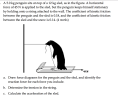 A 5.0 kg penguin sits on top of a 12 kg sled, as in the figure. A horizontal force of 45 N is applied to the sled, but the penguin keeps himself stationary by holding onto a string attached to the wall. The coefficient of kinetic friction between the penguin and the sled is 0.18, and the coefficient of kinetic friction between the sled and the snow is 0.14. (4 marks) 45N Draw force diagrams for the penguin and the...
A team of eight dogs pulls a sled with waxed wood runners on wet snow (mush!)....
A team of eight dogs pulls a sled with waxed wood runners on wet snow (mush!). The dogs have average masses of 19.0 kg, and the loaded sled with its rider has a mass of 210 kg. (a) Calculate the acceleration of the dogs starting from rest if each dog exerts an average force of 185 N backward on the snow. (b) Calculate the force in the coupling between the dogs and the sled.( Correct Answers 3.68 m/s2 and 1330N...
The mass of the child with the sled is 25 kg and the magnitude of the...
The mass of the child with the sled is 25 kg and the magnitude of the push on the child is 45 N acting to the left. The coefficient of kinetic friction between the sled and the snow, mk = 0.15. The magnitude of the friction force is _____N The net force acting on the child-sled system is _____ What will be the ACCELERATION of the sled shown below? _____ m/s2
A 950-kg race car can drive around an unbanked turn at a maximum speed of 44...
A 950-kg race car can drive around an unbanked turn at a maximum speed of 44 m/s without slipping. The turn has a radius of 140 m. Air flowing over the car's wing exerts a downward-pointing force (called the downforce) of 12000 N on the car. (a) What is the coefficient of static friction between the track and the car's tires? (b) What would be the maximum speed if no downforce acted on the car? Refer to Interactive Solution 6.59...
1. A person exerts a horizontal force of 125 N on a crate with a mass...
 1. A person exerts a horizontal force of 125 N on a crate with a mass of 30.0 kg. a. If the crate doesn't move, what's the magnitude of the static friction force? b. What is the minimum possible value of the coefficient of static friction between the crate and the floor? 2. A horse is hamessed to a sled having a mass of 236 kg, including supplies. The horse must exert a force exceeding 1.240 N at an angle...
 A 810-kg race car can drive around an unbanked turn at a maximum speed of 40 m/s without slipping. The turn has a radius of 120 m. Air flowing over the car's wing exerts a downward-pointing force (called the downforce) of 9200 N on the car. What is the coefficient of static friction between the track and the car's tires? What would be the maximum speed if no downforce acted on the car?
 A 5.0 kg penguin sits on top of a 12 kg sled, as in the figure. A horizontal force of 45 N is applied to the sled, but the penguin keeps himself stationary by holding onto a string attached to the wall. The coefficient of kinetic friction between the penguin and the sled is 0.18, and the coefficient of kinetic friction between the sled and the snow is 0.14. (4 marks) 45N Draw force diagrams for the penguin and the...
 1. A person exerts a horizontal force of 125 N on a crate with a mass of 30.0 kg. a. If the crate doesn't move, what's the magnitude of the static friction force? b. What is the minimum possible value of the coefficient of static friction between the crate and the floor? 2. A horse is hamessed to a sled having a mass of 236 kg, including supplies. The horse must exert a force exceeding 1.240 N at an angle...
Most questions answered within 3 hours.
-
Where is the error in this code sequence?
String s1 = "Hello";
String s2 = "ello";...
asked 10 months ago -
Financial data for Joel de Paris, Inc., for last year
follow:
Joel de Paris, Inc.
Balance...
asked 10 months ago -
Consider this reaction:
Al2(SO4)3 (aq)+ BaCl3
(aq) Al2Cl6 (aq)- +
3BaSO4(s) . What is the...
asked 10 months ago -
Suppose that Savneet is considering increasing her
recent random sample from 20 car rentals to 40...
asked 10 months ago -
Trucks arrive at an unloading terminal at an average rate of 120
per hour.
Trucks arrive...
asked 10 months ago -
Why are methanol and ethanol completely soluble in water while
octanol is not very little soluble....
asked 10 months ago -
A facilities manager at a university reads in a research report
that the mean amount of...
asked 10 months ago -
When the CuSO4 is rehydrated by adding water to the anhydrous
compound, is this an endothermic...
asked 10 months ago -
A ray of sunlight is passing from diamond into crown glass; the
angle of incidence is...
asked 10 months ago -
A block of mass 0.249 kg is placed on top of a light, vertical
spring of...
asked 10 months ago -
how do the kidneys compensate in the presences of acidosis
a) trigger hyperventilate
b) reserve acid...
asked 10 months ago -
Question 501 pts
The rental rate of capital to the firm increases. Which of the
following...
asked 10 months ago