Solve the following recurrence by giving the tightest bound possible. T(n) = 4T(n/4) + 4n
Solve the following recurrence by giving the tightest bound possible. T(n) = 4T(n/4) + 4n
Homework Answers
T(n) = 4T(n/4) + 4n
Master Theorem:
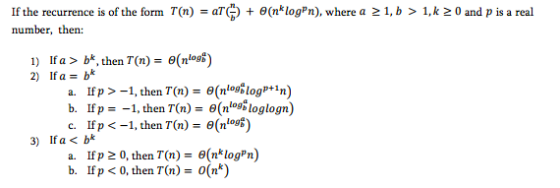
As per Master Theorem,
a = 4, b = 4, k = 1 and p = 0
Clearly, a = bk and p > -1, hence
T(n) = Θ(nlog44 * log n) = Θ(n log n)
Add Answer to:
Solve the following recurrence by giving the tightest bound
possible. T(n) = 4T(n/4) + 4n
Solve the recurrence relations: T(n) = 4T(n/2)+1 when n>2 and T(n) = 1 when n =...
Solve the recurrence relations: T(n) = 4T(n/2)+1 when n>2 and T(n) = 1 when n = 2. T(n) = 4T(n/4)+1 when n>4 and T(n) = 1 when n = 4
T(n) = aT(n/b)+O(nd) T(n) = 4T(n/2) + 5nlogn a = 4, b = 2, d =...
 T(n) = aT(n/b)+O(nd)
T(n) = 4T(n/2) + 5nlogn
a = 4, b = 2, d = ? <----I don't know how to find
d
If d > logba, then T(n) = O(nd)
If d = logba, then T(n) = O(nd logn)
If d < logba, then T(n) =
O(nlogba)
Question 5 What is the tightest bound the Master Theorem can put on this recurrence relation? T(n) 4 T(n/2) 5n log n O O 1.1 O o(n2 og n o(n2) O(n)...
T(n) = aT(n/b)+O(nd)
T(n) = 4T(n/2) + 5nlogn
a = 4, b = 2, d = ? <----I don't know how to find
d
If d > logba, then T(n) = O(nd)
If d = logba, then T(n) = O(nd logn)
If d < logba, then T(n) =
O(nlogba)
Question 5 What is the tightest bound the Master Theorem can put on this recurrence relation? T(n) 4 T(n/2) 5n log n O O 1.1 O o(n2 og n o(n2) O(n)...
Let T(1) = 2, T(n) = 4T(n/2) + 2n use subsition to solve this recurrence problem.
Let T(1) = 2, T(n) = 4T(n/2) + 2n use subsition to solve this recurrence problem.
Solve the following recurrence relations and give a Θ bound for each of them. (a) T(n)...
Solve the following recurrence relations and give a Θ bound for each of them. (a) T(n) = T(n − 1) + 2n (assume T(0) = 0) (b) T(n) = 2T(n − 1) + c (assume T(0) = 0) (c) T(n) = 2T(n/3) + n (assume T(1) = 1)
Solve the recurrence relation T(n)=T(n1/2)+1 and give a Θ bound. Assume that T (n) is constant for sufficiently small n....
Solve the recurrence relation T(n)=T(n1/2)+1 and give a Θ bound. Assume that T (n) is constant for sufficiently small n. Can you show a verification of the recurrence relation? I've not been able to solve the verification part so far note: n1/2 is square root(n)
Compute the recurrence relation, T(n), for the following function, solve it, and give a e bound....
 Compute the recurrence relation, T(n), for the following function, solve it, and give a e bound. Justify your answer public static double myPower(double r, int n) if (n1){ return 1 } else if (n % 2 == 0) { double tmp myPower (r, n/2); return tmp tmp; } else{ myPower (r, (n 1)/2); return }
1Recurrences. a)Solve the following recurrence. You may assume any convenient form for n. T(1) = 0....
1Recurrences. a)Solve the following recurrence. You may assume any convenient form for n. T(1) = 0. T(n) = T(n/2)+1, n>1 b)Consider the following recurrence relation: T(1) = 4 T(n) = T(n-1) +4 Argue using mathematical induction that T(n) = 4n Note that you must induction to establish the solution.
Consider the recurrence T (n) = T (⌈n/4⌉) + T (⌈n/3⌉) + n with T (1)...
Consider the recurrence T (n) = T (⌈n/4⌉) + T (⌈n/3⌉) + n with T (1) = 1. 12 points (a) (4 Points) Using a recursion tree, determine a tight asymptotic upper bound on T(n). (b) (4 Points) Prove your upper bound using induction. (c) (4 Points) Using a suitable variable change, solve the recurrence U (n) = 3U (⌈n^(1/3) ⌉) + 7 with U(2) = 1.
draw the first 3 levels of a recursion tree for the recurrence T(n) = 4T(n/2) +...
draw the first 3 levels of a recursion tree for the recurrence T(n) = 4T(n/2) + n. How many levels does it have? Find a summation for the running time and solve for it.
From the code below with Binary Search Tree recurrence T(n)=? use the recursion method and substitution method to solve the recurrence. Find the tightest bound g(n) for T(n) you can for which T(n)= O(...
 From the code below with Binary Search Tree recurrence T(n)=?
use the recursion method and substitution method to solve the
recurrence. Find the tightest bound g(n) for T(n) you can for which
T(n)= O(g(n)). Explain your answer and use recursion tree
method.
void insert(int data) {
struct node *tempNode = (struct node*) malloc(sizeof(struct node));
struct node *current;
struct node *parent;
tempNode->data = data;
tempNode->leftChild = NULL;
tempNode->rightChild = NULL;
//if tree is empty
if(root == NULL) {
root = tempNode;...
From the code below with Binary Search Tree recurrence T(n)=?
use the recursion method and substitution method to solve the
recurrence. Find the tightest bound g(n) for T(n) you can for which
T(n)= O(g(n)). Explain your answer and use recursion tree
method.
void insert(int data) {
struct node *tempNode = (struct node*) malloc(sizeof(struct node));
struct node *current;
struct node *parent;
tempNode->data = data;
tempNode->leftChild = NULL;
tempNode->rightChild = NULL;
//if tree is empty
if(root == NULL) {
root = tempNode;...
 T(n) = aT(n/b)+O(nd)
T(n) = 4T(n/2) + 5nlogn
a = 4, b = 2, d = ? <----I don't know how to find
d
If d > logba, then T(n) = O(nd)
If d = logba, then T(n) = O(nd logn)
If d < logba, then T(n) =
O(nlogba)
Question 5 What is the tightest bound the Master Theorem can put on this recurrence relation? T(n) 4 T(n/2) 5n log n O O 1.1 O o(n2 og n o(n2) O(n)...
T(n) = aT(n/b)+O(nd)
T(n) = 4T(n/2) + 5nlogn
a = 4, b = 2, d = ? <----I don't know how to find
d
If d > logba, then T(n) = O(nd)
If d = logba, then T(n) = O(nd logn)
If d < logba, then T(n) =
O(nlogba)
Question 5 What is the tightest bound the Master Theorem can put on this recurrence relation? T(n) 4 T(n/2) 5n log n O O 1.1 O o(n2 og n o(n2) O(n)...
 Compute the recurrence relation, T(n), for the following function, solve it, and give a e bound. Justify your answer public static double myPower(double r, int n) if (n1){ return 1 } else if (n % 2 == 0) { double tmp myPower (r, n/2); return tmp tmp; } else{ myPower (r, (n 1)/2); return }
 From the code below with Binary Search Tree recurrence T(n)=?
use the recursion method and substitution method to solve the
recurrence. Find the tightest bound g(n) for T(n) you can for which
T(n)= O(g(n)). Explain your answer and use recursion tree
method.
void insert(int data) {
struct node *tempNode = (struct node*) malloc(sizeof(struct node));
struct node *current;
struct node *parent;
tempNode->data = data;
tempNode->leftChild = NULL;
tempNode->rightChild = NULL;
//if tree is empty
if(root == NULL) {
root = tempNode;...
From the code below with Binary Search Tree recurrence T(n)=?
use the recursion method and substitution method to solve the
recurrence. Find the tightest bound g(n) for T(n) you can for which
T(n)= O(g(n)). Explain your answer and use recursion tree
method.
void insert(int data) {
struct node *tempNode = (struct node*) malloc(sizeof(struct node));
struct node *current;
struct node *parent;
tempNode->data = data;
tempNode->leftChild = NULL;
tempNode->rightChild = NULL;
//if tree is empty
if(root == NULL) {
root = tempNode;...
Most questions answered within 3 hours.
-
Where is the error in this code sequence?
String s1 = "Hello";
String s2 = "ello";...
asked 10 months ago -
Financial data for Joel de Paris, Inc., for last year
follow:
Joel de Paris, Inc.
Balance...
asked 10 months ago -
Consider this reaction:
Al2(SO4)3 (aq)+ BaCl3
(aq) Al2Cl6 (aq)- +
3BaSO4(s) . What is the...
asked 10 months ago -
Suppose that Savneet is considering increasing her
recent random sample from 20 car rentals to 40...
asked 10 months ago -
Trucks arrive at an unloading terminal at an average rate of 120
per hour.
Trucks arrive...
asked 10 months ago -
Why are methanol and ethanol completely soluble in water while
octanol is not very little soluble....
asked 10 months ago -
A facilities manager at a university reads in a research report
that the mean amount of...
asked 10 months ago -
When the CuSO4 is rehydrated by adding water to the anhydrous
compound, is this an endothermic...
asked 10 months ago -
A ray of sunlight is passing from diamond into crown glass; the
angle of incidence is...
asked 10 months ago -
A block of mass 0.249 kg is placed on top of a light, vertical
spring of...
asked 10 months ago -
how do the kidneys compensate in the presences of acidosis
a) trigger hyperventilate
b) reserve acid...
asked 10 months ago -
Question 501 pts
The rental rate of capital to the firm increases. Which of the
following...
asked 10 months ago