Dr. Yuan opens a lab. The lab has an initial cost of $100,000. Expected net cash...
Dr. Yuan opens a lab. The lab has an initial cost of $100,000. Expected net cash flow is $24,000 in the first year, growing by 15% per year. Net cash flow is revenue less expenses. Assume the lab has a 6 year life and there is no scrap value for the lab. Assume instead that Dr. Yuan forms a partnership with Dr. Bhat. They agree to share the $100,000 cost equally and to share the cash flow equally. Because of efficiency gains from longer operating hours, they expect the net cash flow to be $32,000 per year. Assume they expect net cash flow to grow at 15% per year.
What is the consequence of the partnership to Dr. Yuan? Please compare the results to the original scenario described (Dr. Yan opening the only lab in the area).
a) The NPV decreases, but is still positive. Dr. Yuan can still expect a positive return on her investment.
b) The NPV decreases, and becomes negative. Dr. Yuan should expect a loss on this investment.
c) The IRR decreases, but is still positive. Dr. Yuan can still expect a positive return on her investment.
d) The IRR and the NPV increase. Dr. Yuan can still expect a positive return on her investment.
e) The IRR and the NPV decrease. Dr. Yuan should expect a negative return on her investment.
Homework Answers
Ans. D. The IRR and NPV increases. Dr.Yuan can still expect a positive return on her investment. - This is the correct option.
Best of Luck !! Keep Chegging !!
Add Answer to:
Dr. Yuan opens a lab. The lab has an initial cost of $100,000.
Expected net cash...
USLUHOPO Do Yuan opens a lab. The lab has an initial cost of $100.000 Expected net...
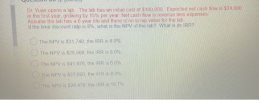 USLUHOPO Do Yuan opens a lab. The lab has an initial cost of $100.000 Expected net cash flow is $24,000 in the first year growing by 15% per year Net cash flow is revenue less expenses Assume the lab has a 6 year life and there is no scrap value for the lab! If the time discount rate is 8%, what is the NPV of the lab? What is its IRR? The NPV is $31,740, the IRR IS 60% The...
you are considering a project with an initial cash outlay of $100,000 and expected free cash...
you are considering a project with an initial cash outlay of $100,000 and expected free cash flow of $50,000 at the end of each year for 3 years. the required rate of return for this project is 10 percent. a. What is the project's conventional payback periods? b. What is the project's discounted payback period? c. what is the project's NPV? d. what is the project's PI? e. what is the project's IRR?
A project requires an initial investment of $100,000 and is expected to produce a cash inflow...
 A project requires an initial investment of $100,000 and is expected to produce a cash inflow before tax of $27,500 per year for five years. Company A has substantial accumulated tax losses and is unlikely to pay taxes in the foreseeable future. Company B pays corporate taxes at a rate of 21% and can claim 100% bonus depreciation on the investment. Suppose the opportunity cost of capital is 10%. Ignore inflation. a. Calculate project NPV for each company. (Do not...
A project requires an initial investment of $100,000 and is expected to produce a cash inflow...
A project requires an initial investment of $100,000 and is expected to produce a cash inflow before tax of $27,200 per year for five years. Company A has substantial accumulated tax losses and is unlikely to pay taxes in the foreseeable future. Company B pays corporate taxes at a rate of 35% and can depreciate the investment for tax purposes using the five-year MACRS tax depreciation schedule. Suppose the opportunity cost of capital is 10%. Ignore inflation. a. Calculate project...
14. Consider four projects with the following sequences of cash flows: n 0 NET CASH FLOWS...
 14. Consider four projects with the following sequences of cash flows: n 0 NET CASH FLOWS A B C -$25,000|-$23,000-$56,500 $12,000 $32,000 -$2,500 $23,000 $32,000-$6,459 $34,000 $25,000 $88,345 3 (a) Identify all the simple investments. (b) Identify all the non-simple investments. (c) Compute the Internal Rate of Return (IRR) for each project using NPV method and Excel. Note the following: A simple (or conventional) investment is simply when one sign change occurs in the net cash flow series. If the...
1. A project has and initial cost of $52,000, expected net cash inflows of $11,000 per...
 1. A project has and initial cost of $52,000, expected net cash inflows of $11,000 per year for 7 years, and a cost of capital of 9%. a. What is the project's NPV? b. What is the project's IRR? c. What is the projects payback period?
1. A project has and initial cost of $52,000, expected net cash inflows of $11,000 per...
1. A project has and initial cost of $52,000, expected net cash inflows of $11,000 per year for 7 years, and a cost of capital of 9%. a. What is the project’s NPV? b. What is the project’s IRR? c. What is the projects payback period?
Clifford Company is choosing between two projects. The larger project has an initial cost of $100,000,...
Clifford Company is choosing between two projects. The larger project has an initial cost of $100,000, annual cash flows of $30,000 for 5 years, and an IRR of 15.24%. The smaller project has an initial cost of $50,000, annual cash flows of $16,000 for 5 years, and an IRR of 16.63%. The projects are equally risky. Which of the following statements is CORRECT? Since the smaller project has the higher IRR, the two projects’ NPV profiles will cross, and the...
A project has an initial cost of $44,700, expected net cash inflows of $15,000 per year...
A project has an initial cost of $44,700, expected net cash inflows of $15,000 per year for 12 years, and a cost of capital of 13%. What is the project's NPV? (Hint: Begin by constructing a time line.) Do not round your intermediate calculations. Round your answer to the nearest cent. A project has an initial cost of $60,000, expected net cash inflows of $14,000 per year for 9 years, and a cost of capital of 8%. What is the...
A project requires an initial investment of $100,000 and is expected to produce a cash inflow...
A project requires an initial investment of $100,000 and is expected to produce a cash inflow before tax of $27,700 per year for five years. Company A has substantial accumulated tax losses and is unlikely to pay taxes in the foreseeable future. Company B pays corporate taxes at a rate of 21% and can claim 100% bonus depreciation on the investment. Suppose the opportunity cost of capital is 11%. Ignore inflation. a. Calculate project NPV for each company. (Do not...
 USLUHOPO Do Yuan opens a lab. The lab has an initial cost of $100.000 Expected net cash flow is $24,000 in the first year growing by 15% per year Net cash flow is revenue less expenses Assume the lab has a 6 year life and there is no scrap value for the lab! If the time discount rate is 8%, what is the NPV of the lab? What is its IRR? The NPV is $31,740, the IRR IS 60% The...
 A project requires an initial investment of $100,000 and is expected to produce a cash inflow before tax of $27,500 per year for five years. Company A has substantial accumulated tax losses and is unlikely to pay taxes in the foreseeable future. Company B pays corporate taxes at a rate of 21% and can claim 100% bonus depreciation on the investment. Suppose the opportunity cost of capital is 10%. Ignore inflation. a. Calculate project NPV for each company. (Do not...
 14. Consider four projects with the following sequences of cash flows: n 0 NET CASH FLOWS A B C -$25,000|-$23,000-$56,500 $12,000 $32,000 -$2,500 $23,000 $32,000-$6,459 $34,000 $25,000 $88,345 3 (a) Identify all the simple investments. (b) Identify all the non-simple investments. (c) Compute the Internal Rate of Return (IRR) for each project using NPV method and Excel. Note the following: A simple (or conventional) investment is simply when one sign change occurs in the net cash flow series. If the...
 1. A project has and initial cost of $52,000, expected net cash inflows of $11,000 per year for 7 years, and a cost of capital of 9%. a. What is the project's NPV? b. What is the project's IRR? c. What is the projects payback period?
Most questions answered within 3 hours.
-
Where is the error in this code sequence?
String s1 = "Hello";
String s2 = "ello";...
asked 10 months ago -
Financial data for Joel de Paris, Inc., for last year
follow:
Joel de Paris, Inc.
Balance...
asked 10 months ago -
Consider this reaction:
Al2(SO4)3 (aq)+ BaCl3
(aq) Al2Cl6 (aq)- +
3BaSO4(s) . What is the...
asked 10 months ago -
Suppose that Savneet is considering increasing her
recent random sample from 20 car rentals to 40...
asked 10 months ago -
Trucks arrive at an unloading terminal at an average rate of 120
per hour.
Trucks arrive...
asked 10 months ago -
Why are methanol and ethanol completely soluble in water while
octanol is not very little soluble....
asked 10 months ago -
A facilities manager at a university reads in a research report
that the mean amount of...
asked 10 months ago -
When the CuSO4 is rehydrated by adding water to the anhydrous
compound, is this an endothermic...
asked 10 months ago -
A ray of sunlight is passing from diamond into crown glass; the
angle of incidence is...
asked 10 months ago -
A block of mass 0.249 kg is placed on top of a light, vertical
spring of...
asked 10 months ago -
how do the kidneys compensate in the presences of acidosis
a) trigger hyperventilate
b) reserve acid...
asked 10 months ago -
Question 501 pts
The rental rate of capital to the firm increases. Which of the
following...
asked 10 months ago