Modify your program from Learning Journal Unit 7 to read dictionary items from a file and...
Modify your program from Learning Journal Unit 7 to read dictionary items from a file and write the inverted dictionary to a file. You will need to decide on the following:
- How to format each dictionary item as a text string in the input file.
- How to covert each input string into a dictionary item.
- How to format each item of your inverted dictionary as a text string in the output file.
Create an input file with your original three-or-more items and add at least three new items, for a total of at least six items.
Include the following in your Learning Journal submission:
- The input file for your original dictionary (with at least six items).
- The Python program to read from a file, invert the dictionary, and write to a different file.
- The output file for your inverted dictionary.
- A description of how you chose to encode the original dictionary and the inverted dictionary in text files.
Here is my code:
def invert_dict(d):
inverse = dict()
for key in d:
val = d[key]
for item in val:
inverse[item]=key;
return inverse
#hist is creating a dictionary to identify the list of animal families and its type.
hist = dict({'Herbi': {'cow', 'horse', 'rabbit'},
'Carnivore': {'lion', 'tiger', 'chetha'},
'Reptiles': {'russel viper', 'python', 'black mamba'}
})
print("Before the inversion")
for key in hist:
print(key,hist[key], sep=" : ")
inverse = invert_dict(hist)
print("\nAfter the inversion")
for key in inverse:
print(key,inverse[key], sep=" : ")
==
Output:
Before the inversion
Herbi : {'rabbit', 'horse', 'cow'}
Carnivore : {'chetha', 'tiger', 'lion'}
Reptiles : {'python', 'black mamba', 'russel viper'}
After the inversion
python : Reptiles
black mamba : Reptiles
russel viper : Reptiles
We identify the list of animals according to their kind. Also inverted dictionary is helpful to identify whether the particular is herbivore, carnivore or reptile family. But here this seems the inverted dictionary is not very helpful because it consumes more memory.
The required answer is bold.. What I need for the answer is above unbolded texts.
Homework Answers
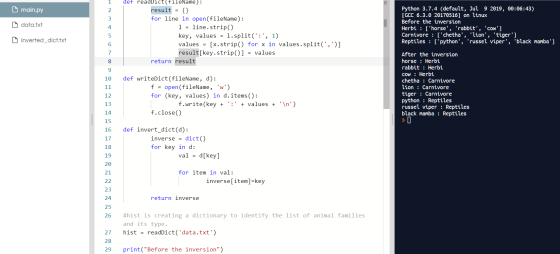
def readDict(fileName):
        result = {}
        for line in open(fileName):
                l = line.strip()
                key, values = l.split(':', 1)
                values = [x.strip() for x in values.split(',')]
                result[key.strip()] = values
        return result

def writeDict(fileName, d):
        f = open(fileName, 'w')
        for (key, values) in d.items():
                f.write(key + ':' + values + '\n')
        f.close()

def invert_dict(d):
        inverse = dict()
        for key in d:
                val = d[key]

                for item in val:
                        inverse[item]=key

        return inverse

#hist is creating a dictionary to identify the list of animal families and its type.
hist = readDict('data.txt')

print("Before the inversion")
for key in hist:
        print(key,hist[key], sep=" : ")

inverse = invert_dict(hist)

print("\nAfter the inversion")
for key in inverse:
        print(key,inverse[key], sep=" : ")

# write the final dict to file
writeDict('inverted_dict.txt', inverse)
data.txt:
Herbi : horse,rabbit,cow
Carnivore : chetha,lion,tiger
Reptiles : python,russel viper,black mamba
Please upvote, as i have given the exact answer as asked in
question. Still in case of any issues in code, let me know in
comments. Thanks!
Add Answer to:
Modify your program from Learning Journal Unit 7 to read
dictionary items from a file and...
Python Modify your program from Learning Journal Unit 7 to read dictionary items from a file...
Python Modify your program from Learning Journal Unit 7 to read dictionary items from a file and write the inverted dictionary to a file. You will need to decide on the following: How to format each dictionary item as a text string in the input file. How to covert each input string into a dictionary item. How to format each item of your inverted dictionary as a text string in the output file. Create an input file with your original...
Modify your program from Learning Journal Unit 7 to read dictionary items from a file and write the inverted dictionary to a file. You will need to decide on the following:
Modify your program from Learning Journal Unit 7 to read dictionary items from a file and write the inverted dictionary to a file. You will need to decide on the following:How to format each dictionary item as a text string in the input file.How to covert each input string into a dictionary item.How to format each item of your inverted dictionary as a text string in the output file.Create an input file with your original three-or-more items and add at...
Hello, Similar questions like this have been previously answered, but this question is different because it has only one...
 Hello,
Similar questions like this have been previously answered, but
this question is different because it has only one part while
similar questions have 2 parts and their solutions is a combination
of the 2 parts. I have not been able to find an absolute solution
for this part.
QUESTION:
Modify your program from Learning Journal Unit 7 to read
dictionary items from a file and write the inverted dictionary to a
file. You will need to decide on the...
Hello,
Similar questions like this have been previously answered, but
this question is different because it has only one part while
similar questions have 2 parts and their solutions is a combination
of the 2 parts. I have not been able to find an absolute solution
for this part.
QUESTION:
Modify your program from Learning Journal Unit 7 to read
dictionary items from a file and write the inverted dictionary to a
file. You will need to decide on the...
Write a French/English dictionary lookup program. Read a list of pairs of English and French words...
Write a French/English dictionary lookup program. Read a list of pairs of English and French words from a file specified by the user. English/French words should be exact matches (don't try to find partial matches). Use the supplied EnglishFrenchDictionary.java class as your main class. Fill in the missing code in the DictionaryTable.java class to read the input file and perform the searches. Add code to the DictionaryTable read() method to: read pairs of lines (English word is on the first...
 Hello,
Similar questions like this have been previously answered, but
this question is different because it has only one part while
similar questions have 2 parts and their solutions is a combination
of the 2 parts. I have not been able to find an absolute solution
for this part.
QUESTION:
Modify your program from Learning Journal Unit 7 to read
dictionary items from a file and write the inverted dictionary to a
file. You will need to decide on the...
Hello,
Similar questions like this have been previously answered, but
this question is different because it has only one part while
similar questions have 2 parts and their solutions is a combination
of the 2 parts. I have not been able to find an absolute solution
for this part.
QUESTION:
Modify your program from Learning Journal Unit 7 to read
dictionary items from a file and write the inverted dictionary to a
file. You will need to decide on the...
Most questions answered within 3 hours.
-
Where is the error in this code sequence?
String s1 = "Hello";
String s2 = "ello";...
asked 11 months ago -
Financial data for Joel de Paris, Inc., for last year
follow:
Joel de Paris, Inc.
Balance...
asked 11 months ago -
Consider this reaction:
Al2(SO4)3 (aq)+ BaCl3
(aq) Al2Cl6 (aq)- +
3BaSO4(s) . What is the...
asked 11 months ago -
Suppose that Savneet is considering increasing her
recent random sample from 20 car rentals to 40...
asked 11 months ago -
Trucks arrive at an unloading terminal at an average rate of 120
per hour.
Trucks arrive...
asked 11 months ago -
Why are methanol and ethanol completely soluble in water while
octanol is not very little soluble....
asked 11 months ago -
A facilities manager at a university reads in a research report
that the mean amount of...
asked 11 months ago -
When the CuSO4 is rehydrated by adding water to the anhydrous
compound, is this an endothermic...
asked 11 months ago -
A ray of sunlight is passing from diamond into crown glass; the
angle of incidence is...
asked 11 months ago -
A block of mass 0.249 kg is placed on top of a light, vertical
spring of...
asked 11 months ago -
how do the kidneys compensate in the presences of acidosis
a) trigger hyperventilate
b) reserve acid...
asked 11 months ago -
Question 501 pts
The rental rate of capital to the firm increases. Which of the
following...
asked 11 months ago