Assignment Three - Chapter 4 16. Suppose labor demand is given by the equation L =...
Assignment Three - Chapter 4
16. Suppose labor demand is given by the equation
L = 50 −2W,
where L is the number of workers and W is the wage rate.
16a. The slope of the demand curve can be viewed as the amount by which Lchanges for every 1 unit change in W. This can be expressed formally as
Slope = ∆∆LWL ,
where∆refers to a small change in the value of L or W. Using this definition, find the slope associated with a wage change from $5 to $6. Would your answer be different if the wage rose from $20 to $21?
16b. Calculate the own-wage elasticity of labor demand as the wage changes from $5 to $6. How would your answer be different if the wage rose from $20 to $21?
16c. How does the slope change as one moves up this labor demand curve? How does the elasticity change as one moves up this labor demand curve? Graph this labor demand curve.
16d. The firm’s total expenditures on labor (the total income received by labor) equals the wage multiplied by the number of workers employed. Calculate the change in the firm’s total expenditures on labor when the wage changes from $5 to $6. Do the same for a change from $20 to $21.
16e. Considering your answer to 16b and 16d, what relationship can you find between the own-wage elasticity of labor demand and the change in a firm’s total expenditures on labor (the total income received by labor)?
16f. Suppose each worker at this firm always works 40 hours a week. If Lwere expressed in terms of labor hours instead of the number of workers, the labor demand curve would be represented by the equation
L = 2000 − 80W.
Find the slope of the curve and the elasticity as the wage rises from $5 to $6. Does the change in the units in which L is measured make any difference to your answers (when compared to the answers in 16a and 16b)?
16g. Why do you think the economists prefer the elasticity when compared to the slope as a measure of labor’s responsiveness to wage changes?
Homework Answers
Solving first 4 as per Chegg policy.
A. Slope is given by deltaL/deltaW
When wage increases from 5 to 6,
L when wage 5= 50-2w=50-10=40
L when wage 6= 50-2w=50-12=38
Slope=38-40/6-5=-2
Calculating same when wage changes from 20 to 21
L when wage 20= 50-2*20=50-40=10
L when wage 21= 50-42=8
Slope=8-10/21-20=-2
The answer does not change.
B.
Wage elasticity of demand can be given by
e=(Cange in L/change in w)*w/L
elasticity when wage changes from 5 to 6
=-2*5/10=-.25
elasticity when wage changes from 20 to 21
=-2*20/10=-4
c.
Given, L=50-2w
as established in part A, slope=-2
and slope remains same as move up the demand curve.
elasticity=(Change in L/change in w)*w/L
As we move upwards in the demand curve, w increases and L falls. Hence, from the above formula, its clear that elasticity increases.
The demand curve has been plotted below

D. When the wage changes from 5 to 6
change in expenditure=6*38-5*40
=228-200
=28 (increases by 28)
when wage changes from 20 to 21
Change in expenditure=21*8-10*20
=168-200
=-32 (falls by 32)
Add Answer to:
Assignment Three - Chapter
4
16. Suppose labor
demand is given by the equation
L =...
16. Suppose labor demand is given by the equation L = 50 −2W, where L is the number of workers and W is the wage rate....
 16. Suppose labor demand is given by the equation
L = 50 −2W,
where L is the number of workers and W is the wage rate.
16a. The slope of the demand curve can be viewed as the amount by which L changes for every 1 unit change in W. This can be expressed formally as C SlopeAL ДW. where A refers to a small change in the value of L or W. Using this definition, find the slope associated...
16. Suppose labor demand is given by the equation
L = 50 −2W,
where L is the number of workers and W is the wage rate.
16a. The slope of the demand curve can be viewed as the amount by which L changes for every 1 unit change in W. This can be expressed formally as C SlopeAL ДW. where A refers to a small change in the value of L or W. Using this definition, find the slope associated...
Consider the labor demand curve given by the equation &n
Consider the labor demand curve given by the equation 100 L = ------- W For small changes in the wage around any given point on the curve, the slope of the curve (the change in L divided by the change in W) is given by the formula 100 Slope = − -------- W 2 a. Find the slope of the curve for a small change in the wage around W = $5. b. Find...
Problem #4: Own-price elasticity Suppose the market labor demand curve is given by LD = 20-(1/2,W...
 Problem #4: Own-price elasticity Suppose the market labor demand curve is given by LD = 20-(1/2,W and the market labor supply curve is given by LS 2 1. Graph the labor demand curve and the labor supply curve on the same graph (with L on the horizontal axis and W on the vertical axis, as we have done in class) 2. Determine the equilibrium employment (L and wage (W in this market 3. Now suppose the government implements a minimum...
Problem #4: Own-price elasticity Suppose the market labor demand curve is given by LD 20- (1/2)W...
 Problem #4: Own-price elasticity Suppose the market labor demand curve is given by LD 20- (1/2)W and the market labor supply curve is given by LS-2W 1. Graph the labor demand curve and the labor supply curve on the same graph (with L on the horizontal axis and W on the vertical axis, as we have done in class). 2. Determine the equilibrium employment (L") and wage (W") in this market. Now suppose the government implements a minimum wage (WM)...
Problem #4: Own-price elasticity Suppose the market labor demand curve is given by LD-20-(1/2)W and the...
 Problem #4: Own-price elasticity Suppose the market labor demand curve is given by LD-20-(1/2)W and the market labor supply curve is given by LS-2 1. Graph the labor demand curve and the labor supply curve on the same graph (with L on the horizontal axis and W on the vertical axis, as we have done in class) 2 Determine the equilibrium employment (L') and wage (W) in this market 3. Now suppose the government implements a minimum wage (WM) of...
Suppose in a particular labor market, the demand for labor is given by the equation LD...
Suppose in a particular labor market, the demand for labor is given by the equation LD = 120 – 3W and that the labor supply in this market for native-born citizens is given by LN = 3W, while the supply curve of immigrants in this market is given by LI = 2W, where L represents the number of workers, W is the wage expressed in real terms.
Suppose the demand for fast food workers can be defined a labor demand equation of LD...
Suppose the demand for fast food workers can be defined a labor demand equation of LD = 95-3w. All fast food workers are covered by the minimum wage and it is binding. The minimum wage is increased from $7.25 to $9.00 per hour. Calculate the elasticity of demand for fast food workers over the relevant portion of the demand curve using the simple formula. Throughout your calculations round to two decimals.
9. Consider the following two demand curves for labor: Qd400- 10*W Qd2 400-20*W a) For each...
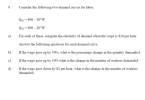 9. Consider the following two demand curves for labor: Qd400- 10*W Qd2 400-20*W a) For each of these, compute the elasticity of demand when the wage is $10 per hour. Answer the following questions for each demand curve If the wage goes up by 10%, what is the percentage change in the quantity demanded. If the wage goes up by 10% what is the change in the number of workers demanded b) d) If the wage goes down by $2...
Suppose a Monopsony facing the following labor supply given by curve: L = 4W, where Lis...
Suppose a Monopsony facing the following labor supply given by curve: L = 4W, where Lis the number of workers and W = hourly wage. a) Express the hourly wage in terms of the number of workers (L). b) Provide an expression of total labor cost in terms of the number of workers (L) c) Express the marginal expense of labor (MEL) in terms of the number of workers. d) Suppose the marginal revenue product of labor ((MRPL) = 15...
A case study in chapter 6 discusses the federal minimum-wage law. Suppose the minimum wage is...
A case study in chapter 6 discusses the federal minimum-wage law. Suppose the minimum wage is above the equilibrium wage in the market for unskilled labor. Using a supply-and-demand diagram of the market for unskilled labor, show the market wage, the number of workers who are employed, and the number of workers who are unemployed. Also show the total wage payments to unskilled workers. Now suppose the secretary of labor proposes a decrease in the minimum wage (with the lower...
 16. Suppose labor demand is given by the equation
L = 50 −2W,
where L is the number of workers and W is the wage rate.
16a. The slope of the demand curve can be viewed as the amount by which L changes for every 1 unit change in W. This can be expressed formally as C SlopeAL ДW. where A refers to a small change in the value of L or W. Using this definition, find the slope associated...
16. Suppose labor demand is given by the equation
L = 50 −2W,
where L is the number of workers and W is the wage rate.
16a. The slope of the demand curve can be viewed as the amount by which L changes for every 1 unit change in W. This can be expressed formally as C SlopeAL ДW. where A refers to a small change in the value of L or W. Using this definition, find the slope associated...
 Problem #4: Own-price elasticity Suppose the market labor demand curve is given by LD = 20-(1/2,W and the market labor supply curve is given by LS 2 1. Graph the labor demand curve and the labor supply curve on the same graph (with L on the horizontal axis and W on the vertical axis, as we have done in class) 2. Determine the equilibrium employment (L and wage (W in this market 3. Now suppose the government implements a minimum...
 Problem #4: Own-price elasticity Suppose the market labor demand curve is given by LD 20- (1/2)W and the market labor supply curve is given by LS-2W 1. Graph the labor demand curve and the labor supply curve on the same graph (with L on the horizontal axis and W on the vertical axis, as we have done in class). 2. Determine the equilibrium employment (L") and wage (W") in this market. Now suppose the government implements a minimum wage (WM)...
 Problem #4: Own-price elasticity Suppose the market labor demand curve is given by LD-20-(1/2)W and the market labor supply curve is given by LS-2 1. Graph the labor demand curve and the labor supply curve on the same graph (with L on the horizontal axis and W on the vertical axis, as we have done in class) 2 Determine the equilibrium employment (L') and wage (W) in this market 3. Now suppose the government implements a minimum wage (WM) of...
 9. Consider the following two demand curves for labor: Qd400- 10*W Qd2 400-20*W a) For each of these, compute the elasticity of demand when the wage is $10 per hour. Answer the following questions for each demand curve If the wage goes up by 10%, what is the percentage change in the quantity demanded. If the wage goes up by 10% what is the change in the number of workers demanded b) d) If the wage goes down by $2...
Most questions answered within 3 hours.
-
Where is the error in this code sequence?
String s1 = "Hello";
String s2 = "ello";...
asked 10 months ago -
Financial data for Joel de Paris, Inc., for last year
follow:
Joel de Paris, Inc.
Balance...
asked 10 months ago -
Consider this reaction:
Al2(SO4)3 (aq)+ BaCl3
(aq) Al2Cl6 (aq)- +
3BaSO4(s) . What is the...
asked 10 months ago -
Suppose that Savneet is considering increasing her
recent random sample from 20 car rentals to 40...
asked 10 months ago -
Trucks arrive at an unloading terminal at an average rate of 120
per hour.
Trucks arrive...
asked 10 months ago -
Why are methanol and ethanol completely soluble in water while
octanol is not very little soluble....
asked 10 months ago -
A facilities manager at a university reads in a research report
that the mean amount of...
asked 10 months ago -
When the CuSO4 is rehydrated by adding water to the anhydrous
compound, is this an endothermic...
asked 10 months ago -
A ray of sunlight is passing from diamond into crown glass; the
angle of incidence is...
asked 10 months ago -
A block of mass 0.249 kg is placed on top of a light, vertical
spring of...
asked 10 months ago -
how do the kidneys compensate in the presences of acidosis
a) trigger hyperventilate
b) reserve acid...
asked 10 months ago -
Question 501 pts
The rental rate of capital to the firm increases. Which of the
following...
asked 10 months ago