Consider the following LP max z=3x1+x2 s.t. −2x1 + x2 ≤ 3 x1 + 2x2 ≤...
Consider the following LP
max z=3x1+x2
s.t. −2x1 + x2 ≤ 3
x1 + 2x2 ≤ 5
x1,x2 ≥0
(a) Find the dual (or shadow) prices of the binding constraints
(b) Find the dual (or shadow) prices of the binding “dual” constraints.
Homework Answers
Solution using graphical method is following:
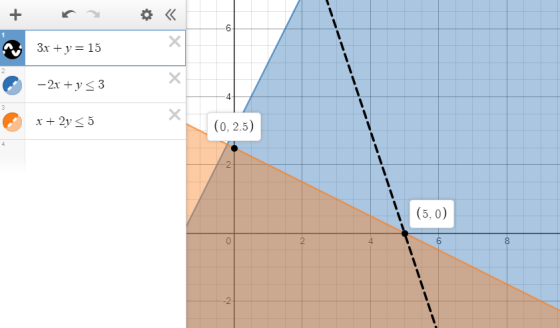
x1 is plotted along x-axis and x2 is plotted along y-axis
Feasible region is the shaded region bounded by corner points, as highlighted on the graph.
Corner points are: (5, 0), (0, 2.5)
Maximum Objective function value is 15 at corner (5, 0)
Therefore, optimal solution is:
x1 = 5
x2 = 0
Objective function value = 15
--------------------------------------------------------
(a)
Optimal lies on curve (x1 + 2x2 ≤ 5)
Therefore, it is the binding constraint.
Shadow price is determined by increasing the Right Hand Side of the binding constraint by 1 unit and again finding the optimal solution and objective value. Shadow price is equal to the difference in objective value for unit change in Right Hand Side (RHS) value of the constraint.
The new graphical solution after increasing the RHS of the constraint by 1 unit, is as follows:
New objective value = 18
Shadow price = 18 - 15
= 3
----------------------------------------------------------------------------------------------
(b)
Dual problem is following:
Minimize W = 3y1+5y2
s.t.
-2y1+1y2 >= 3
1y1+2y2 >= 1
y1, y2 >= 0
It solution by graphical method is following:
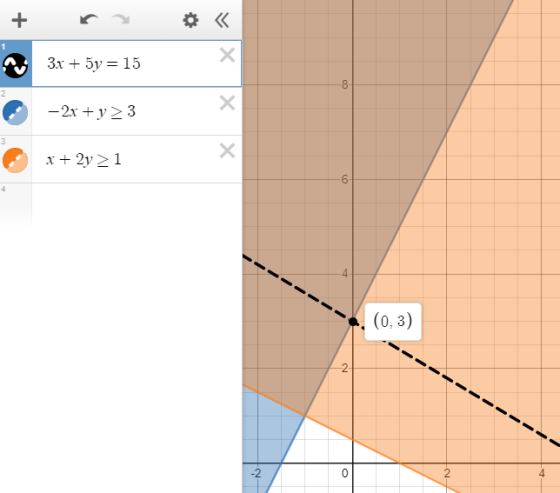
In the above graph, y1 is plotted along x-axis and y2 is plotted along y-axis
Optimal solution is:
y1 = 0
y2 = 3
Objective value = 15
--------------------
The binding constraint is: -2y1+y2>=3
After increasing the RHS of binding constraint by 1 unit, the new optimal solution is determined as below:
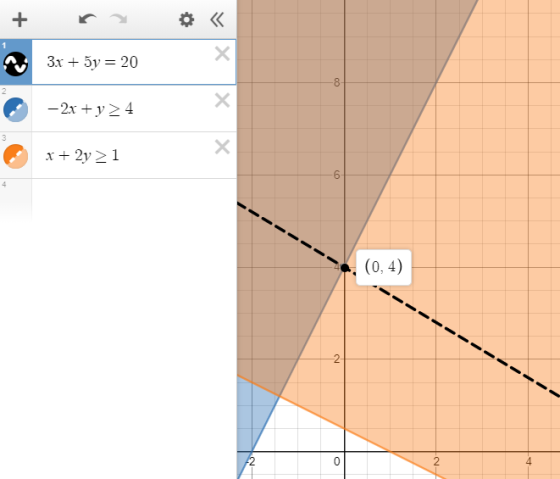
New optimal solution is:
y1 = 0
y2 = 4
New objective value = 20
Shadow price = 20 - 15
= 5
Add Answer to:
Consider the following LP
max z=3x1+x2
s.t. −2x1 + x2 ≤ 3
x1 + 2x2 ≤...
(1) Convert the following LPs to standard form: 22 (a) max z 3x1 + 2x2 s.t....
 (1) Convert the following LPs to standard form: 22 (a) max z 3x1 + 2x2 s.t. 21 < 40 X1 + x2 < 80 2x1 + x2 < 100 X1, X2 > 0 (b) max z = 2x1 s.t. X1 – X2 <1 2x1 + x2 > 6 X1, X2 > 0 (c) max z = 3x1 + x2 s.t. 1 > 3 X1 + x2 < 4 2x1 – X2 = 3 X1, X2 > 0
Consider the following LP problem max z = x1 +2x2 + x3 + x4 s.t. x1...
 Consider the following LP problem max z = x1 +2x2 + x3 + x4 s.t. x1 + 2x2 + x3 く2 +2x3 く! X1, x2, x3, x4 20 a) Obtain the dual formulation of the LP.
Consider the following linear program Max 3xl +2x2 S.t 1x1 + 1x2 〈 10 3x1 1x2...
 Consider the following linear program Max 3xl +2x2 S.t 1x1 + 1x2 〈 10 3x1 1x2 〈 24 1xl t 2x2< 16 And xl, x2> 0. a) Use Excel Solver to find the optimal solution to this problem. State the optimal values of xl, x2, and Z. b) Assume that the objective function coefficient for xl changes from 3 to 5. Does the optimal solution change? c) Assume that the objective function coefficient for x1 remains 3, but the objective...
Use the simplex algorithm to find all optimal solutions to the following LP. max z=2x1+x2 s.t....
Use the simplex algorithm to find all optimal solutions to the following LP. max z=2x1+x2 s.t. 4x1 + 2x2 ≤ 4 −2x1 + x2 ≤ 2 x1 ≥1 x1,x2 ≥0
Max 3x1+2x2 s.t. 6x1+3x2 <=42 3x1+4x2<=36 x1,x2>=0 a) write the dual problem of the above primal...
Max 3x1+2x2 s.t. 6x1+3x2 <=42 3x1+4x2<=36 x1,x2>=0 a) write the dual problem of the above primal problem and define the physical meaning of the dual objective function and the dual constraints
Consider the mathematical program max 3x1 x2 +3x3 s.t. 2X1 + X2 + X3 +X4-2 x1...
 Consider the mathematical program max 3x1 x2 +3x3 s.t. 2X1 + X2 + X3 +X4-2 x1 + 2x2 + 3x3 + 2xs 5 2x1 + 2x2 + x3 + 3x6 = 6 Three feasible solutions ((a) through (c)) are listed below. (b) xo) (0.9, 0, 0, 0.2,2.05, 1.4) (c) xo) (0.3, 0.1, 0.4, 0.9, 1.65, 1.6) Please choose one appropriate interior point from the list, and use the Karmarkar's Method at the interior point and determine the optimal solution.
Consider the following LP problem: Minimize Cost = 3x1 + 2x2 s.t. 1x1 + 2x2 ≤...
Consider the following LP problem: Minimize Cost = 3x1 + 2x2 s.t. 1x1 + 2x2 ≤ 12 2x1 + 3 x2 = 12 2 x1 + x2 ≥ 8 x1≥ 0, x2 ≥ 0 A) What is the optimal solution of this LP? Give an explanation. (4,0) (2,3) (0,8) (0,4) (0,6) (3,2) (12,0) B)Which of the following statements are correct for a linear programming which is feasible and not unbounded? 1)All of the above. 2)Only extreme points may be optimal....
MAX X Z = 3X1 + 4x2 s.t 2x1 + 2x2 ≤ 8 1x1 + 2x2...
MAX X Z = 3X1 + 4x2 s.t 2x1 + 2x2 ≤ 8 1x1 + 2x2 ≤ 6 2x2 ≥ 1 please graph with the optimal solution. Then dual price for the first constraint by adding one. Then dual price for the third constraint adding one. Please also graph these with the same graph showing the new optimal solutions Also please show the iso-z lines for the initial problem.
Question 3: Identify which of LP problems (1)--(4) has (x1,x2) = (20,60) as its optimal solution....
 Question 3: Identify which of LP problems (1)--(4) has (x1,x2) = (20,60) as its optimal solution. (1) min z = 50xı + 100X2 s.t. 7x1 + 2x2 > 28 2x1 + 12x2 > 24 X1, X2 > 0 (2) max z = 3x1 + 2x2 s.t. 2x1 + x2 < 100 X1 + x2 < 80 X1 <40 X1, X2 > 0 (3) min z = 3x1 + 5x2 s.t. 3x1 + 2x2 > 36 3x1 + 5x2 > 45...
Q4. (Sensitivity Analysis: Adding a new constraint) (3 marks) Consider the following LP max z= 6x1+x2 s.t.xi + x2 S5 2x1 + x2 s6 with the following final optimal Simplex tableau basis x1 r2 S2 rhs 0...
 Q4. (Sensitivity Analysis: Adding a new constraint) (3 marks) Consider the following LP max z= 6x1+x2 s.t.xi + x2 S5 2x1 + x2 s6 with the following final optimal Simplex tableau basis x1 r2 S2 rhs 0 0 18 0.5 0.5 0.5 0.5 x1 where sı and s2 are the slack variables in the first and second constraints, respectively (a) Please find the optimal solution if we add the new constraint 3x1 + x2 S 10 into the LP (b)...
 (1) Convert the following LPs to standard form: 22 (a) max z 3x1 + 2x2 s.t. 21 < 40 X1 + x2 < 80 2x1 + x2 < 100 X1, X2 > 0 (b) max z = 2x1 s.t. X1 – X2 <1 2x1 + x2 > 6 X1, X2 > 0 (c) max z = 3x1 + x2 s.t. 1 > 3 X1 + x2 < 4 2x1 – X2 = 3 X1, X2 > 0
 Consider the following LP problem max z = x1 +2x2 + x3 + x4 s.t. x1 + 2x2 + x3 く2 +2x3 く! X1, x2, x3, x4 20 a) Obtain the dual formulation of the LP.
 Consider the following linear program Max 3xl +2x2 S.t 1x1 + 1x2 〈 10 3x1 1x2 〈 24 1xl t 2x2< 16 And xl, x2> 0. a) Use Excel Solver to find the optimal solution to this problem. State the optimal values of xl, x2, and Z. b) Assume that the objective function coefficient for xl changes from 3 to 5. Does the optimal solution change? c) Assume that the objective function coefficient for x1 remains 3, but the objective...
 Consider the mathematical program max 3x1 x2 +3x3 s.t. 2X1 + X2 + X3 +X4-2 x1 + 2x2 + 3x3 + 2xs 5 2x1 + 2x2 + x3 + 3x6 = 6 Three feasible solutions ((a) through (c)) are listed below. (b) xo) (0.9, 0, 0, 0.2,2.05, 1.4) (c) xo) (0.3, 0.1, 0.4, 0.9, 1.65, 1.6) Please choose one appropriate interior point from the list, and use the Karmarkar's Method at the interior point and determine the optimal solution.
 Question 3: Identify which of LP problems (1)--(4) has (x1,x2) = (20,60) as its optimal solution. (1) min z = 50xı + 100X2 s.t. 7x1 + 2x2 > 28 2x1 + 12x2 > 24 X1, X2 > 0 (2) max z = 3x1 + 2x2 s.t. 2x1 + x2 < 100 X1 + x2 < 80 X1 <40 X1, X2 > 0 (3) min z = 3x1 + 5x2 s.t. 3x1 + 2x2 > 36 3x1 + 5x2 > 45...
 Q4. (Sensitivity Analysis: Adding a new constraint) (3 marks) Consider the following LP max z= 6x1+x2 s.t.xi + x2 S5 2x1 + x2 s6 with the following final optimal Simplex tableau basis x1 r2 S2 rhs 0 0 18 0.5 0.5 0.5 0.5 x1 where sı and s2 are the slack variables in the first and second constraints, respectively (a) Please find the optimal solution if we add the new constraint 3x1 + x2 S 10 into the LP (b)...
Most questions answered within 3 hours.
-
Where is the error in this code sequence?
String s1 = "Hello";
String s2 = "ello";...
asked 11 months ago -
Financial data for Joel de Paris, Inc., for last year
follow:
Joel de Paris, Inc.
Balance...
asked 11 months ago -
Consider this reaction:
Al2(SO4)3 (aq)+ BaCl3
(aq) Al2Cl6 (aq)- +
3BaSO4(s) . What is the...
asked 11 months ago -
Suppose that Savneet is considering increasing her
recent random sample from 20 car rentals to 40...
asked 11 months ago -
Trucks arrive at an unloading terminal at an average rate of 120
per hour.
Trucks arrive...
asked 11 months ago -
Why are methanol and ethanol completely soluble in water while
octanol is not very little soluble....
asked 11 months ago -
A facilities manager at a university reads in a research report
that the mean amount of...
asked 11 months ago -
When the CuSO4 is rehydrated by adding water to the anhydrous
compound, is this an endothermic...
asked 11 months ago -
A ray of sunlight is passing from diamond into crown glass; the
angle of incidence is...
asked 11 months ago -
A block of mass 0.249 kg is placed on top of a light, vertical
spring of...
asked 11 months ago -
how do the kidneys compensate in the presences of acidosis
a) trigger hyperventilate
b) reserve acid...
asked 11 months ago -
Question 501 pts
The rental rate of capital to the firm increases. Which of the
following...
asked 11 months ago