#include <errno.h> #include <stdbool.h> #include <stdio.h> #include <stdlib.h> #include <string.h> #include <ctype.h> /* * Expected usage:...
Homework Answers
Screenshots
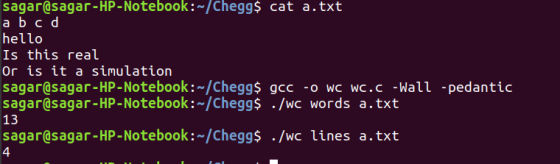
CODE:
#include <errno.h>
#include <stdbool.h>
#include <stdio.h>
#include <stdlib.h>
#include <string.h>
#include <ctype.h>
/*
* This should return the number of spaces in the buffer using the
isspace
* function.
*/
static size_t words(const char* buffer, size_t length)
{
size_t sum = 0;
int i;
for(i=0; i<length; i++){
if(isspace(buffer[i])){
sum++;
}
}
return sum;
}
/*
* This should return the number of lines in the buffer by checking
for the
* existence of '\n' characters in the buffer.
*/
static size_t lines(const char* buffer, size_t length)
{
size_t sum = 0;
int i;
for(i=0; i<length; i++){
if(buffer[i]=='\n'){
sum++;
}
}
return sum;
}
int main(int argc, const char* argv[])
{
char buffer[256];
FILE* fp;
size_t bytes_read;
size_t sum = 0;
enum {
MODE_LINES,
MODE_WORDS
} mode;
bool middle = false;
if (argc != 3) {
printf("Usage: ./wc <words |
lines> <file>\n");
exit(EXIT_FAILURE);
}
/*
* Set mode here based on the value of argv[1]. Use
the
* strcmp function for string comparison.
*/
if(strcmp(argv[1],"words") == 0)
mode = MODE_WORDS;
else if(strcmp(argv[1],"lines") == 0)
mode = MODE_LINES;
else{
printf("Usage: ./wc <words |
lines> <file>\n");
exit(EXIT_FAILURE);
}
fp = fopen(argv[2], "r");
if (fp == NULL) {
printf("error: could not open %s:
%s\n",
argv[1],
strerror(errno));
exit(EXIT_FAILURE);
}
for (;;) {
bytes_read = fread(buffer, 1,
sizeof(buffer), fp);
if (bytes_read == 0)
break;
if (mode == MODE_LINES) {
sum +=
lines(buffer, bytes_read);
}
else if (mode == MODE_WORDS)
{
sum +=
words(buffer, bytes_read);
}
}
/*
* You need to increment sum if you were in the middle
of a line or word and end of
* file was hit.
*/
if (feof(fp) == 0){
middle = true;
}
printf("%zu\n", sum + middle);
return 0;
}
Add Answer to:
#include <errno.h>
#include <stdbool.h>
#include <stdio.h>
#include <stdlib.h>
#include <string.h>
#include <ctype.h>
/*
* Expected usage:...
devmem2.c #include <stdio.h> #include <stdlib.h> #include <unistd.h> #include <string.h> #include <errno.h> #include <signal.h> #include <fcntl.h> #include...
 devmem2.c
#include <stdio.h>
#include <stdlib.h>
#include <unistd.h>
#include <string.h>
#include <errno.h>
#include <signal.h>
#include <fcntl.h>
#include <ctype.h>
#include <termios.h>
#include <sys/types.h>
#include <sys/mman.h>
#define FATAL do { fprintf(stderr, "Error at line %d, file %s
(%d) [%s]\n", \
__LINE__, __FILE__, errno, strerror(errno)); exit(1); }
while(0)
#define MAP_SIZE 4096UL
#define MAP_MASK (MAP_SIZE - 1)
int main(int argc, char **argv) {
int fd;
void *map_base = NULL, *virt_addr = NULL;
unsigned long read_result, writeval;
off_t target;
int access_type = 'w';
if(argc...
devmem2.c
#include <stdio.h>
#include <stdlib.h>
#include <unistd.h>
#include <string.h>
#include <errno.h>
#include <signal.h>
#include <fcntl.h>
#include <ctype.h>
#include <termios.h>
#include <sys/types.h>
#include <sys/mman.h>
#define FATAL do { fprintf(stderr, "Error at line %d, file %s
(%d) [%s]\n", \
__LINE__, __FILE__, errno, strerror(errno)); exit(1); }
while(0)
#define MAP_SIZE 4096UL
#define MAP_MASK (MAP_SIZE - 1)
int main(int argc, char **argv) {
int fd;
void *map_base = NULL, *virt_addr = NULL;
unsigned long read_result, writeval;
off_t target;
int access_type = 'w';
if(argc...
#include <stdlib.h> #include <stdio.h> #include "main.h" #define MAX_NUM_LENGTH 11 void usage(int argc, char** argv) { if(argc...
#include <stdlib.h> #include <stdio.h> #include "main.h" #define MAX_NUM_LENGTH 11 void usage(int argc, char** argv) { if(argc < 4) { fprintf(stderr, "usage: %s <input file 1> <input file 2> <output file>\n", argv[0]); exit(EXIT_FAILURE); } } /* This function takes in the two input file names (stored in argv) and determines the number of integers in each file. If the two files both have N integers, return N, otherwise return -1. If one or both of the files do not exist, it...
Following code is a POSIX semaphore usage example. Fill in the blanks. (assume proper headers were...
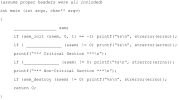 Following code is a POSIX semaphore usage example. Fill in the
blanks.
(assume proper headers were al1 included) int main (int argc, char** argv) sem if (seminit (&sen, 0, 1) == -1) print f ("%s\n", strerror(errno): if printf ("*** Critical Section **n" İS: ( printf("* Non-Critical Section **n") if (semdestroy (&sem) '= 0) printf("%s\n", strerror (errno)); return 0 (&sem) ' 0) printf("%s\n", strerror (errno)); ( & sem) .- 0) printf ("%s\n", strerror (errno) ) ; -
Following code is a POSIX semaphore usage example. Fill in the
blanks.
(assume proper headers were al1 included) int main (int argc, char** argv) sem if (seminit (&sen, 0, 1) == -1) print f ("%s\n", strerror(errno): if printf ("*** Critical Section **n" İS: ( printf("* Non-Critical Section **n") if (semdestroy (&sem) '= 0) printf("%s\n", strerror (errno)); return 0 (&sem) ' 0) printf("%s\n", strerror (errno)); ( & sem) .- 0) printf ("%s\n", strerror (errno) ) ; -
My question is listed the below please any help this assignment ; There is a skeleton...
My question is listed the below please any help this assignment ; There is a skeleton code: copy_file_01.c #include <stdio.h> #include <stdlib.h> int main(int argc, char* argv[]) { char ch ; FILE *source , *target; if(argc != 3){ printf ("Usage: copy file1 file2"); exit(EXIT_FAILURE); } source = fopen(argv[1], "r"); if (source == NULL) { printf("Press any key to exit...\n"); exit(EXIT_FAILURE); } target = fopen(argv[2], "w"); if (target == NULL) { fclose(source); printf("Press any key to exit...\n"); exit(EXIT_FAILURE); } while ((ch...
Below is a basic implementation of the Linux command "cat". This command is used to print...
 Below is a basic implementation of the Linux command "cat". This command is used to print the contents of a file on the console/terminal window. #include <stdio.h> #include <stdlib.h> int main(int argc, char* argv[]) {FILE *fp; if(2 != argc) {priritf ("Usage: cat <filename>\n"); exit(1);} if ((fp = fopen(argv[1], "r")) == NULL) {fprintf (stderr, "Can't. open input file %s\n", argv[1]); exit (1);} char buffer[256]; while (fgets(X, 256, fp) != NULL) fprintf(Y, "%s", buffer); fclose(Z); return 0;} Which one of the following...
can someone help me with changing this to c++ language #include <stdlib.h> #include <stdio.h> #include <pthread.h>...
can someone help me with changing this to c++ language #include <stdlib.h> #include <stdio.h> #include <pthread.h> #include <string.h> #include <dirent.h> #include <sys/wait.h> #include <time.h> #include <sys/stat.h> #include <unistd.h> char *pathLog; char *pathRep; struct stat attr; int fileNum, curNum; char *create_logPath(char *directory); void *funcChecker(void *pathSub); void *funcprintTimeAndChanges(void *pathSub); void main(int argc, char *argv[]) { if(argc < 3) { printf("%s must be executed with exactly two additional arguments (pathRep, pathSub)!\n", argv[0]); printf("Typed count is %d\n", argc); printf("Aborted...
#include <stdio.h> #include <string.h> #include <ctype.h> #include <stdlib.h> int main(void) { /* Type your code here....
#include <stdio.h> #include <string.h> #include <ctype.h> #include <stdlib.h> int main(void) { /* Type your code here. */ int GetNumOfNonWSCharacters(const char usrStr[]) { int length; int i; int count = 0; char c; length=strlen(usrStr); for (i = 0; i < length; i++) { c=usrStr[i]; if ( c!=' ' ) { count++; } } return count; } int GetNumOfWords(const char usrStr[]) { int counted = 0; // result // state: const char* it = usrStr; int inword = 0; do switch(*it)...
Would u help me fixing this CODE With Debugging Code with GDB #include <stdio.h> #include <stdlib.h>...
Would u help me fixing this CODE With Debugging Code with GDB #include <stdio.h> #include <stdlib.h> #define SIZE (10) typedef struct _debugLab { int i; char c; } debugLab; // Prototypes void PrintUsage(char *); void DebugOption1(void); void DebugOption2(void); int main(int argc, char **argv) { int option = 0; if (argc == 1) { PrintUsage(argv[0]); exit(0); } option = atoi(argv[1]); if (option == 1) { DebugOption1(); } else if (option == 2) { DebugOption2(); } else { PrintUsage(argv[0]); exit(0); } }...
Convert C to C++ I need these 4 C file code convert to C++. Please Convert...
Convert C to C++ I need these 4 C file code convert to C++. Please Convert it to C++ //////first C file: Wunzip.c #include int main(int argc, char* argv[]) { if(argc ==1){ printf("wunzip: file1 [file2 ...]\n"); return 1; } else{ for(int i =1; i< argc;i++){ int num=-1; int numout=-1; int c; int c1; FILE* file = fopen(argv[i],"rb"); if(file == NULL){ printf("Cannot Open File\n"); return 1; } else{ while(numout != 0){ numout = fread(&num, sizeof(int), 1, file); c...
How to create different files to test whether it passes the serial number checking. (Hint: need...
How to create different files to test whether it passes the serial number checking. (Hint: need a hex editor.) please provide two files, one pass, one cannot pass C code: ---------------------------------------------- #include <stdio.h> #include <string.h> int chkserial(char *s) { char buffer[16]; strcpy(buffer, s); return strcmp(buffer, "cs780880"); } void fullversion() { printf("Thanks for purchasing! Enjoy the full-version software!\n"); } void trialversion() { printf("This is a trial version. Please purchase the full version to enable all features!\n"); } int main(int argc, char...
 devmem2.c
#include <stdio.h>
#include <stdlib.h>
#include <unistd.h>
#include <string.h>
#include <errno.h>
#include <signal.h>
#include <fcntl.h>
#include <ctype.h>
#include <termios.h>
#include <sys/types.h>
#include <sys/mman.h>
#define FATAL do { fprintf(stderr, "Error at line %d, file %s
(%d) [%s]\n", \
__LINE__, __FILE__, errno, strerror(errno)); exit(1); }
while(0)
#define MAP_SIZE 4096UL
#define MAP_MASK (MAP_SIZE - 1)
int main(int argc, char **argv) {
int fd;
void *map_base = NULL, *virt_addr = NULL;
unsigned long read_result, writeval;
off_t target;
int access_type = 'w';
if(argc...
devmem2.c
#include <stdio.h>
#include <stdlib.h>
#include <unistd.h>
#include <string.h>
#include <errno.h>
#include <signal.h>
#include <fcntl.h>
#include <ctype.h>
#include <termios.h>
#include <sys/types.h>
#include <sys/mman.h>
#define FATAL do { fprintf(stderr, "Error at line %d, file %s
(%d) [%s]\n", \
__LINE__, __FILE__, errno, strerror(errno)); exit(1); }
while(0)
#define MAP_SIZE 4096UL
#define MAP_MASK (MAP_SIZE - 1)
int main(int argc, char **argv) {
int fd;
void *map_base = NULL, *virt_addr = NULL;
unsigned long read_result, writeval;
off_t target;
int access_type = 'w';
if(argc...
 Following code is a POSIX semaphore usage example. Fill in the
blanks.
(assume proper headers were al1 included) int main (int argc, char** argv) sem if (seminit (&sen, 0, 1) == -1) print f ("%s\n", strerror(errno): if printf ("*** Critical Section **n" İS: ( printf("* Non-Critical Section **n") if (semdestroy (&sem) '= 0) printf("%s\n", strerror (errno)); return 0 (&sem) ' 0) printf("%s\n", strerror (errno)); ( & sem) .- 0) printf ("%s\n", strerror (errno) ) ; -
Following code is a POSIX semaphore usage example. Fill in the
blanks.
(assume proper headers were al1 included) int main (int argc, char** argv) sem if (seminit (&sen, 0, 1) == -1) print f ("%s\n", strerror(errno): if printf ("*** Critical Section **n" İS: ( printf("* Non-Critical Section **n") if (semdestroy (&sem) '= 0) printf("%s\n", strerror (errno)); return 0 (&sem) ' 0) printf("%s\n", strerror (errno)); ( & sem) .- 0) printf ("%s\n", strerror (errno) ) ; -
 Below is a basic implementation of the Linux command "cat". This command is used to print the contents of a file on the console/terminal window. #include <stdio.h> #include <stdlib.h> int main(int argc, char* argv[]) {FILE *fp; if(2 != argc) {priritf ("Usage: cat <filename>\n"); exit(1);} if ((fp = fopen(argv[1], "r")) == NULL) {fprintf (stderr, "Can't. open input file %s\n", argv[1]); exit (1);} char buffer[256]; while (fgets(X, 256, fp) != NULL) fprintf(Y, "%s", buffer); fclose(Z); return 0;} Which one of the following...
Most questions answered within 3 hours.
-
Where is the error in this code sequence?
String s1 = "Hello";
String s2 = "ello";...
asked 11 months ago -
Financial data for Joel de Paris, Inc., for last year
follow:
Joel de Paris, Inc.
Balance...
asked 11 months ago -
Consider this reaction:
Al2(SO4)3 (aq)+ BaCl3
(aq) Al2Cl6 (aq)- +
3BaSO4(s) . What is the...
asked 11 months ago -
Suppose that Savneet is considering increasing her
recent random sample from 20 car rentals to 40...
asked 11 months ago -
Trucks arrive at an unloading terminal at an average rate of 120
per hour.
Trucks arrive...
asked 11 months ago -
Why are methanol and ethanol completely soluble in water while
octanol is not very little soluble....
asked 11 months ago -
A facilities manager at a university reads in a research report
that the mean amount of...
asked 11 months ago -
When the CuSO4 is rehydrated by adding water to the anhydrous
compound, is this an endothermic...
asked 11 months ago -
A ray of sunlight is passing from diamond into crown glass; the
angle of incidence is...
asked 11 months ago -
A block of mass 0.249 kg is placed on top of a light, vertical
spring of...
asked 11 months ago -
how do the kidneys compensate in the presences of acidosis
a) trigger hyperventilate
b) reserve acid...
asked 11 months ago -
Question 501 pts
The rental rate of capital to the firm increases. Which of the
following...
asked 11 months ago