// I understand what I have to do on a fundamental level however I am having...
// I understand what I have to do on a fundamental level however I am having trouble just grasping how to implement them into the program. Explanation greatly appreciated!
The files section has a gutted List class for you. Just write all the methods. Easy peasy. Just remember that if your code never calls a template method, the compiler deletes it entirely. Make sure you test everything.
List's big three: Destructor, Copy, Assignment. Vanilla constructor is right - don't change it. PushFront: Add a new node as the new first piece of data.
Do NOT add anything before Head.
PopFront: Remove the first piece of data if there is one.
Front: Return the first piece of data.
PushBack: Add a new node as the new first piece of data. Do NOT add anything before Head.
PopBack: Remove the first piece of data if there is one.
Back: Return the first piece of data.
Size: How many things.
Clear: Remove all data, leave head and tail.
At: Return data at that position. 0 is first data
List.h
#pragma once
template <typename T>
class List
{
struct ListNode
{
ListNode()
{
mPrev = nullptr;
mNext = nullptr;
}
T mData;
ListNode* mPrev;
ListNode* mNext;
};
ListNode* mHead;
ListNode* mTail;
T mUndefined;
public:
List()
{
// Getting Head and Tail correct is not part of the Big 3. It is hella
mega required no matter what.
//mHead = nullptr;
//mTail = nullptr;// bleh. Full of crash.
mHead = new ListNode;
mTail = new ListNode;
mHead->mNext = mTail;
mHead->mPrev = nullptr;
mTail->mPrev = mHead;// This RULES. We always know we have 2 nodes, so
we never have to check for null.
mTail->mNext = nullptr;
}
List(const List& tOther)
{
}
List& operator = (const List& tRHS)
{
}
~List()
{
}
void PushFront(const T& tWhat)
{
}
void PopFront()
{
}
T& Front()
{
return mUndefined;
}
void PushBack(const T& tWhat)
{
}
void PopBack()
{
}
T& Back()
{
return mUndefined;
}
int Size() const
{
return 0;
}
void Clear()
{
}
T& At(int tWhere) const
{
}
};
/ ListStart.cpp : This file contains the 'main' function. Program execution begins
and ends there.
//
#include <iostream>
#include "List.h"
using namespace std;
int main()
{
List<int> tSomeInts;
tSomeInts.PushBack(14);// 14
tSomeInts.PushBack(1);// 14 1
tSomeInts.PushBack(54);// 14 1 54
tSomeInts.PushBack(25);// 14 1 54 25
List<int> tIntCopy = tSomeInts;// 14 1 54 25
tSomeInts.PopBack();// 14 1 54
cout << "This better say 4: " << tIntCopy.Size() << endl;
cout << "This better say 3: " << tSomeInts.Size() << endl;
cout << "This better say 14: " << tSomeInts.Front() << endl;
cout << "This better say 54: " << tSomeInts.Back() << endl;
return 0;
}
Homework Answers
List.h
==========================
#pragma once
template <typename T>
class List
{
struct ListNode
{
ListNode()
{
mPrev =
nullptr;
mNext =
nullptr;
}
T mData;
ListNode* mPrev;
ListNode* mNext;
};
ListNode* mHead;
ListNode* mTail;
T mUndefined; // why need this?
public:
List()
{
// Getting Head and Tail correct is
not part of the Big 3. It is hellamega required no matter
what.
//mHead = nullptr;
//mTail = nullptr;// bleh. Full of
crash.
mHead = new ListNode;
mTail = new ListNode;
mHead->mNext = mTail;
mHead->mPrev = nullptr;
mTail->mPrev = mHead;// This
RULES. We always know we have 2 nodes, so we never have to check
for null.
mTail->mNext = nullptr;
}
List(const List& tOther)
{
// use assignment operator for copy
constructor
*this = tOther;
}
List& operator = (const List& tRHS)
{
// initialize front and back
mHead = new ListNode;
mTail = new ListNode;
mHead->mNext = mTail;
mHead->mPrev = nullptr;
mTail->mPrev = mHead;
mTail->mNext = nullptr;
// create iterator for RHS
ListNode* itr =
tRHS.mHead->mNext;
// loop through RHS list and copy
each node
while (itr != tRHS.mTail) {
// create a new
node before tail
ListNode* node =
new ListNode;
// copy data to
new node
node->mData =
itr->mData;
// link the node
on left
mTail->mPrev->mNext = node;
node->mPrev =
mTail->mPrev;
// link the node
on right
node->mNext =
mTail;
mTail->mPrev
= node;
itr =
itr->mNext;
}
// return the list
return *this;
}
~List()
{
ListNode* temp = mHead; // create
iterator
// remove each node from list
while (mHead != mTail) {
// move to next
node and delete current node
mHead =
mHead->mNext;
delete
temp;
temp =
mHead;
}
// delete last node
delete temp;
}
void PushFront(const T& tWhat)
{
// create new node
ListNode* node = new
ListNode;
// get data
node->mData = tWhat;
// link the node on right
mHead->mNext->mPrev =
node;
node->mNext =
mHead->mNext;
// link the node on left
node->mPrev = mHead;
mHead->mNext = node;
}
void PopFront()
{
// remove first node if it
exist
if (mHead != mTail) {
ListNode* temp =
mHead->mNext;
// remove nodes
link
mHead->mNext->mNext->mPrev = mHead;
mHead->mNext
= mHead->mNext->mNext;
delete
temp;
}
}
T& Front()
{
return
mHead->mNext->mData;
}
void PushBack(const T& tWhat)
{
// create new node
ListNode* node = new
ListNode;
// get data
node->mData = tWhat;
// link the node on left
node->mPrev =
mTail->mPrev;
mTail->mPrev->mNext =
node;
// link the node on right
node->mNext = mTail;
mTail->mPrev = node;
}
void PopBack()
{
// remove first node if it
exist
if (mHead != mTail) {
ListNode* temp =
mTail->mPrev;
// remove nodes
link
mTail->mPrev->mPrev->mNext = mTail;
mTail->mPrev
= mTail->mPrev->mPrev;
delete
temp;
}
}
T& Back()
{
return
mTail->mPrev->mData;
}
int Size() const
{
// create varaible to count
nodes
int count = 0;
ListNode* itr = mHead->mNext; //
create iterator
// loop through list to count
nodes
while (itr != mTail) {
count++;
itr =
itr->mNext;
}
return count;
}
void Clear()
{
ListNode* temp = mHead->mNext;
// create iterator
// remove each node from list
while (temp != mTail) {
// move to next
node and delete current node
mHead =
mHead->mNext;
delete
temp;
temp =
mHead->mNext;
}
// delete last node
}
T& At(int tWhere) const
{
ListNode* itr = mHead->mNext; //
create iterator
// move to given index using for
loop
for (int i = 0; i < tWhere; i++)
{
itr =
itr->mNext;
}
// return the element
return itr->mData;
}
};
=============================
ListStart.cpp
=============================
#include <iostream>
#include "List.h"
using namespace std;
int main()
{
List<int> tSomeInts;
tSomeInts.PushBack(14);// 14
tSomeInts.PushBack(1);// 14 1
tSomeInts.PushBack(54);// 14 1 54
tSomeInts.PushBack(25);// 14 1 54 25
tSomeInts.PushFront(18);//18 14 54 25
cout << "This better say 18: " <<
tSomeInts.Front() << endl;
tSomeInts.PopFront();// 14 1 54 25
List<int> tIntCopy = tSomeInts;// 14 1 54
25
tSomeInts.PopBack();// 14 1 54
cout << "This better say 4: " <<
tIntCopy.Size() << endl;
cout << "This better say 3: " <<
tSomeInts.Size() << endl;
cout << "This better say 14: " <<
tSomeInts.Front() << endl;
cout << "This better say 54: " <<
tSomeInts.Back() << endl;
return 0;
}
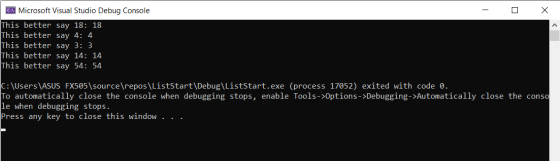
let me know if you have any problem or doubt. thank you.
Add Answer to:
// I understand what I have to do on a fundamental level however
I am having...
In C++, for the provided template linked list class create a derived class of it which...
In C++, for the provided template linked list class create a derived class of it which adds the functionality to it to find the high and low value of any given data stored in the list. The derived class must be a template. LinkedList.h #pragma once #include <iostream> using namespace std; template <class T> class ListNode { public: T data; ListNode<T>* next; ListNode(T data) { this->data = data;...
C++ Assignment Project 1 - NodeList Building upon the the ListNode/List code I would like you...
C++ Assignment Project 1 - NodeList Building upon the the ListNode/List code I would like you to extend the interface of a list to have these member functions as well. struct ListNode { int element; ListNode *next; } Write a function to concatenate two linked lists. Given lists l1 = (2, 3, 1)and l2 = (4, 5), after return from l1.concatenate(l2)the list l1should be changed to be l1 = (2, 3, 1, 4, 5). Your function should not change l2and...
C++ Assignment Project 1 - NodeList Building upon the the ListNode/List code I would like you to extend the interface of...
C++ Assignment Project 1 - NodeList Building upon the the ListNode/List code I would like you to extend the interface of a list to have these member functions as well. struct ListNode { int element; ListNode *next; } Write a function to concatenate two linked lists. Given lists l1 = (2, 3, 1)and l2 = (4, 5), after return from l1.concatenate(l2)the list l1should be changed to be l1 = (2, 3, 1, 4, 5). Your function should not change l2and...
Implementing the vector class in the following code (It's C++, not Java). You just need to...
Implementing the vector class in the following code (It's C++, not Java). You just need to implement all these methods: PushFront, PopFront, At, Erase, Insert, Clear, Reserve, Copy, Assign, and Destroy, please do not add any new properties. You cannot use std:: functions, && (unless being used for "AND"), or pass by reference. Your solutions must conform to the Big O notations next to each method. In the following code, I am going to match the names that STL uses...
What is the specific answer for 1. and 2. Thanks! Add a new method, find, to...
What is the specific answer for 1. and 2. Thanks! Add a new method, find, to class SinglyLinkedList (defined here) that takes as input a “data” value and returns a pointer to a node. If the input data is present in the linked list, the returned pointer should point to that node; if not, the returned pointer is nullptr. Write the (single line) method declaration/specification. Write the method definition/implementation. Test by running the main() function below and capture the console...
I have the following c++ data structures assignment: Copy Constructors, Destructors, and Assignment Operators An understanding...
I have the following c++ data structures assignment: Copy Constructors, Destructors, and Assignment Operators An understanding of how to implement copy constructors, destructors, and assignment operators is essential when working with data structures using dynamic memory allocation. Failure to implement these methods correctly can and probably will result in memory leaks. In this project, you are provided with a working implementation of a doubly-linked list in which the copy constructor, destructor, and assignment operator methods are not complete. To complete...
For the LinkedList class, create a getter and setter for the private member 'name', constructing your...
For the LinkedList class, create a getter and setter for the private member 'name', constructing your definitions based upon the following declarations respectively: std::string get_name() const; and void set_name(std::string); In the Main.cpp file, let's test your getter and setter for the LinkedLIst private member 'name'. In the main function, add the following lines of code: cout << ll.get_name() << endl; ll.make_test_list(); ll.set_name("My List"); cout << ll.get_name() << endl; Output should be: Test List My List Compile and run your code;...
Fill the code in list.cpp app.cpp: #include "list.hpp" int main() { LinkedList aList; bool success =...
Fill the code in list.cpp app.cpp: #include "list.hpp" int main() { LinkedList aList; bool success = false; aList.evensFrontOddsEnd(3); aList.evensFrontOddsEnd(10); aList.evensFrontOddsEnd(6); aList.evensFrontOddsEnd(9); aList.evensFrontOddsEnd(17); aList.evensFrontOddsEnd(12); aList.printForward(); // output should be: 12 6 10 3 9 17 aList.printBackward(); // output should be: 17 9 3 10 6 12 success = aList.remove(17); if(success) cout << "17 Successfully Removed." << endl; success = aList.remove(10); if(success) cout << "10 Successfully Removed." << endl; success = aList.remove(7); // 7 is not in the list, so success should...
Design and implement your own linked list class to hold a sorted list of integers in ascending order. The class should h...
Design and implement your own linked list class to hold a sorted list of integers in ascending order. The class should have member function for inserting an item in the list, deleting an item from the list, and searching the list for an item. Note: the search function should return the position of the item in the list (first item at position 0) and -1 if not found. In addition, it should member functions to display the list, check if...
Design and implement your own linked list class to hold a sorted list of integers in...
Design and implement your own linked list class to hold a sorted list of integers in ascending order. The class should have member function for inserting an item in the list, deleting an item from the list, and searching the list for an item. Note: the search function should return the position of the item in the list (first item at position 0) and -1 if not found. In addition, it should member functions to display the list, check if...
Most questions answered within 3 hours.
-
Where is the error in this code sequence?
String s1 = "Hello";
String s2 = "ello";...
asked 10 months ago -
Financial data for Joel de Paris, Inc., for last year
follow:
Joel de Paris, Inc.
Balance...
asked 10 months ago -
Consider this reaction:
Al2(SO4)3 (aq)+ BaCl3
(aq) Al2Cl6 (aq)- +
3BaSO4(s) . What is the...
asked 10 months ago -
Suppose that Savneet is considering increasing her
recent random sample from 20 car rentals to 40...
asked 10 months ago -
Trucks arrive at an unloading terminal at an average rate of 120
per hour.
Trucks arrive...
asked 10 months ago -
Why are methanol and ethanol completely soluble in water while
octanol is not very little soluble....
asked 10 months ago -
A facilities manager at a university reads in a research report
that the mean amount of...
asked 10 months ago -
When the CuSO4 is rehydrated by adding water to the anhydrous
compound, is this an endothermic...
asked 10 months ago -
A ray of sunlight is passing from diamond into crown glass; the
angle of incidence is...
asked 10 months ago -
A block of mass 0.249 kg is placed on top of a light, vertical
spring of...
asked 10 months ago -
how do the kidneys compensate in the presences of acidosis
a) trigger hyperventilate
b) reserve acid...
asked 10 months ago -
Question 501 pts
The rental rate of capital to the firm increases. Which of the
following...
asked 10 months ago