def append_length(my_list): """ Append the length to a list Finish this function which gets the length...
def append_length(my_list):
    """
    Append the length to a list
    Finish this function which gets the length of a list, then append the length (as an integer) to the list.
    For example, if the parameter my_list is [0,1,2,3], after running this function, a 4 will be appended to this list:
    [0, 1, 2, 3, 4]
    This function does not have any explicit return value.

    Micro-credential(s):
    - Applying basic operations/operators (including len(), concatenation, repetition and in operator) to lists
    - Adding an item to the end of a list with append() function
    """
#=======================================
my_small_list = [9,8,7,6]
append_length(my_small_list)
print(my_small_list)  # [9, 8, 7, 6, 4]
append_length(my_2d_list)
print(my_2d_list)  # [[88, 1], [5, 67], [52, 60, 7], 3]
print("--"*10)Homework Answers
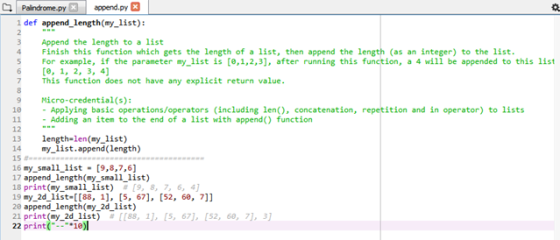
Here is the completed code in Python: (refer to screenshot below for indentations)
def append_length(my_list):
"""
Append the length to a list
Finish this function which gets the length of a list, then append
the length (as an integer) to the list.
For example, if the parameter my_list is [0,1,2,3], after running
this function, a 4 will be appended to this list:
[0, 1, 2, 3, 4]
This function does not have any explicit return value.
Micro-credential(s):
- Applying basic operations/operators (including len(),
concatenation, repetition and in operator) to lists
- Adding an item to the end of a list with append() function
"""
length=len(my_list)
my_list.append(length)
#=======================================
my_small_list = [9,8,7,6]
append_length(my_small_list)
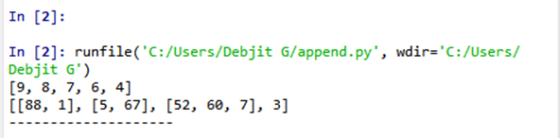
print(my_small_list) # [9, 8, 7, 6, 4]
my_2d_list=[[88, 1], [5, 67], [52, 60, 7]]
append_length(my_2d_list)
print(my_2d_list) # [[88, 1], [5, 67], [52, 60, 7], 3]
print("--"*10)
Output:
Add Answer to:
def append_length(my_list):
"""
Append the length to a list
Finish this function which gets the length...
def double_odd_values(my_list): """ 04. making changes to some values in a list Finish this function takes...
def double_odd_values(my_list): """ 04. making changes to some values in a list Finish this function takes a list as parameter, and double all the odd values in place. For example, for the parameter [1, 2, 3], after calling this function, the list will be changed to [2,2,6] and the changes will be made in place. You can assume all the items in the parameter are integers. There is no explicit return value for this function. - Updating the items in...
Explain this lisp recursive function that gets the length of a list. ; a recursive function...
Explain this lisp recursive function that gets the length of a list. ; a recursive function to find the lenght of the list (defun len (list) (if list (1+ (len (cdr list))) 0)) What does the 1+ and the 0 at the end do?
Python homework Write a function called insert_value(my_list, value, insert_position) that takes a list, a value and...
Python homework Write a function called insert_value(my_list, value, insert_position) that takes a list, a value and an insert_position as parameters. The function returns a copy of the list with the value inserted into the list (my_list) at the index specified by insert_position. Check for the insert_position value exceeding the list (my_list) bounds. if the insert_position is greater than the length of the list, insert the value at the end of the list. if the insert_position is less than or equal...
1. What is the result of calling the append method on a list? 2. What must...
1. What is the result of calling the append method on a list? 2. What must be defined prior to using a method like append? 3. Explain why two lines caused an IndexError. 4. What is the result of calling the remove method on a list? 5. Give one example of a list method that requires an argument and one that does not. 6. Describe the syntax similarities and differences between using a list method like append and Python built-in...
Create a Scheme function for the following: Thank you! 2. combine which has 3 arguments that...
 Create a Scheme function for the following:
Thank you!
2. combine which has 3 arguments that are all lists. The result should be equivalent to the concatenation of the first list, the reverse of the second list, followed by the third list. Use the built-in functions append and reverse. For example, (combine '(1 2) (3 4 5) '(6 7)) should return the list '(1 2 5 4 3 6 7).
Create a Scheme function for the following:
Thank you!
2. combine which has 3 arguments that are all lists. The result should be equivalent to the concatenation of the first list, the reverse of the second list, followed by the third list. Use the built-in functions append and reverse. For example, (combine '(1 2) (3 4 5) '(6 7)) should return the list '(1 2 5 4 3 6 7).
Python: P2 Write a function that reverses a python list using recursion (Chapter 6-3 in our...
Python: P2 Write a function that reverses a python list using recursion (Chapter 6-3 in our textbook) E.g.: Input: [9, 8, 7, 6, 5, 4, 3, 2, 1, 0] Output: [0, 1, 2, 3, 4, 5, 6, 7, 8, 9] Constraints: - List elements are integers - The function should return a reversed array, not print its elements You may use the following code as template: def reverse(my_list, index = None): # your code here
In LISP write one function using length that gets the last atom in a list and...
In LISP write one function using length that gets the last atom in a list and another function that triples all the elements in a list (triple-value '(1 2 3 4 5)) so the result should be (1 8 27 64 125)
(+30) Provide a python program which will Populate an array(list) of size 25 with integers in...
(+30) Provide a python program which will Populate an array(list) of size 25 with integers in the range -100 (negative 100) to +100 inclusive Display the array and its length (use the len function) Display the average of all the integers in the array Display the number of even integers (how many) Display the number of odd integers (how many) Display the number of integers > 0 (how many) Display the number of integers < 0 (how many) Display the...
Question 1a - Increasing Numbers in List - First Occurence(3 points) Write a function numIncreasing1(L) that...
 Question 1a - Increasing Numbers in List - First Occurence(3 points) Write a function numIncreasing1(L) that takes as input a list of numbers and returns a list of the first sequence within that is increasing order, and has a length of at least 2. If no increasing sequential numbers are found, (ie. the input list is in descending order) then naturally a list of just the first value is returned. Increasing sequence means for a number to be valid it...
1 [Run Lengths] Write a function (in Python and numpy) with the following specification def run_lenths(n,...
1 [Run Lengths] Write a function (in Python and numpy) with the following specification def run_lenths(n, p): """Return a list of the run lengths in n tosses of a coin whose heads probability is p. Arguments: n--Number of tosses (a positive int), p--The probability of observing heads for any given toss (float between 0 and 1). """ For example, if the simulated sequence of coin tosses is HTTHHTHHHTTHHTTTTH, then the list of run lengths the function returns will be [1,...
 Create a Scheme function for the following:
Thank you!
2. combine which has 3 arguments that are all lists. The result should be equivalent to the concatenation of the first list, the reverse of the second list, followed by the third list. Use the built-in functions append and reverse. For example, (combine '(1 2) (3 4 5) '(6 7)) should return the list '(1 2 5 4 3 6 7).
Create a Scheme function for the following:
Thank you!
2. combine which has 3 arguments that are all lists. The result should be equivalent to the concatenation of the first list, the reverse of the second list, followed by the third list. Use the built-in functions append and reverse. For example, (combine '(1 2) (3 4 5) '(6 7)) should return the list '(1 2 5 4 3 6 7).
 Question 1a - Increasing Numbers in List - First Occurence(3 points) Write a function numIncreasing1(L) that takes as input a list of numbers and returns a list of the first sequence within that is increasing order, and has a length of at least 2. If no increasing sequential numbers are found, (ie. the input list is in descending order) then naturally a list of just the first value is returned. Increasing sequence means for a number to be valid it...
Most questions answered within 3 hours.
-
Where is the error in this code sequence?
String s1 = "Hello";
String s2 = "ello";...
asked 10 months ago -
Financial data for Joel de Paris, Inc., for last year
follow:
Joel de Paris, Inc.
Balance...
asked 10 months ago -
Consider this reaction:
Al2(SO4)3 (aq)+ BaCl3
(aq) Al2Cl6 (aq)- +
3BaSO4(s) . What is the...
asked 10 months ago -
Suppose that Savneet is considering increasing her
recent random sample from 20 car rentals to 40...
asked 10 months ago -
Trucks arrive at an unloading terminal at an average rate of 120
per hour.
Trucks arrive...
asked 10 months ago -
Why are methanol and ethanol completely soluble in water while
octanol is not very little soluble....
asked 10 months ago -
A facilities manager at a university reads in a research report
that the mean amount of...
asked 10 months ago -
When the CuSO4 is rehydrated by adding water to the anhydrous
compound, is this an endothermic...
asked 10 months ago -
A ray of sunlight is passing from diamond into crown glass; the
angle of incidence is...
asked 10 months ago -
A block of mass 0.249 kg is placed on top of a light, vertical
spring of...
asked 10 months ago -
how do the kidneys compensate in the presences of acidosis
a) trigger hyperventilate
b) reserve acid...
asked 10 months ago -
Question 501 pts
The rental rate of capital to the firm increases. Which of the
following...
asked 10 months ago