The sodium azide required for automobile air bags is made by the reaction of sodium metal...
The sodium azide required for automobile air bags is made by the reaction of sodium metal with dinitrogen monoxide in liquid ammonia:
3N2O(g) + 4Na(s) + NH3(l) = NaN3(s) + 3NaOH(s) + 2N2(g)
You have 66.7 g of sodium, a 38.4-L flask containing N2O gas with a pressure of 2.93 atm at 24 °C, and excess ammonia. What is the theoretical yield (in grams) of NaN3?
Homework Answers

Add Answer to:
The sodium azide required for automobile air bags is made by the
reaction of sodium metal...
The sodium azide required for automobile air bags is made by the reaction of sodium metal...
The sodium azide required for automobile air bags is made by the reaction of sodium metal with dinitrogen monoxide in liquid ammonia: You have 62.8 g of sodium, a 35.5-L flask containing N2O gas with a pressure of 2.48 atm at 23 °C, and excess ammonia. What is the theoretical yield (in grams) of NaN3? 3 N2O (g) + 4 Na (s) + NH3 (l) ---> NaN3 (s) + 3 NaOH (s) + 2 N2 (g) Mass = g
de in agus asmoa The sodium azide required for automobile bags is made by the reaction...
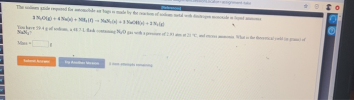 de in agus asmoa The sodium azide required for automobile bags is made by the reaction of sodium metal with donutsoen mo 3 NO(8) + 4 Na(9) +NH ( + NaNa (8) + 3 NaOH(4) + 2 N3 (8) You have 59.4 g of sodium, 248.7.La conting N, O gas with a pressure of 2.93 atm 21 °C, and excess NaN3? monia. What is the theoretical yield (in grams) of Submit AS Try Another Version
10. (10 points) Sodium azide, NaNs, is used to provide gas to inflate automobile air bags....
 10. (10 points) Sodium azide, NaNs, is used to provide gas to inflate automobile air bags. What mass of sodium azide is needed to provide the nitrogen needed to inflate a 70.0 L bag to a pressure of 1.3 atm at 25°C? 2 NaN3 (s) → 2 Na (s) + 3 N2(g)
1. Automotive air bags inflate when a sample of sodium azide, NaN3, is very rapidly decomposed:...
1. Automotive air bags inflate when a sample of sodium azide, NaN3, is very rapidly decomposed: 2NaN3 (s) ―—› 2Na(s) + 3N2(g) What mass of sodium azide is required to produce 2.6 ft3 (73.6 L) of nitrogen gas with a density of 1.25 g/L?
QUESTION 3 Automobile airbags use the decomposition of sodium azide, NaN3, to provide gas for rapid...
 QUESTION 3 Automobile airbags use the decomposition of sodium azide, NaN3, to provide gas for rapid inflation 2 NaN3(s) - 2 Na(s) + 3 N2(9) Using stoichiometry and the ideal gas law, calculate the mass (ing) of NaN3 required to provide 42 L of N2(g) at 28.3 °C and 1.00 atm?
Automobile airbags contain solid sodium azide, NaN3, that reacts to produce nitrogen gas when heated, thus...
Automobile airbags contain solid sodium azide, NaN3, that reacts to produce nitrogen gas when heated, thus inflating the bag. 2NaN3(s)⟶2Na(s)+3N2(g) Calculate the value of work, ?, for the system if 13.2 g NaN3 reacts completely at 1.00 atm and 22 ∘ C.
Automobile airbags contain solid sodium azide,NaN3, that reacts to produce nitrogen gas when heated, thus inflating...
Automobile airbags contain solid sodium azide,NaN3, that reacts to produce nitrogen gas when heated, thus inflating the bag. 2NaN3(s)⟶2Na(s)+3N2(g) Calculate the value of work w, for the system if 22.7 g NaN3 reacts completely at 1.00 atm and 22 ∘C.
Automotive air bags inflate when sodium azide, NaN3, rapidly decomposes to its component elements: 2NaN3(s)→2Na(s)+3N2(g) a....
Automotive air bags inflate when sodium azide, NaN3, rapidly decomposes to its component elements: 2NaN3(s)→2Na(s)+3N2(g) a. How many moles of N2 are produced by the decomposition of 1.70 mol of NaN3? b. How many grams of NaN3 are required to form 13.0 g of nitrogen gas? c. How many grams of NaN3 are required to produce 11.0 ft3 of nitrogen gas if the gas has a density of 1.25 g/L?
QUESTION 3 Automobile airbags use the decomposition of sodium azide, NaN3, to provide gas for rapid...
 QUESTION 3 Automobile airbags use the decomposition of sodium azide, NaN3, to provide gas for rapid inflation: 2 NaN3(s) → 2 Na(s) + 3 N2(g). Using stoichiometry and the ideal gas law, calculate the mass (in g) of NaN3 required to provide 27.2 L of N2(g) at 44 °C and 1.00 atm? QUESTION 4 Consider the reaction between hydrogen gas and oxygen gas to form water: 2 H2(g) + O2(g) + 2 H20(9). How many grams of water could be...
Automobile airbags use the decomposition of sodium azide, NaN3, to provide gas for rapid inflation: 2...
 Automobile airbags use the decomposition of sodium azide, NaN3, to provide gas for rapid inflation: 2 NaN3(s) – 2 Na(s) + 3 N2(9). Using stoichiometry and the ideal gas law, calculate the mass (in g) of NaN3 required to provide 20 L of N2(g) at 38 °C and 1.00 atm? QUESTION 4 Consider the reaction between hydrogen gas and oxygen gas to form water: 2 H2(g) + O2(g) → 2 H2O(g). How many grams of water could be produced by...
 de in agus asmoa The sodium azide required for automobile bags is made by the reaction of sodium metal with donutsoen mo 3 NO(8) + 4 Na(9) +NH ( + NaNa (8) + 3 NaOH(4) + 2 N3 (8) You have 59.4 g of sodium, 248.7.La conting N, O gas with a pressure of 2.93 atm 21 °C, and excess NaN3? monia. What is the theoretical yield (in grams) of Submit AS Try Another Version
 10. (10 points) Sodium azide, NaNs, is used to provide gas to inflate automobile air bags. What mass of sodium azide is needed to provide the nitrogen needed to inflate a 70.0 L bag to a pressure of 1.3 atm at 25°C? 2 NaN3 (s) → 2 Na (s) + 3 N2(g)
 QUESTION 3 Automobile airbags use the decomposition of sodium azide, NaN3, to provide gas for rapid inflation 2 NaN3(s) - 2 Na(s) + 3 N2(9) Using stoichiometry and the ideal gas law, calculate the mass (ing) of NaN3 required to provide 42 L of N2(g) at 28.3 °C and 1.00 atm?
 QUESTION 3 Automobile airbags use the decomposition of sodium azide, NaN3, to provide gas for rapid inflation: 2 NaN3(s) → 2 Na(s) + 3 N2(g). Using stoichiometry and the ideal gas law, calculate the mass (in g) of NaN3 required to provide 27.2 L of N2(g) at 44 °C and 1.00 atm? QUESTION 4 Consider the reaction between hydrogen gas and oxygen gas to form water: 2 H2(g) + O2(g) + 2 H20(9). How many grams of water could be...
 Automobile airbags use the decomposition of sodium azide, NaN3, to provide gas for rapid inflation: 2 NaN3(s) – 2 Na(s) + 3 N2(9). Using stoichiometry and the ideal gas law, calculate the mass (in g) of NaN3 required to provide 20 L of N2(g) at 38 °C and 1.00 atm? QUESTION 4 Consider the reaction between hydrogen gas and oxygen gas to form water: 2 H2(g) + O2(g) → 2 H2O(g). How many grams of water could be produced by...
Most questions answered within 3 hours.
-
Where is the error in this code sequence?
String s1 = "Hello";
String s2 = "ello";...
asked 11 months ago -
Financial data for Joel de Paris, Inc., for last year
follow:
Joel de Paris, Inc.
Balance...
asked 11 months ago -
Consider this reaction:
Al2(SO4)3 (aq)+ BaCl3
(aq) Al2Cl6 (aq)- +
3BaSO4(s) . What is the...
asked 11 months ago -
Suppose that Savneet is considering increasing her
recent random sample from 20 car rentals to 40...
asked 11 months ago -
Trucks arrive at an unloading terminal at an average rate of 120
per hour.
Trucks arrive...
asked 11 months ago -
Why are methanol and ethanol completely soluble in water while
octanol is not very little soluble....
asked 11 months ago -
A facilities manager at a university reads in a research report
that the mean amount of...
asked 11 months ago -
When the CuSO4 is rehydrated by adding water to the anhydrous
compound, is this an endothermic...
asked 11 months ago -
A ray of sunlight is passing from diamond into crown glass; the
angle of incidence is...
asked 11 months ago -
A block of mass 0.249 kg is placed on top of a light, vertical
spring of...
asked 11 months ago -
how do the kidneys compensate in the presences of acidosis
a) trigger hyperventilate
b) reserve acid...
asked 11 months ago -
Question 501 pts
The rental rate of capital to the firm increases. Which of the
following...
asked 11 months ago