You are told that the frequency dependence of the gain of a circuit goes like w^-4....
You are told that the frequency dependence of the gain of a circuit goes like w^-4. If you measured a Bode plot for this circuit, what would you find for the slope of the Bode Plot in dB/decade?
Homework Answers

Add Answer to:
You are told that the frequency dependence of the gain of a
circuit goes like w^-4....
A circuit has a gain that goes as G(w)=A/ (sqrt(w)) What are the dimensions of the...
A circuit has a gain that goes as G(w)=A/ (sqrt(w)) What are the dimensions of the constant A? What is the slope of the bode plot in dB/decade?
C 1m2 w 1E-4 1E-10 2.1: What is the resonant frequency of the circuit? 2.2: When...
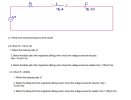 C 1m2 w 1E-4 1E-10 2.1: What is the resonant frequency of the circuit? 2.2: When R = 100.01 kO 1. What is the damping ratio, 5? 2. Sketch the Bode plot of the magnitude (dB-log) when Vout is the voltage across the inductor, H(s) VL(s)N1(s) 3. Sketch the Bode plot of the magnitude (dB-log) when Vout is the voltage across the resistor H(s) = VR(s)N1(s) 2.3. When R = 20000, 1. What is the damping ratio, ? 2. Sketch...
(a) Show that a fall-off of 6dB/octave is equal to 20dB/decade. (Recall that an octave is...
(a) Show that a fall-off of 6dB/octave is equal to 20dB/decade. (Recall that an octave is a factor of two in frequency, while a decade is a factor of ten.) (b) If the curve on a Bode plot is falling off at 60 dB/decade, what is the frequency dependence of the gain?
752) See Figure 752. D-4. The Bode gain and phase plots for a RC circuit are phase (deg), and frequency B. Also find the other shown in the fig. Determine gain (dB), (rad/sec) for the points la...
 752) See Figure 752. D-4. The Bode gain and phase plots for a RC circuit are phase (deg), and frequency B. Also find the other shown in the fig. Determine gain (dB), (rad/sec) for the points labeled A and exponents. Answers: GdBA, phA, wA, GdBB, phB,wB,C, E,F. ans:9 Bode Gain and Phase Plots Gain in dB 6 -10 12.64 10 Frequency in rad/sec 10 10 Phase in deg 765 40 10 F 4764 Frequency in rad/sec Figure 752 10 10...
3. For the active filter circuit below, complete the following: a) Find the magnitude of the...
 3. For the active filter circuit below, complete the following: a) Find the magnitude of the transfer function | H | starting from the nodal equations. b) Find the phase shift of the transfer function (W) c) Find the cutoff frequency fc in Hz d) Is this a high pass or low pass filter? e) Find the passband gain of the filter 62 k2 ANA EVA 22 nF 3.3k f) Given the following input signal: vi(t) = 1.0 sin(2nft +...
Design a lowpass filter, with cutoff frequencỵ 14 16 rad s w. The maximum gain of the filter should be A 17.46 dB, and...
 Design a lowpass filter, with cutoff frequencỵ 14 16 rad s w. The maximum gain of the filter should be A 17.46 dB, and the filter gain at angularfrequencỵws 3519 rad should be no more than As -21.99 dB. a) Give a detailed analytical solution, leading to your filter order, and circuit parameters Sketchan approximate bode plot of your filter's frequency response, using a straight line approxi- mation Can you solve the problem? I think its 3th order if im...
Chapter 12, Problem 12.16 Describe the sketch of the magnitude characteristic of the Bode plot for...
 Chapter 12, Problem 12.16 Describe the sketch of the magnitude characteristic of the Bode plot for the transfer function The magnitude asymptote plot has a slope of dB/decade from ω-0 to ω! rad/s, a slope of dB/decade from ω1 to ω2- 5 rad/s, a slope of dB/decade from ω2 to ω3-65 rad/s, and a slope of dB/decade from w3 to oo. The value of the magnitude asymptote at 0.1 rad/s is dB. Click if you would like to Show Work...
12. Design a fourth order, 2 dB Chebyshev highpass filter with a cutoff frequency of 2.4...
 12. Design a fourth order, 2 dB Chebyshev highpass filter with a cutoff frequency of 2.4 kHz a. Draw the circuit, labeling Vin, Yout, and all component values. (14 points) and a passband gain of 0 dB. Use capacitor values of 3300 pF an approximation of the Bode plot of the magnitude transfer function IH(ia) in dB, İndicating the ripple, the cutoff frequency, and the approximate filter roll-off in dB/decade. Note, this does not reguire solving for the function. (6...
3) Opamp Frequency Response An opamp comprises 2 voltage gain stages; cach yields a gain of 500. The 3 dB roll- off frequencies of the 2 gain stages are at 40 Hz and 10 MHz, respectively a) What is t...
 3) Opamp Frequency Response An opamp comprises 2 voltage gain stages; cach yields a gain of 500. The 3 dB roll- off frequencies of the 2 gain stages are at 40 Hz and 10 MHz, respectively a) What is the approximate value of the unity-gain frequency FuG of this opamp? (Hint: consider the asymptotic Bode plot).
3) Opamp Frequency Response An opamp comprises 2 voltage gain stages; cach yields a gain of 500. The 3 dB roll- off frequencies of...
3) Opamp Frequency Response An opamp comprises 2 voltage gain stages; cach yields a gain of 500. The 3 dB roll- off frequencies of the 2 gain stages are at 40 Hz and 10 MHz, respectively a) What is the approximate value of the unity-gain frequency FuG of this opamp? (Hint: consider the asymptotic Bode plot).
3) Opamp Frequency Response An opamp comprises 2 voltage gain stages; cach yields a gain of 500. The 3 dB roll- off frequencies of...
 C 1m2 w 1E-4 1E-10 2.1: What is the resonant frequency of the circuit? 2.2: When R = 100.01 kO 1. What is the damping ratio, 5? 2. Sketch the Bode plot of the magnitude (dB-log) when Vout is the voltage across the inductor, H(s) VL(s)N1(s) 3. Sketch the Bode plot of the magnitude (dB-log) when Vout is the voltage across the resistor H(s) = VR(s)N1(s) 2.3. When R = 20000, 1. What is the damping ratio, ? 2. Sketch...
 752) See Figure 752. D-4. The Bode gain and phase plots for a RC circuit are phase (deg), and frequency B. Also find the other shown in the fig. Determine gain (dB), (rad/sec) for the points labeled A and exponents. Answers: GdBA, phA, wA, GdBB, phB,wB,C, E,F. ans:9 Bode Gain and Phase Plots Gain in dB 6 -10 12.64 10 Frequency in rad/sec 10 10 Phase in deg 765 40 10 F 4764 Frequency in rad/sec Figure 752 10 10...
 3. For the active filter circuit below, complete the following: a) Find the magnitude of the transfer function | H | starting from the nodal equations. b) Find the phase shift of the transfer function (W) c) Find the cutoff frequency fc in Hz d) Is this a high pass or low pass filter? e) Find the passband gain of the filter 62 k2 ANA EVA 22 nF 3.3k f) Given the following input signal: vi(t) = 1.0 sin(2nft +...
 Design a lowpass filter, with cutoff frequencỵ 14 16 rad s w. The maximum gain of the filter should be A 17.46 dB, and the filter gain at angularfrequencỵws 3519 rad should be no more than As -21.99 dB. a) Give a detailed analytical solution, leading to your filter order, and circuit parameters Sketchan approximate bode plot of your filter's frequency response, using a straight line approxi- mation Can you solve the problem? I think its 3th order if im...
 Chapter 12, Problem 12.16 Describe the sketch of the magnitude characteristic of the Bode plot for the transfer function The magnitude asymptote plot has a slope of dB/decade from ω-0 to ω! rad/s, a slope of dB/decade from ω1 to ω2- 5 rad/s, a slope of dB/decade from ω2 to ω3-65 rad/s, and a slope of dB/decade from w3 to oo. The value of the magnitude asymptote at 0.1 rad/s is dB. Click if you would like to Show Work...
 12. Design a fourth order, 2 dB Chebyshev highpass filter with a cutoff frequency of 2.4 kHz a. Draw the circuit, labeling Vin, Yout, and all component values. (14 points) and a passband gain of 0 dB. Use capacitor values of 3300 pF an approximation of the Bode plot of the magnitude transfer function IH(ia) in dB, İndicating the ripple, the cutoff frequency, and the approximate filter roll-off in dB/decade. Note, this does not reguire solving for the function. (6...
 3) Opamp Frequency Response An opamp comprises 2 voltage gain stages; cach yields a gain of 500. The 3 dB roll- off frequencies of the 2 gain stages are at 40 Hz and 10 MHz, respectively a) What is the approximate value of the unity-gain frequency FuG of this opamp? (Hint: consider the asymptotic Bode plot).
3) Opamp Frequency Response An opamp comprises 2 voltage gain stages; cach yields a gain of 500. The 3 dB roll- off frequencies of...
3) Opamp Frequency Response An opamp comprises 2 voltage gain stages; cach yields a gain of 500. The 3 dB roll- off frequencies of the 2 gain stages are at 40 Hz and 10 MHz, respectively a) What is the approximate value of the unity-gain frequency FuG of this opamp? (Hint: consider the asymptotic Bode plot).
3) Opamp Frequency Response An opamp comprises 2 voltage gain stages; cach yields a gain of 500. The 3 dB roll- off frequencies of...
Most questions answered within 3 hours.
-
Where is the error in this code sequence?
String s1 = "Hello";
String s2 = "ello";...
asked 11 months ago -
Financial data for Joel de Paris, Inc., for last year
follow:
Joel de Paris, Inc.
Balance...
asked 11 months ago -
Consider this reaction:
Al2(SO4)3 (aq)+ BaCl3
(aq) Al2Cl6 (aq)- +
3BaSO4(s) . What is the...
asked 11 months ago -
Suppose that Savneet is considering increasing her
recent random sample from 20 car rentals to 40...
asked 11 months ago -
Trucks arrive at an unloading terminal at an average rate of 120
per hour.
Trucks arrive...
asked 11 months ago -
Why are methanol and ethanol completely soluble in water while
octanol is not very little soluble....
asked 11 months ago -
A facilities manager at a university reads in a research report
that the mean amount of...
asked 11 months ago -
When the CuSO4 is rehydrated by adding water to the anhydrous
compound, is this an endothermic...
asked 11 months ago -
A ray of sunlight is passing from diamond into crown glass; the
angle of incidence is...
asked 11 months ago -
A block of mass 0.249 kg is placed on top of a light, vertical
spring of...
asked 11 months ago -
how do the kidneys compensate in the presences of acidosis
a) trigger hyperventilate
b) reserve acid...
asked 11 months ago -
Question 501 pts
The rental rate of capital to the firm increases. Which of the
following...
asked 11 months ago