Two planets with masses M1 and M2 are located at a distance d from each far...
Homework Answers
For better understanding i am supposing mass of satellite be
m if any doubt please comment if
you like my solution hit the like button below
if any doubt please comment if
you like my solution hit the like button below
Add Answer to:
Two planets with masses M1 and M2 are located at a distance d
from each far...
Two masses m1 and m2 are located a distance r apart and are initially at rest....
Two masses m1 and m2 are located a distance r apart and are initially at rest. Due to the attractive gravitational force, the two masses will move towards each other. Find the velocity of each mass when they are located a distance d apart. You are given G. (Answer: For mass m1: v1 = m2sqrt(2G(1/d-1/r)/(m1 + m2)))
Two bodies with masses m1 and m2 are located in some distance ‘d’ between each other.they...
Two bodies with masses m1 and m2 are located in some distance ‘d’ between each other.they are attract each other with the gravity of force 1N.what is the gravity force between anther two bodies if their masses and the distance between each other are greater exactly twice than for the first bodies?
answer all please Problem 1. A block of mass m = 735 g is located on...
 answer all please
Problem 1. A block of mass m = 735 g is located on an incline which makes an angle of 40 with the horizontal The friction coefficient between the block and the incline is K = 0.21. The block is released and it is let slide down the incline. (a) Draw a free body diagram and identify all forces acting on the block. Find the acceleration of the block (b) If the block moves d = 0.42...
answer all please
Problem 1. A block of mass m = 735 g is located on an incline which makes an angle of 40 with the horizontal The friction coefficient between the block and the incline is K = 0.21. The block is released and it is let slide down the incline. (a) Draw a free body diagram and identify all forces acting on the block. Find the acceleration of the block (b) If the block moves d = 0.42...
Learning Goal: To understand Newton's law of gravitation and the distinction between inertial and gravitational masses....
 Learning Goal: To understand Newton's law of gravitation and the distinction between inertial and gravitational masses. In this problem, you will practice using Newton's law of gravitation. According to that law, the magnitude of the gravitational force Fg between two small particles of masses m1 and m2 separated by a distance r, is given by m1m2 T2 where G is the universal gravitational constant, whose numerical value (in SI units) is 6.67 x 10⁻¹¹ Nm2 kg2 This formula applies not...
Four planets, A through D, orbit the same star. The relative masses and distances from the...
Four planets, A through D, orbit the same star. The relative masses and distances from the start for each planet are shown in the table. For example, Plant A has twice the mass of Planet B, and Planet D has three times the orbital radius of Planet A. Which planet has the highest gravitational attraction to the star and why? Planet A, relative mass is 2m, relative distance is r Planet B, relative mass is m, relative distance is 0.1...
----------- ---------- m1 - - - - m3 Suppose three planets, each with a mass of...
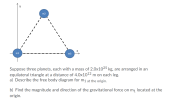 ----------- ---------- m1 - - - - m3 Suppose three planets, each with a mass of 2.0x1025 kg, are arranged in an equilateral triangle at a distance of 4.0x10¹² m on each leg. a) Describe the free body diagram for m1 at the origin. b) Find the magnitude and direction of the gravitational force on my located at the origin.
Two masses are in space far away from any star or planet. Mass 1 is 2...
 Two masses are in space far away from any star or planet. Mass 1 is 2 times 10^5 kg and mass 2 is 13 kg. The magnitude of the gravitational force between is 1.2 Newtons. If mass 2 is orbiting in a circular orbit around mass 1, what is its period of orbit in seconds? Assume mass 1 is not moving at all.
You have two equal masses m1 and m2 and a spring with a spring constant k....
 You have two equal masses m1 and m2 and a
spring with a spring constant k. The mass m1 is
connected to the spring and placed on a frictionless horizontal
surface at the relaxed position of the spring. You then hang mass
m2, connected to mass m1 by a
massless cord, over a pulley at the edge of the horizontal surface.
When the entire system comes to rest in the equilibrium position,
the spring is stretched an amount d1 as shown...
You have two equal masses m1 and m2 and a
spring with a spring constant k. The mass m1 is
connected to the spring and placed on a frictionless horizontal
surface at the relaxed position of the spring. You then hang mass
m2, connected to mass m1 by a
massless cord, over a pulley at the edge of the horizontal surface.
When the entire system comes to rest in the equilibrium position,
the spring is stretched an amount d1 as shown...
Two masses, m1 and m2 are separated by a distance, r. The force of attraction between...
Two masses, m1 and m2 are separated by a distance, r. The force of attraction between the two masses is F. If the original force is 20N and both masses quadruple while the r decreases to ¼ of the original distance: A) how much would F change? B) what will be the new force?
5. A simple Atwood machine consists of two masses m1 and m2 that are connected by...
 5. A simple Atwood machine consists of two masses
m1 and m2 that are
connected by a string wound over a pulley, as seen in the figure
below. Assume m2 is larger than
m1. Motion in the upward direction is positive.
On a piece of paper, draw two free body diagrams; one for each of
the masses, showing all forces acting on each mass. Then answer the
following questions.
(b) Using the direction rosette indicate the direction for each
of...
5. A simple Atwood machine consists of two masses
m1 and m2 that are
connected by a string wound over a pulley, as seen in the figure
below. Assume m2 is larger than
m1. Motion in the upward direction is positive.
On a piece of paper, draw two free body diagrams; one for each of
the masses, showing all forces acting on each mass. Then answer the
following questions.
(b) Using the direction rosette indicate the direction for each
of...
 answer all please
Problem 1. A block of mass m = 735 g is located on an incline which makes an angle of 40 with the horizontal The friction coefficient between the block and the incline is K = 0.21. The block is released and it is let slide down the incline. (a) Draw a free body diagram and identify all forces acting on the block. Find the acceleration of the block (b) If the block moves d = 0.42...
answer all please
Problem 1. A block of mass m = 735 g is located on an incline which makes an angle of 40 with the horizontal The friction coefficient between the block and the incline is K = 0.21. The block is released and it is let slide down the incline. (a) Draw a free body diagram and identify all forces acting on the block. Find the acceleration of the block (b) If the block moves d = 0.42...
 Learning Goal: To understand Newton's law of gravitation and the distinction between inertial and gravitational masses. In this problem, you will practice using Newton's law of gravitation. According to that law, the magnitude of the gravitational force Fg between two small particles of masses m1 and m2 separated by a distance r, is given by m1m2 T2 where G is the universal gravitational constant, whose numerical value (in SI units) is 6.67 x 10⁻¹¹ Nm2 kg2 This formula applies not...
 ----------- ---------- m1 - - - - m3 Suppose three planets, each with a mass of 2.0x1025 kg, are arranged in an equilateral triangle at a distance of 4.0x10¹² m on each leg. a) Describe the free body diagram for m1 at the origin. b) Find the magnitude and direction of the gravitational force on my located at the origin.
 Two masses are in space far away from any star or planet. Mass 1 is 2 times 10^5 kg and mass 2 is 13 kg. The magnitude of the gravitational force between is 1.2 Newtons. If mass 2 is orbiting in a circular orbit around mass 1, what is its period of orbit in seconds? Assume mass 1 is not moving at all.
 You have two equal masses m1 and m2 and a
spring with a spring constant k. The mass m1 is
connected to the spring and placed on a frictionless horizontal
surface at the relaxed position of the spring. You then hang mass
m2, connected to mass m1 by a
massless cord, over a pulley at the edge of the horizontal surface.
When the entire system comes to rest in the equilibrium position,
the spring is stretched an amount d1 as shown...
You have two equal masses m1 and m2 and a
spring with a spring constant k. The mass m1 is
connected to the spring and placed on a frictionless horizontal
surface at the relaxed position of the spring. You then hang mass
m2, connected to mass m1 by a
massless cord, over a pulley at the edge of the horizontal surface.
When the entire system comes to rest in the equilibrium position,
the spring is stretched an amount d1 as shown...
 5. A simple Atwood machine consists of two masses
m1 and m2 that are
connected by a string wound over a pulley, as seen in the figure
below. Assume m2 is larger than
m1. Motion in the upward direction is positive.
On a piece of paper, draw two free body diagrams; one for each of
the masses, showing all forces acting on each mass. Then answer the
following questions.
(b) Using the direction rosette indicate the direction for each
of...
5. A simple Atwood machine consists of two masses
m1 and m2 that are
connected by a string wound over a pulley, as seen in the figure
below. Assume m2 is larger than
m1. Motion in the upward direction is positive.
On a piece of paper, draw two free body diagrams; one for each of
the masses, showing all forces acting on each mass. Then answer the
following questions.
(b) Using the direction rosette indicate the direction for each
of...
Most questions answered within 3 hours.
-
Where is the error in this code sequence?
String s1 = "Hello";
String s2 = "ello";...
asked 10 months ago -
Financial data for Joel de Paris, Inc., for last year
follow:
Joel de Paris, Inc.
Balance...
asked 10 months ago -
Consider this reaction:
Al2(SO4)3 (aq)+ BaCl3
(aq) Al2Cl6 (aq)- +
3BaSO4(s) . What is the...
asked 10 months ago -
Suppose that Savneet is considering increasing her
recent random sample from 20 car rentals to 40...
asked 10 months ago -
Trucks arrive at an unloading terminal at an average rate of 120
per hour.
Trucks arrive...
asked 10 months ago -
Why are methanol and ethanol completely soluble in water while
octanol is not very little soluble....
asked 10 months ago -
A facilities manager at a university reads in a research report
that the mean amount of...
asked 10 months ago -
When the CuSO4 is rehydrated by adding water to the anhydrous
compound, is this an endothermic...
asked 10 months ago -
A ray of sunlight is passing from diamond into crown glass; the
angle of incidence is...
asked 10 months ago -
A block of mass 0.249 kg is placed on top of a light, vertical
spring of...
asked 10 months ago -
how do the kidneys compensate in the presences of acidosis
a) trigger hyperventilate
b) reserve acid...
asked 10 months ago -
Question 501 pts
The rental rate of capital to the firm increases. Which of the
following...
asked 10 months ago