How do you calculate the molar mass of an unknown sample when added To water and...
Homework Answers
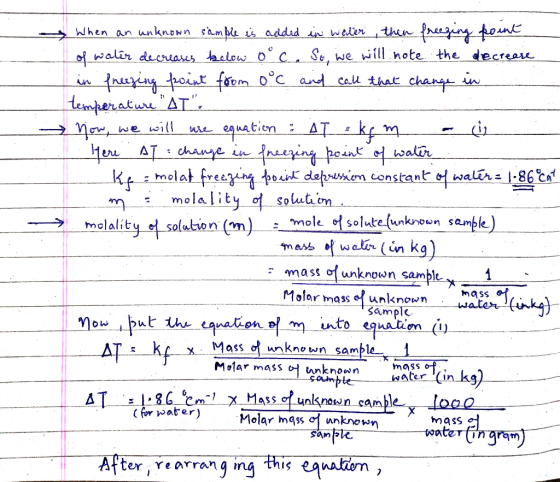
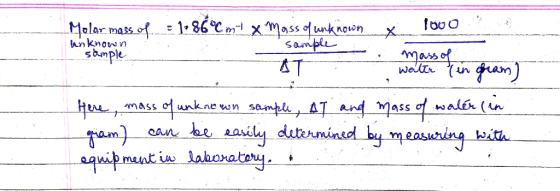
Well, the technique used here is called "freezing point depression."
If you don't understand something just ask me.
Add Answer to:
How
do you calculate the molar mass of an unknown sample when added To
water and...
A 0.155 g sample of a diprotic acid of unknown molar mass is dissolved in water...
A 0.155 g sample of a diprotic acid of unknown molar mass is dissolved in water and titrated with 0.1268 M NaOH. The equivalence point is reached after adding 13.2 mL of base. What is the molar mass of the unknown acid?
calculate the molar mass of the unknown acid round your answer to three significant digits. An...
 calculate the molar mass of the unknown acid round your answer
to three significant digits.
An analytical chemist weighs out 0.280 g of an unknown diprotic acid into a 250 ml. volumetric flask and dilutes to the mark with distilled water. She then titrates this solution with 0.1400 M NaOH solution. When the titration reaches the equivalence point, the chemist finds she has added 26.7 ml of NaOH solution Calculate the molar mass of the unknown acid. Round your answer...
calculate the molar mass of the unknown acid round your answer
to three significant digits.
An analytical chemist weighs out 0.280 g of an unknown diprotic acid into a 250 ml. volumetric flask and dilutes to the mark with distilled water. She then titrates this solution with 0.1400 M NaOH solution. When the titration reaches the equivalence point, the chemist finds she has added 26.7 ml of NaOH solution Calculate the molar mass of the unknown acid. Round your answer...
What is the molar mass of a substance that when added to 1.000 kg of water...
What is the molar mass of a substance that when added to 1.000 kg of water lowers the freezing temperature by 1.2 ºC? The amount added to water was 38.20 g and the substance has a van't Hoff factor of 3.
When 25 g of the unknown metal were added, the water was displaced 3.50 mL. Calculate...
When 25 g of the unknown metal were added, the water was displaced 3.50 mL. Calculate the density of the unknown metal. Remember, density = mass/volume. Express your answer as g/cm3 ( 1 mL = 1 cm3). Choose the closest answer. How many significant figures should be shown in the final answer?
please show how to calculate molar mass, and how to calculate mole from molar mass..please will...
 please show how to calculate molar mass, and how to calculate
mole from molar mass..please will give a thumbs up
11. What is the percent water in lithium nitrate trhydrate? (Show work for credit) 12. In another experiment, the mass of a hydrate was found to be 2.7090 grams. After heating, the anhydrous sample had a mass of 1.8820 grams. Answer the folowing and show al work for credit a. What was the mass of water lost? b. How many...
please show how to calculate molar mass, and how to calculate
mole from molar mass..please will give a thumbs up
11. What is the percent water in lithium nitrate trhydrate? (Show work for credit) 12. In another experiment, the mass of a hydrate was found to be 2.7090 grams. After heating, the anhydrous sample had a mass of 1.8820 grams. Answer the folowing and show al work for credit a. What was the mass of water lost? b. How many...
Calculate the molar mass of your unknown using delta T between experimental fp of pure water...
Calculate the molar mass of your unknown using delta T between experimental fp of pure water and fp with ~0.10 g of unknown. All unknowns are assumed to have i=1 unless given otherwise during the lab. Data Initial Temp for Pure Water 23.4°C Final Temp for Pure Water 0°C Initial Temp for H2O + unknown (~0.10 g) 5.2°C Final Temp for H2O + unknown (~0.10 g) -0.2°C Mass of Water 20.0 g Mass of Unknown 0.090 g
Given a .210 g sample of a diprotic acid of unknown molar mass: If the acid...
Given a .210 g sample of a diprotic acid of unknown molar mass: If the acid is dissolved in water and titrated with .241 M KOH it takes 10.5 mL of base to reach the equivalence point. What is the molar mass of the solution?
Chemistry: Molar mass determination and freezing point depression. If your unknown solute sample weighed 0.634 grams,...
 Chemistry:
Molar mass determination and freezing point depression.
If your unknown solute sample weighed 0.634 grams, but some of it stuck to the test tube wall when you were pouring it in and did not dissolve in the t-butyl alcohol, what sort of error will this cause in the calculated molar mass of your unknown solute? Explain. What would be the freezing point of an aqueous solution that contains 10.3 grams of ethylene glycol [(C_2H_4(OH)_2] in 100 mL of water?
Chemistry:
Molar mass determination and freezing point depression.
If your unknown solute sample weighed 0.634 grams, but some of it stuck to the test tube wall when you were pouring it in and did not dissolve in the t-butyl alcohol, what sort of error will this cause in the calculated molar mass of your unknown solute? Explain. What would be the freezing point of an aqueous solution that contains 10.3 grams of ethylene glycol [(C_2H_4(OH)_2] in 100 mL of water?
use the information given to calculate the formula for mass/molar mass of the anhydrous salt of...
 use the information given to calculate the formula for
mass/molar mass of the anhydrous salt of your unknown sample(show
calculations)
B. Determine the Formula of an Unknown Hydrate Unknown sample number: 20 Nickel II Molecular formula of the unknown: 1. Mass of crucible + unknown hydrate Nisou "X"H60 (sulfate) 37.40g 36-3lg 1:09g 2. Mass of crucible 3. Mass of unknown hydrate( 1 - 2) 4. Mass of crucible + anhydrous salt a. after first heating b. after second heating 31.3919...
use the information given to calculate the formula for
mass/molar mass of the anhydrous salt of your unknown sample(show
calculations)
B. Determine the Formula of an Unknown Hydrate Unknown sample number: 20 Nickel II Molecular formula of the unknown: 1. Mass of crucible + unknown hydrate Nisou "X"H60 (sulfate) 37.40g 36-3lg 1:09g 2. Mass of crucible 3. Mass of unknown hydrate( 1 - 2) 4. Mass of crucible + anhydrous salt a. after first heating b. after second heating 31.3919...
An unknown metal has a mass of 30.5 g. When 545 J of heat are added...
An unknown metal has a mass of 30.5 g. When 545 J of heat are added to the sample, the sample temperature changes by 39.8 ∘C . Calculate the specific heat of the unknown metal.
 calculate the molar mass of the unknown acid round your answer
to three significant digits.
An analytical chemist weighs out 0.280 g of an unknown diprotic acid into a 250 ml. volumetric flask and dilutes to the mark with distilled water. She then titrates this solution with 0.1400 M NaOH solution. When the titration reaches the equivalence point, the chemist finds she has added 26.7 ml of NaOH solution Calculate the molar mass of the unknown acid. Round your answer...
calculate the molar mass of the unknown acid round your answer
to three significant digits.
An analytical chemist weighs out 0.280 g of an unknown diprotic acid into a 250 ml. volumetric flask and dilutes to the mark with distilled water. She then titrates this solution with 0.1400 M NaOH solution. When the titration reaches the equivalence point, the chemist finds she has added 26.7 ml of NaOH solution Calculate the molar mass of the unknown acid. Round your answer...
 please show how to calculate molar mass, and how to calculate
mole from molar mass..please will give a thumbs up
11. What is the percent water in lithium nitrate trhydrate? (Show work for credit) 12. In another experiment, the mass of a hydrate was found to be 2.7090 grams. After heating, the anhydrous sample had a mass of 1.8820 grams. Answer the folowing and show al work for credit a. What was the mass of water lost? b. How many...
please show how to calculate molar mass, and how to calculate
mole from molar mass..please will give a thumbs up
11. What is the percent water in lithium nitrate trhydrate? (Show work for credit) 12. In another experiment, the mass of a hydrate was found to be 2.7090 grams. After heating, the anhydrous sample had a mass of 1.8820 grams. Answer the folowing and show al work for credit a. What was the mass of water lost? b. How many...
 Chemistry:
Molar mass determination and freezing point depression.
If your unknown solute sample weighed 0.634 grams, but some of it stuck to the test tube wall when you were pouring it in and did not dissolve in the t-butyl alcohol, what sort of error will this cause in the calculated molar mass of your unknown solute? Explain. What would be the freezing point of an aqueous solution that contains 10.3 grams of ethylene glycol [(C_2H_4(OH)_2] in 100 mL of water?
Chemistry:
Molar mass determination and freezing point depression.
If your unknown solute sample weighed 0.634 grams, but some of it stuck to the test tube wall when you were pouring it in and did not dissolve in the t-butyl alcohol, what sort of error will this cause in the calculated molar mass of your unknown solute? Explain. What would be the freezing point of an aqueous solution that contains 10.3 grams of ethylene glycol [(C_2H_4(OH)_2] in 100 mL of water?
 use the information given to calculate the formula for
mass/molar mass of the anhydrous salt of your unknown sample(show
calculations)
B. Determine the Formula of an Unknown Hydrate Unknown sample number: 20 Nickel II Molecular formula of the unknown: 1. Mass of crucible + unknown hydrate Nisou "X"H60 (sulfate) 37.40g 36-3lg 1:09g 2. Mass of crucible 3. Mass of unknown hydrate( 1 - 2) 4. Mass of crucible + anhydrous salt a. after first heating b. after second heating 31.3919...
use the information given to calculate the formula for
mass/molar mass of the anhydrous salt of your unknown sample(show
calculations)
B. Determine the Formula of an Unknown Hydrate Unknown sample number: 20 Nickel II Molecular formula of the unknown: 1. Mass of crucible + unknown hydrate Nisou "X"H60 (sulfate) 37.40g 36-3lg 1:09g 2. Mass of crucible 3. Mass of unknown hydrate( 1 - 2) 4. Mass of crucible + anhydrous salt a. after first heating b. after second heating 31.3919...
Most questions answered within 3 hours.
-
Where is the error in this code sequence?
String s1 = "Hello";
String s2 = "ello";...
asked 11 months ago -
Financial data for Joel de Paris, Inc., for last year
follow:
Joel de Paris, Inc.
Balance...
asked 11 months ago -
Consider this reaction:
Al2(SO4)3 (aq)+ BaCl3
(aq) Al2Cl6 (aq)- +
3BaSO4(s) . What is the...
asked 11 months ago -
Suppose that Savneet is considering increasing her
recent random sample from 20 car rentals to 40...
asked 11 months ago -
Trucks arrive at an unloading terminal at an average rate of 120
per hour.
Trucks arrive...
asked 11 months ago -
Why are methanol and ethanol completely soluble in water while
octanol is not very little soluble....
asked 11 months ago -
A facilities manager at a university reads in a research report
that the mean amount of...
asked 11 months ago -
When the CuSO4 is rehydrated by adding water to the anhydrous
compound, is this an endothermic...
asked 11 months ago -
A ray of sunlight is passing from diamond into crown glass; the
angle of incidence is...
asked 11 months ago -
A block of mass 0.249 kg is placed on top of a light, vertical
spring of...
asked 11 months ago -
how do the kidneys compensate in the presences of acidosis
a) trigger hyperventilate
b) reserve acid...
asked 11 months ago -
Question 501 pts
The rental rate of capital to the firm increases. Which of the
following...
asked 11 months ago