If we are testing the hypothesis about the mean of a population of paired differences with...
If we are testing the hypothesis about the mean of a population of paired differences with samples of n1 = 10, n2 = 10, the degrees of freedom for the t statistic is ____. 19 18 9 8 10
Homework Answers

Add Answer to:
If we are testing the hypothesis about the mean of a population
of paired differences with...
10. If we are doing two-sample hypothesis testing with related samples of sizes n1 = 10...
10. If we are doing two-sample hypothesis testing with related samples of sizes n1 = 10 and n2 = 10, what is the number of degrees of freedom? a. 9 b. 10 c. 19 d. 20 11. If we are doing two-sample hypothesis testing with independent samples of sizes n1 = 10 and n2 = 10, what is the number of degrees of freedom? a. 10 b. 18 c. 19 d. 20
If we are testing the difference between the means of two normally distributed independent populations with...
If we are testing the difference between the means of two normally distributed independent populations with samples of n1 = 10, n2 = 11, the degrees of freedom for the t statistic is ______. 19 9 8 18
。CONFOENCE INTERVALS AND HYPOTHESIS TESTING Hypothesis test for the difference of population means: Paired... 76 61...
 。CONFOENCE INTERVALS AND HYPOTHESIS TESTING Hypothesis test for the difference of population means: Paired... 76 61 42 31 16 53 23 65 23 24 13 10 69 that the mean assembly times for the two processes differ? Answer this Based on these data, can the company conclude, at the 0.05 level of question by performing a hypothesstest regarding (which is μ with a letter d subscript), the population mean difference in assembly times for the two processes. Assume that this...
Test the claim below about the mean of the differences for a population of paired data...
 Test the claim below about the mean of the differences for a population of paired data at the level of significance a. Assume the samples are random and dependent, and the populations are normally distributed. Claim: Ho<0; a=0.01. Sample statistics: d = 1.8, Sa = 3.4, n = 13 Identify the null and alternative hypotheses. Choose the correct answer below. 0 O B. Ho Hd < 0 Ha Ha 20 OD. Ho Hd = 0 O A. Ho Hd >...
3. Testing a population mean The test statistic (Chapter 11) Aa Aa You conduct a hypothesis...
 3. Testing a population mean The test statistic (Chapter 11) Aa Aa You conduct a hypothesis test about a population mean u with the following null and alternative hypotheses: Ho: u-25.8 H1: <25.8 Suppose that the population standard deviation has a known value of a observations, which provides a sample mean of % 30.7. 17.8. You obtain a sample of n =62 Since the sample size large enough, you assume that the sample mean X follows a normal distribution. Let...
A random sample of 49 measurements from one population had a sample mean of 13, with...
A random sample of 49 measurements from one population had a sample mean of 13, with sample standard deviation 3. An independent random sample of 64 measurements from a second population had a sample mean of 15, with sample standard deviation 4. Test the claim that the population means are different. Use the level of significance 0.01. Using s1 = 3 and s2 = 4, we can compute the t value corresponding to the test statistic x1 − x2 = −2. Recall...
Test the claim about the mean of the differences for a population of dependent (paired) data...
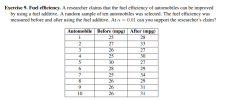 Test the claim about the mean of the differences for a
population of dependent (paired) data at the level of significance
α. Please remember to include all 5 parts of a hypothesis test
mentioned in the module summary. Assume the samples are random and
dependent, and the populations are normally
distributed.
Exercise 9. Fuel efficiency. A researcher claims that the fuel efficiency of automobiles can be improved by using a fuel additive. A random sample of ten automobiles was selected....
Test the claim about the mean of the differences for a
population of dependent (paired) data at the level of significance
α. Please remember to include all 5 parts of a hypothesis test
mentioned in the module summary. Assume the samples are random and
dependent, and the populations are normally
distributed.
Exercise 9. Fuel efficiency. A researcher claims that the fuel efficiency of automobiles can be improved by using a fuel additive. A random sample of ten automobiles was selected....
In testing a research hypothesis that the population mean for group 1 is smaller than group...
In testing a research hypothesis that the population mean for group 1 is smaller than group 2, the data do indeed yield a sample mean for group 1 that is smaller than group 2. Given the test statistic value of -0.380 with 3,555 degrees of freedom, what is the P-value? (Answer as a probability, not a percent. Record your answer accurate to at least the nearest THIRD decimal place with standard rounding.)
The following information was obtained from matched samples. The daily production rates for a sample of...
The following information was obtained from matched samples. The daily production rates for a sample of workers before and after a training program are shown below. Worker Before After 1 20 22 2 25 23 3 23 27 4 23 20 5 22 21 6 20 19 7 17 18 8 20 21 9 19 18 Refer to Exhibit 3. Assuming that the population of differences has a normal distribution, what is the degrees of freedom for the t distribution...
These two groups are two samples representing the population of workers in the economy. We want t...
 These two groups are two samples representing the population of
workers in the economy. We want to know if the workers who take the
training (treatment sample) have higher earnings than the group
that do not take the training (control sample). If we find that the
trained workers have higher earnings it would indicate that the
training is effective.[1]In terms of statistics, we will do a
hypothesis test on the difference between the mean earnings in the
treatment population and...
These two groups are two samples representing the population of
workers in the economy. We want to know if the workers who take the
training (treatment sample) have higher earnings than the group
that do not take the training (control sample). If we find that the
trained workers have higher earnings it would indicate that the
training is effective.[1]In terms of statistics, we will do a
hypothesis test on the difference between the mean earnings in the
treatment population and...
 。CONFOENCE INTERVALS AND HYPOTHESIS TESTING Hypothesis test for the difference of population means: Paired... 76 61 42 31 16 53 23 65 23 24 13 10 69 that the mean assembly times for the two processes differ? Answer this Based on these data, can the company conclude, at the 0.05 level of question by performing a hypothesstest regarding (which is μ with a letter d subscript), the population mean difference in assembly times for the two processes. Assume that this...
 Test the claim below about the mean of the differences for a population of paired data at the level of significance a. Assume the samples are random and dependent, and the populations are normally distributed. Claim: Ho<0; a=0.01. Sample statistics: d = 1.8, Sa = 3.4, n = 13 Identify the null and alternative hypotheses. Choose the correct answer below. 0 O B. Ho Hd < 0 Ha Ha 20 OD. Ho Hd = 0 O A. Ho Hd >...
 3. Testing a population mean The test statistic (Chapter 11) Aa Aa You conduct a hypothesis test about a population mean u with the following null and alternative hypotheses: Ho: u-25.8 H1: <25.8 Suppose that the population standard deviation has a known value of a observations, which provides a sample mean of % 30.7. 17.8. You obtain a sample of n =62 Since the sample size large enough, you assume that the sample mean X follows a normal distribution. Let...
 Test the claim about the mean of the differences for a
population of dependent (paired) data at the level of significance
α. Please remember to include all 5 parts of a hypothesis test
mentioned in the module summary. Assume the samples are random and
dependent, and the populations are normally
distributed.
Exercise 9. Fuel efficiency. A researcher claims that the fuel efficiency of automobiles can be improved by using a fuel additive. A random sample of ten automobiles was selected....
Test the claim about the mean of the differences for a
population of dependent (paired) data at the level of significance
α. Please remember to include all 5 parts of a hypothesis test
mentioned in the module summary. Assume the samples are random and
dependent, and the populations are normally
distributed.
Exercise 9. Fuel efficiency. A researcher claims that the fuel efficiency of automobiles can be improved by using a fuel additive. A random sample of ten automobiles was selected....
 These two groups are two samples representing the population of
workers in the economy. We want to know if the workers who take the
training (treatment sample) have higher earnings than the group
that do not take the training (control sample). If we find that the
trained workers have higher earnings it would indicate that the
training is effective.[1]In terms of statistics, we will do a
hypothesis test on the difference between the mean earnings in the
treatment population and...
These two groups are two samples representing the population of
workers in the economy. We want to know if the workers who take the
training (treatment sample) have higher earnings than the group
that do not take the training (control sample). If we find that the
trained workers have higher earnings it would indicate that the
training is effective.[1]In terms of statistics, we will do a
hypothesis test on the difference between the mean earnings in the
treatment population and...
Most questions answered within 3 hours.
-
Where is the error in this code sequence?
String s1 = "Hello";
String s2 = "ello";...
asked 10 months ago -
Financial data for Joel de Paris, Inc., for last year
follow:
Joel de Paris, Inc.
Balance...
asked 10 months ago -
Consider this reaction:
Al2(SO4)3 (aq)+ BaCl3
(aq) Al2Cl6 (aq)- +
3BaSO4(s) . What is the...
asked 10 months ago -
Suppose that Savneet is considering increasing her
recent random sample from 20 car rentals to 40...
asked 10 months ago -
Trucks arrive at an unloading terminal at an average rate of 120
per hour.
Trucks arrive...
asked 10 months ago -
Why are methanol and ethanol completely soluble in water while
octanol is not very little soluble....
asked 10 months ago -
A facilities manager at a university reads in a research report
that the mean amount of...
asked 10 months ago -
When the CuSO4 is rehydrated by adding water to the anhydrous
compound, is this an endothermic...
asked 10 months ago -
A ray of sunlight is passing from diamond into crown glass; the
angle of incidence is...
asked 10 months ago -
A block of mass 0.249 kg is placed on top of a light, vertical
spring of...
asked 10 months ago -
how do the kidneys compensate in the presences of acidosis
a) trigger hyperventilate
b) reserve acid...
asked 10 months ago -
Question 501 pts
The rental rate of capital to the firm increases. Which of the
following...
asked 10 months ago