Paul consumes only two goods, pizza (P) and hamburgers (H) and considers them to be perfect...
Paul consumes only two goods, pizza (P) and hamburgers (H) and
considers them to
be perfect substitutes, as shown by his utility function:
U = P + 4H
. The price of pizza
is $3 and the price of hamburgers is $6, and Paul’s monthly income
is $300 (Put pizza
on the horizontal axis and hamburgers on the vertical axis).
c) Knowing that he likes pizza, Paul’s grandmother gives him a
birthday gift
certificate of $60 redeemable only at Pizza Hut. Though Paul is
happy to get this
gift, his grandmother did not realize that she could have made him
exactly as happy
by spending far less than she did. How much would she have needed
to give him in
cash to make him just as well as off as with the gift certificate?
Illustrate your
answer on a graph.
Homework Answers
Theoretically we can solve this question by marginal analysis.
When Paul gets extra $60 for pizza. He can buy 20 pizzas (60/3=20).
His utility increases by 20.
As U=20+4H, H is constant rise in P leads to U↑ by 20.
Now to Increase his utility by 20. How many extra Hamburgers he would need?
20=P+4H. P is fixed, he would need 20/4=5 hamburgers.
5 hambugers will cost 5*$6= $30
So his grandmother could have given him $30 instead of $60 as it would have also raised the utility by the same amount.
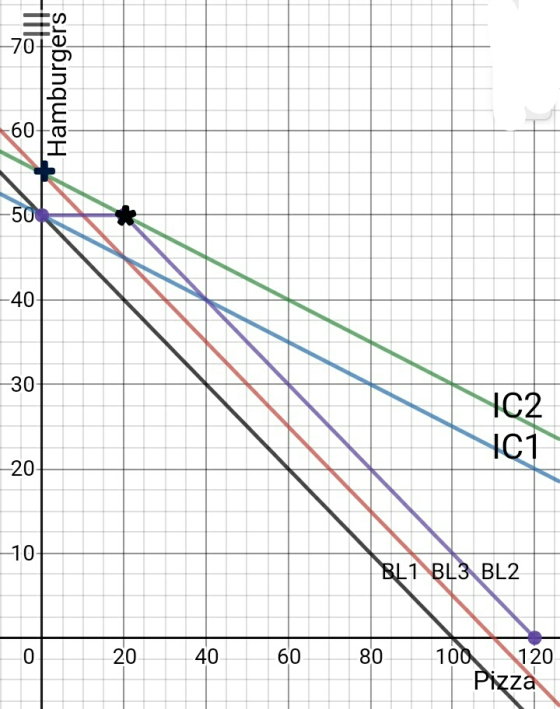
Graphically.
We know optimal point is at the tangency of IC and BL line.
Plot the initial Budget line, BL1: 300= 4p+6h and IC1.
New kinked budget line BL2
Optimal point will be tangent to the kink.(*)
IC2 is tangent to BL2 at the kink.
IC2 can also be tangent to another BL, BL3 which is lower than BL2, 330= 4p+6h.
This point is (+).
We see the same IC, IC2 gives same utility at lower level of income also.
Add Answer to:
Paul consumes only two goods, pizza (P) and hamburgers (H) and
considers them to
be perfect...
pls use microeconomic knowledge to solve 1. Paul consumes only two goods, pizza P and hamburgers...
 pls use microeconomic knowledge to solve
1. Paul consumes only two goods, pizza P and hamburgers H and considers them to be perfect substitutes, as shown by his utility function U(P, H) = P+4H. The price of pizza is pp = 3 and the price of hamburgers is pu = 6, and Paul's monthly income is M = 300. (a) How many pizzas and hamburgers does he consume when he maxi- mizes utility? Is the tangency condition satisfied? (b) Knowing...
pls use microeconomic knowledge to solve
1. Paul consumes only two goods, pizza P and hamburgers H and considers them to be perfect substitutes, as shown by his utility function U(P, H) = P+4H. The price of pizza is pp = 3 and the price of hamburgers is pu = 6, and Paul's monthly income is M = 300. (a) How many pizzas and hamburgers does he consume when he maxi- mizes utility? Is the tangency condition satisfied? (b) Knowing...
Question 1: Louis the retired Canadian lives on a fixed budget and consumes only two goods:...
 Question 1: Louis the retired Canadian lives on a fixed budget and consumes only two goods: toques (T) and maple syrup (M). Suppose Louis monthly budget is 100 and the price of the two goods are (PT,PM) (4,2). (a) Make a properly labeled diagram illustrating Louis'budget constraint with T on the hori- zontal axis and M on the vertical axis. Indicate the area corresponding to the set of bundles (M, T) that Louis can afford. (b) What is the maximum...
Using the book, write another paragraph or two: write 170 words: Q: Compare the assumptions of...
 Using the book, write another paragraph or two: write 170
words:
Q: Compare the assumptions of physician-centered and
collaborative communication. How is the caregiver’s role different
in each model? How is the patient’s role different?
Answer: Physical-centered communication involves the specialists
taking control of the conversation. They decide on the topics of
discussion and when to end the process. The patient responds to the
issues raised by the caregiver and acts accordingly. On the other
hand, Collaborative communication involves a...
Using the book, write another paragraph or two: write 170
words:
Q: Compare the assumptions of physician-centered and
collaborative communication. How is the caregiver’s role different
in each model? How is the patient’s role different?
Answer: Physical-centered communication involves the specialists
taking control of the conversation. They decide on the topics of
discussion and when to end the process. The patient responds to the
issues raised by the caregiver and acts accordingly. On the other
hand, Collaborative communication involves a...
 pls use microeconomic knowledge to solve
1. Paul consumes only two goods, pizza P and hamburgers H and considers them to be perfect substitutes, as shown by his utility function U(P, H) = P+4H. The price of pizza is pp = 3 and the price of hamburgers is pu = 6, and Paul's monthly income is M = 300. (a) How many pizzas and hamburgers does he consume when he maxi- mizes utility? Is the tangency condition satisfied? (b) Knowing...
pls use microeconomic knowledge to solve
1. Paul consumes only two goods, pizza P and hamburgers H and considers them to be perfect substitutes, as shown by his utility function U(P, H) = P+4H. The price of pizza is pp = 3 and the price of hamburgers is pu = 6, and Paul's monthly income is M = 300. (a) How many pizzas and hamburgers does he consume when he maxi- mizes utility? Is the tangency condition satisfied? (b) Knowing...
 Question 1: Louis the retired Canadian lives on a fixed budget and consumes only two goods: toques (T) and maple syrup (M). Suppose Louis monthly budget is 100 and the price of the two goods are (PT,PM) (4,2). (a) Make a properly labeled diagram illustrating Louis'budget constraint with T on the hori- zontal axis and M on the vertical axis. Indicate the area corresponding to the set of bundles (M, T) that Louis can afford. (b) What is the maximum...
 Using the book, write another paragraph or two: write 170
words:
Q: Compare the assumptions of physician-centered and
collaborative communication. How is the caregiver’s role different
in each model? How is the patient’s role different?
Answer: Physical-centered communication involves the specialists
taking control of the conversation. They decide on the topics of
discussion and when to end the process. The patient responds to the
issues raised by the caregiver and acts accordingly. On the other
hand, Collaborative communication involves a...
Using the book, write another paragraph or two: write 170
words:
Q: Compare the assumptions of physician-centered and
collaborative communication. How is the caregiver’s role different
in each model? How is the patient’s role different?
Answer: Physical-centered communication involves the specialists
taking control of the conversation. They decide on the topics of
discussion and when to end the process. The patient responds to the
issues raised by the caregiver and acts accordingly. On the other
hand, Collaborative communication involves a...
Most questions answered within 3 hours.
-
Where is the error in this code sequence?
String s1 = "Hello";
String s2 = "ello";...
asked 10 months ago -
Financial data for Joel de Paris, Inc., for last year
follow:
Joel de Paris, Inc.
Balance...
asked 10 months ago -
Consider this reaction:
Al2(SO4)3 (aq)+ BaCl3
(aq) Al2Cl6 (aq)- +
3BaSO4(s) . What is the...
asked 10 months ago -
Suppose that Savneet is considering increasing her
recent random sample from 20 car rentals to 40...
asked 10 months ago -
Trucks arrive at an unloading terminal at an average rate of 120
per hour.
Trucks arrive...
asked 10 months ago -
Why are methanol and ethanol completely soluble in water while
octanol is not very little soluble....
asked 10 months ago -
A facilities manager at a university reads in a research report
that the mean amount of...
asked 10 months ago -
When the CuSO4 is rehydrated by adding water to the anhydrous
compound, is this an endothermic...
asked 10 months ago -
A ray of sunlight is passing from diamond into crown glass; the
angle of incidence is...
asked 10 months ago -
A block of mass 0.249 kg is placed on top of a light, vertical
spring of...
asked 10 months ago -
how do the kidneys compensate in the presences of acidosis
a) trigger hyperventilate
b) reserve acid...
asked 10 months ago -
Question 501 pts
The rental rate of capital to the firm increases. Which of the
following...
asked 10 months ago