1. in the copper cycle experiment when a solution of NaOH(aq) is added to a solution...
1. in the copper cycle experiment when a solution of NaOH(aq) is added to a solution of Cu(NO3)2, what happens?
a. no reaction occurs
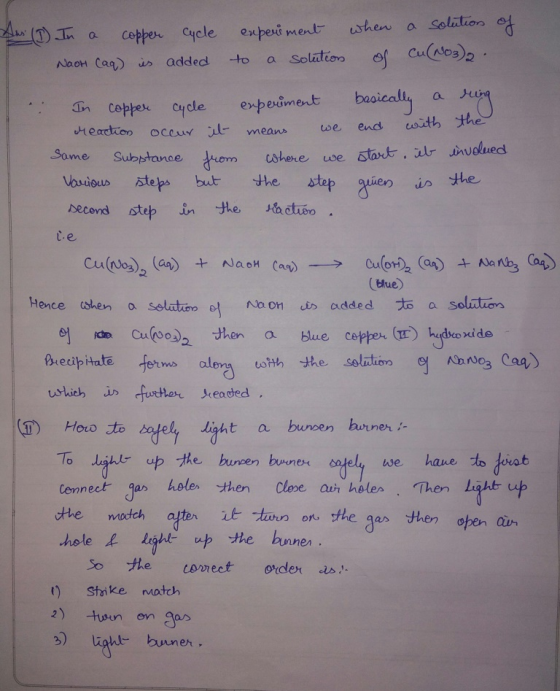
b. a blue copper (II) hydroxide precipitate forms along with a solution of NaNO3(aq)
c. a reddish copper solid forms and the solutions bubbles because the presence of H2 gas
d. a black copper (II) oxide solid forms and H2O molecules are released in a decomposition
2. Put these in order in how to safely light a Bunsen burner:
-turn on gas
-strike match
-light burner
Homework Answers
In this reaction a blue precipitate of copper (2) hydroxide is formed along with NaNO3 solution, blue color shows the basic nature of the precipitate .
Add Answer to:
1. in the copper cycle experiment when a solution of NaOH(aq) is
added to a solution...
3. If some red-brown Cu(s) is heated with a Bunsen burner in the presence of O,(g),...
 3. If some red-brown Cu(s) is heated with a Bunsen burner in the presence of O,(g), some black solid, copper(II) oxide, CuO(s), forms. Write the balanced equation for this reaction. Classify this reaction as one of the five general types.
1. Write a balanced chemical equation for the oxidation of zinc metal (Zn) by copper(II) ions...
 1. Write a balanced chemical equation for the oxidation of zinc metal (Zn) by copper(II) ions (Cu?") in a copper sulfate solution. Note that copper(II) sulfate completely dissociates in aqueous solution and forms Cu2+ (aq) and SO,- (aq) in water. Zinc metal is a solid and should be represented as Zn (3) Write a chemical equation for the decomposition of limestone (CaCO,) by heating to high temperature to drive off carbon dioxide. The other product of this decomposition reaction is...
In this laboratory exploration various reactions of copper will illustrate these properties. First, begin with copper...
In this laboratory exploration various reactions of copper will illustrate these properties. First, begin with copper metal. When concentrated nitric acid is added, dramatic changes occur and the metal dissolves forming a brightly colored copper ion-containing solution. Cu(s) + 4HNO3(aq) à Cu(NO3)2(aq) + 2NO2(g) + 2H2O(l) _____________ equation Cu(s) + 4H+ + 4NO3-(aq) à Cu+2(aq) +2NO3-(aq)+ 2NO2(g) + 2H2O(l) _____________ equation Reaction type_______________ What advantage(s) is/are there to the second version of the reaction equation? However, if diluted...
QUESTION 13 When 2 mL of 0.1 M aqueous HCI (hydrochloric acid) are added to a...
 QUESTION 13 When 2 mL of 0.1 M aqueous HCI (hydrochloric acid) are added to a small strip of magnesium (Mg) what happens? A violent explosion O Nothing Bubbles of hydrogen are produced and the magnesium dissolves O The magnesium turns red and the solution goes yellow QUESTION 14 1 poi Which is the balanced chemical equation describing the reaction of question 13? O Mg(aq) + HCl(aq) → MgCl(s) + H(g) O Mg(s) + HCl(aq) - MgCl (aq) + H2(g)....
40. Concentrated aqueous ammonia is added to a solution of copper(II) sulfate. A white precipitate forms....
 40. Concentrated aqueous ammonia is added to a solution of copper(II) sulfate. A white precipitate forms. The precipitate dissolves as more ammonia is added, generating an intensely blue solution. Which combination of net ionic equations, in the appropriate order, describes this chemistry?! I Cu?* (aq) + 2OH(aq) Cu(OH)2 (19) II Cu?" (aq) + 2OH(aq) = Cu(OH)2 (8) III Cu(OH)(aq) + 4 NH, (aq) Cu(NH3),?* () + 2OH(aq) IV Cu(OH)2 (8) + 4NH, (aq) Cu(NH3)*(14) + 2OH(aq) V NH3(aq) + H20...
1 Reaction C: Copper(II) Hydroxide to Copper(IT) Oxide Observations: The solntich goes from a light blue...
 1 Reaction C: Copper(II) Hydroxide to Copper(IT) Oxide Observations: The solntich goes from a light blue to a dark blue. when heated the solution turns to a green/black color. Balanced Molecular Equation: Balanced Net lonie Equation: Reaction D: Copper(IT) Oxide to Copper(II) Sulfate Observations: "The back sond is dissolved in the acid. This creates a light blue / Clear solurich Balanced Molecular Equation: Balanced Net Ionic Equation: Reaction E: Copper(II) Sulfate to Copper Metal (and Dissolution of excess Mg) Observations:...
i only need g, h and I please Classifying Chemical Reactions continued Classifying Chemical Reactions continued...
 i
only need g, h and I please
Classifying Chemical Reactions continued Classifying Chemical Reactions continued 3. Write a balanced chemical equation for each reaction and classify the reaction. a. Copper metal heated with oxygen gives solid copper(II)oxide. 4 cu +02 → 2420 (5) combination reachon b. Mixing ammonium nitrate and sodium hydroxide solutions gives aqueous sodium nitrate, ammonia gas, and water. NHL NO2+ NaOH -> Na NO₃(aq) + NH₃ (9)+H₂O (e) double replacement c. Mercury(II) nitrate solution reacts with...
i
only need g, h and I please
Classifying Chemical Reactions continued Classifying Chemical Reactions continued 3. Write a balanced chemical equation for each reaction and classify the reaction. a. Copper metal heated with oxygen gives solid copper(II)oxide. 4 cu +02 → 2420 (5) combination reachon b. Mixing ammonium nitrate and sodium hydroxide solutions gives aqueous sodium nitrate, ammonia gas, and water. NHL NO2+ NaOH -> Na NO₃(aq) + NH₃ (9)+H₂O (e) double replacement c. Mercury(II) nitrate solution reacts with...
Exp 210 CYCLE OF COPPER REACTIONS Part 1: Reaction of solid copper with concentrated nitric acid ...
 Exp 210 CYCLE OF COPPER REACTIONS Part 1: Reaction of solid copper with concentrated nitric acid Observations: (partial example given) Tke copper wire was bright/shiny after cleaning wits steel wool. The nitric acia solution. was nearly clear/coloriess olthongh α very faint reddish brown discoloration was evident. Reaction Products The cemplet d Balanced molecular chemical equation (this first reaction equation is given as an example) What ions are in solution after the reaction is complete? What is the oxidation state of...
In experiment 7, when concentrated ammonia is added to acidic copper solution, the pale-blue precipitate forms,...
In experiment 7, when concentrated ammonia is added to acidic copper solution, the pale-blue precipitate forms, followed by formation of bright blue soluble compound. Write formulas of the precipitate and of colored complex. When potassium iodide is added to copper(II) nitrate solution, a brown precipitate forms. Write and balance the corresponding reaction equation. This brown precipitate is titrated with sodium thiosulfate solution. Write and balance the corresponding equation. After titration, a white precipitate is left in the solution. Write the...
Oxalate ion will interfere with the Group D tests after we make the solution acidic. Also,...
 Oxalate ion will interfere with the Group D tests after we make the solution acidic. Also, ammonium ion may prevent the precipitation of Group Dcations as hydroxides in sodium hydroxide solution. Thus, must treat the supernatant liquid left after we have precipitated calcium oxalate, in order to destroy any remaining Oxalate or ammonium ions prior to further analysis. To accomplish this, we transfer the solution to a crucible, add concentrated nitric acid and heat the mixture to dryness in a...
 3. If some red-brown Cu(s) is heated with a Bunsen burner in the presence of O,(g), some black solid, copper(II) oxide, CuO(s), forms. Write the balanced equation for this reaction. Classify this reaction as one of the five general types.
 1. Write a balanced chemical equation for the oxidation of zinc metal (Zn) by copper(II) ions (Cu?") in a copper sulfate solution. Note that copper(II) sulfate completely dissociates in aqueous solution and forms Cu2+ (aq) and SO,- (aq) in water. Zinc metal is a solid and should be represented as Zn (3) Write a chemical equation for the decomposition of limestone (CaCO,) by heating to high temperature to drive off carbon dioxide. The other product of this decomposition reaction is...
 QUESTION 13 When 2 mL of 0.1 M aqueous HCI (hydrochloric acid) are added to a small strip of magnesium (Mg) what happens? A violent explosion O Nothing Bubbles of hydrogen are produced and the magnesium dissolves O The magnesium turns red and the solution goes yellow QUESTION 14 1 poi Which is the balanced chemical equation describing the reaction of question 13? O Mg(aq) + HCl(aq) → MgCl(s) + H(g) O Mg(s) + HCl(aq) - MgCl (aq) + H2(g)....
 40. Concentrated aqueous ammonia is added to a solution of copper(II) sulfate. A white precipitate forms. The precipitate dissolves as more ammonia is added, generating an intensely blue solution. Which combination of net ionic equations, in the appropriate order, describes this chemistry?! I Cu?* (aq) + 2OH(aq) Cu(OH)2 (19) II Cu?" (aq) + 2OH(aq) = Cu(OH)2 (8) III Cu(OH)(aq) + 4 NH, (aq) Cu(NH3),?* () + 2OH(aq) IV Cu(OH)2 (8) + 4NH, (aq) Cu(NH3)*(14) + 2OH(aq) V NH3(aq) + H20...
 1 Reaction C: Copper(II) Hydroxide to Copper(IT) Oxide Observations: The solntich goes from a light blue to a dark blue. when heated the solution turns to a green/black color. Balanced Molecular Equation: Balanced Net lonie Equation: Reaction D: Copper(IT) Oxide to Copper(II) Sulfate Observations: "The back sond is dissolved in the acid. This creates a light blue / Clear solurich Balanced Molecular Equation: Balanced Net Ionic Equation: Reaction E: Copper(II) Sulfate to Copper Metal (and Dissolution of excess Mg) Observations:...
 i
only need g, h and I please
Classifying Chemical Reactions continued Classifying Chemical Reactions continued 3. Write a balanced chemical equation for each reaction and classify the reaction. a. Copper metal heated with oxygen gives solid copper(II)oxide. 4 cu +02 → 2420 (5) combination reachon b. Mixing ammonium nitrate and sodium hydroxide solutions gives aqueous sodium nitrate, ammonia gas, and water. NHL NO2+ NaOH -> Na NO₃(aq) + NH₃ (9)+H₂O (e) double replacement c. Mercury(II) nitrate solution reacts with...
i
only need g, h and I please
Classifying Chemical Reactions continued Classifying Chemical Reactions continued 3. Write a balanced chemical equation for each reaction and classify the reaction. a. Copper metal heated with oxygen gives solid copper(II)oxide. 4 cu +02 → 2420 (5) combination reachon b. Mixing ammonium nitrate and sodium hydroxide solutions gives aqueous sodium nitrate, ammonia gas, and water. NHL NO2+ NaOH -> Na NO₃(aq) + NH₃ (9)+H₂O (e) double replacement c. Mercury(II) nitrate solution reacts with...
 Exp 210 CYCLE OF COPPER REACTIONS Part 1: Reaction of solid copper with concentrated nitric acid Observations: (partial example given) Tke copper wire was bright/shiny after cleaning wits steel wool. The nitric acia solution. was nearly clear/coloriess olthongh α very faint reddish brown discoloration was evident. Reaction Products The cemplet d Balanced molecular chemical equation (this first reaction equation is given as an example) What ions are in solution after the reaction is complete? What is the oxidation state of...
 Oxalate ion will interfere with the Group D tests after we make the solution acidic. Also, ammonium ion may prevent the precipitation of Group Dcations as hydroxides in sodium hydroxide solution. Thus, must treat the supernatant liquid left after we have precipitated calcium oxalate, in order to destroy any remaining Oxalate or ammonium ions prior to further analysis. To accomplish this, we transfer the solution to a crucible, add concentrated nitric acid and heat the mixture to dryness in a...
Most questions answered within 3 hours.
-
Where is the error in this code sequence?
String s1 = "Hello";
String s2 = "ello";...
asked 10 months ago -
Financial data for Joel de Paris, Inc., for last year
follow:
Joel de Paris, Inc.
Balance...
asked 10 months ago -
Consider this reaction:
Al2(SO4)3 (aq)+ BaCl3
(aq) Al2Cl6 (aq)- +
3BaSO4(s) . What is the...
asked 10 months ago -
Suppose that Savneet is considering increasing her
recent random sample from 20 car rentals to 40...
asked 10 months ago -
Trucks arrive at an unloading terminal at an average rate of 120
per hour.
Trucks arrive...
asked 10 months ago -
Why are methanol and ethanol completely soluble in water while
octanol is not very little soluble....
asked 10 months ago -
A facilities manager at a university reads in a research report
that the mean amount of...
asked 10 months ago -
When the CuSO4 is rehydrated by adding water to the anhydrous
compound, is this an endothermic...
asked 10 months ago -
A ray of sunlight is passing from diamond into crown glass; the
angle of incidence is...
asked 10 months ago -
A block of mass 0.249 kg is placed on top of a light, vertical
spring of...
asked 10 months ago -
how do the kidneys compensate in the presences of acidosis
a) trigger hyperventilate
b) reserve acid...
asked 10 months ago -
Question 501 pts
The rental rate of capital to the firm increases. Which of the
following...
asked 10 months ago