max U(C,L) = ln(C)+θlnL subject to C=w(h-L)+π - t Determine the solution of the problem according...
max U(C,L) = ln(C)+θlnL
subject to C=w(h-L)+π - t
Determine the solution of the problem according to θ and w using lagrangien method
Homework Answers

Add Answer to:
max U(C,L) = ln(C)+θlnL
subject to C=w(h-L)+π - t
Determine the solution of the problem according...
Solve the following Utility Maximization Problem for x* and y* that Max U(x,y)= ln(x) subject to...
 Solve the following Utility Maximization Problem for x* and y* that Max U(x,y)= ln(x) subject to Pxx + pyy = I ----.-.(2) where In denotes the natural logarithm (base e) and x and y>0. a) (25 points) by Substitution and show that your values of x* and y* max U (x*,y*). Problem 1. b) (20 points) by the Lagrange Multiplier Method
Solve for the optimal (c,l) pair in the following problem 1+0 max C ед subject to...
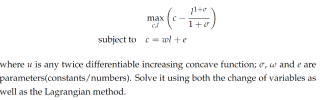 Solve for the optimal (c,l) pair in the following problem
1+0 max C ед subject to cwl+e where u is any twice differentiable increasing concave function; ơ, a, and are parameters(constants/numbers). Solve it using both the change of variables as well as the Lagrangian method.
Solve for the optimal (c,l) pair in the following problem
1+0 max C ед subject to cwl+e where u is any twice differentiable increasing concave function; ơ, a, and are parameters(constants/numbers). Solve it using both the change of variables as well as the Lagrangian method.
30] Find th e solution of the following boundary value problem. 1<r<2, u(r, θ = 0) = 0, u(r, θ = π) =0, 1,0-0, u(...
 30] Find th e solution of the following boundary value problem. 1<r<2, u(r, θ = 0) = 0, u(r, θ = π) =0, 1,0-0, u(r-2,0)-sin(20), 0 < θ < π. u(r Please also draw the sketch associated with this problem. You may assume that An -n2, Hn(s)sin(ns), n 1,2,3,. are the eigenpairs for the eigenvalue problem H(0) 0, H(T)0.
30] Find th e solution of the following boundary value problem. 1
30] Find th e solution of the following boundary value problem. 1<r<2, u(r, θ = 0) = 0, u(r, θ = π) =0, 1,0-0, u(r-2,0)-sin(20), 0 < θ < π. u(r Please also draw the sketch associated with this problem. You may assume that An -n2, Hn(s)sin(ns), n 1,2,3,. are the eigenpairs for the eigenvalue problem H(0) 0, H(T)0.
30] Find th e solution of the following boundary value problem. 1
Determine the system response y(t) for h(t)=u(t)+u(t-2) and x(t)=u(t). [Hint: use Laplace Transform multiplication: L[x(t)h(t)) =...
 Determine the system response y(t) for h(t)=u(t)+u(t-2) and x(t)=u(t). [Hint: use Laplace Transform multiplication: L[x(t)h(t)) = x(s)H(s). Useful Formula: Fourier Transform: F[f(t)] = F(w) sof(t)e-jw dt Inverse Fourier Transform: F-1[F(w)] = f (t) = 24., F(w)ejwidw Time Transformation property of Fourier Transform: f(at – to). FC)e=itoch Laplace Transform: L[f(t)] = F(s) = $© f(t)e-st dt Shifting property: L[f(t – to)u(t – to)] = e-toSF(s) e [tuce) = 1 and c [u(e) = )
H=1.68 T=26 F=2 L=2 S=30 11) Determine the extrema of g(u,v) = Hu-(F+L)t/2 subject to the...
 H=1.68 T=26 F=2 L=2 S=30
11) Determine the extrema of g(u,v) = Hu-(F+L)t/2 subject to the constraint x2+y2= S*H Ans.
H=1.68 T=26 F=2 L=2 S=30
11) Determine the extrema of g(u,v) = Hu-(F+L)t/2 subject to the constraint x2+y2= S*H Ans.
Problem 1. Consider the nonhomogeneous heat equation for u,t) ut = uzz + sin(2x), 0<x<π, t>0 subject to the nonhomogeneous boundary conditions u(0, t) t > 0 u(n, t) = 0, 1, - and the...
 Problem 1. Consider the nonhomogeneous heat equation for u,t) ut = uzz + sin(2x), 0<x<π, t>0 subject to the nonhomogeneous boundary conditions u(0, t) t > 0 u(n, t) = 0, 1, - and the initial condition Lee) Find the solution u(z, t) by completing each of the following steps: (a) Find the equilibrium temperature distribution ue(x). (b) Denote v(x, t) u(a, t) - e(). Derive the IBVP for the function v(x,t). (c) Find v(x, t) (d) Find u(, t)...
1 point) Solve the nonhomogeneous heat problem ut=uxx+4sin(2x), 0<x<π,ut=uxx+4sin(2x), 0<x<π, u(0,t)=0, u(π,t)=0u(0,t)=0, u(π,t)=0 u(x,0)=5sin(5x)u(x,0)=5sin(5x) u(x,t)=u(x,t)= Ste
 1 point) Solve the nonhomogeneous heat problem
ut=uxx+4sin(2x), 0<x<π,ut=uxx+4sin(2x), 0<x<π,
u(0,t)=0, u(π,t)=0u(0,t)=0, u(π,t)=0
u(x,0)=5sin(5x)u(x,0)=5sin(5x)
u(x,t)=u(x,t)=
Steady State Solution limt→∞u(x,t)=limt→∞u(x,t)=
Please show all work.
(1 point) Solve the nonhomogeneous heat problem Ut = Uxx + 4 sin(2x), 0< x < , u(0,1) = 0, tu(T, t) = 0 u(x,0) = 5 sin(52) u(a,t) Steady State Solution limt u(x, t) = Note: You can earn partial credit on this problem. Preview My Answers Submit Answers You have attempted this problem 0 times. You have unlimited attempts...
1 point) Solve the nonhomogeneous heat problem
ut=uxx+4sin(2x), 0<x<π,ut=uxx+4sin(2x), 0<x<π,
u(0,t)=0, u(π,t)=0u(0,t)=0, u(π,t)=0
u(x,0)=5sin(5x)u(x,0)=5sin(5x)
u(x,t)=u(x,t)=
Steady State Solution limt→∞u(x,t)=limt→∞u(x,t)=
Please show all work.
(1 point) Solve the nonhomogeneous heat problem Ut = Uxx + 4 sin(2x), 0< x < , u(0,1) = 0, tu(T, t) = 0 u(x,0) = 5 sin(52) u(a,t) Steady State Solution limt u(x, t) = Note: You can earn partial credit on this problem. Preview My Answers Submit Answers You have attempted this problem 0 times. You have unlimited attempts...
Suppose the representative household has the following utility function: U (C; l) = ln C +...
Suppose the representative household has the following utility function: U (C; l) = ln C + 0:5 ln l where C is consumption and l is leisure. The householdís time constraint is l+N=1 where Ns is the representative householdís labour supply. Further assume that the production function is Cobb-Douglas zK0:5 (N)0:5 where z = 1 and K = 1: 2.1 Assuming that the government spending is G = 0; use the Social Plannerís problem to solve for Pareto optimal numerical...
Question 16 (2 marks) Attempt 1 4 π[H(u+4)-H(u-16) Determine the Inverse Fourier transform of: F(a) Your...
 Question 16 (2 marks) Attempt 1 4 π[H(u+4)-H(u-16) Determine the Inverse Fourier transform of: F(a) Your answer should be expressed as a function of t using the correct syntax Inverse F.T. is ft)Skipped
Problem 1. Consider the nonhomogeneous heat equation for u(,) subject to the nonhomogeneous boundary conditions 14(0,t) 1, u(r,t)-0,t> and the initial condition the solution u(x, t) by complet...
 Problem 1. Consider the nonhomogeneous heat equation for u(,) subject to the nonhomogeneous boundary conditions 14(0,t) 1, u(r,t)-0,t> and the initial condition the solution u(x, t) by completing each of the following steps (a) Find the equilibrium temperature distribution u ( (b) Denote v, t)t) - u(). Derive the IBVP for the function vz,t). (c) Find v(x, t) (d) Find u(x, t)
Problem 1. Consider the nonhomogeneous heat equation for u(,) subject to the nonhomogeneous boundary conditions 14(0,t) 1, u(r,t)-0,t>...
Problem 1. Consider the nonhomogeneous heat equation for u(,) subject to the nonhomogeneous boundary conditions 14(0,t) 1, u(r,t)-0,t> and the initial condition the solution u(x, t) by completing each of the following steps (a) Find the equilibrium temperature distribution u ( (b) Denote v, t)t) - u(). Derive the IBVP for the function vz,t). (c) Find v(x, t) (d) Find u(x, t)
Problem 1. Consider the nonhomogeneous heat equation for u(,) subject to the nonhomogeneous boundary conditions 14(0,t) 1, u(r,t)-0,t>...
 Solve the following Utility Maximization Problem for x* and y* that Max U(x,y)= ln(x) subject to Pxx + pyy = I ----.-.(2) where In denotes the natural logarithm (base e) and x and y>0. a) (25 points) by Substitution and show that your values of x* and y* max U (x*,y*). Problem 1. b) (20 points) by the Lagrange Multiplier Method
 Solve for the optimal (c,l) pair in the following problem
1+0 max C ед subject to cwl+e where u is any twice differentiable increasing concave function; ơ, a, and are parameters(constants/numbers). Solve it using both the change of variables as well as the Lagrangian method.
Solve for the optimal (c,l) pair in the following problem
1+0 max C ед subject to cwl+e where u is any twice differentiable increasing concave function; ơ, a, and are parameters(constants/numbers). Solve it using both the change of variables as well as the Lagrangian method.
 30] Find th e solution of the following boundary value problem. 1<r<2, u(r, θ = 0) = 0, u(r, θ = π) =0, 1,0-0, u(r-2,0)-sin(20), 0 < θ < π. u(r Please also draw the sketch associated with this problem. You may assume that An -n2, Hn(s)sin(ns), n 1,2,3,. are the eigenpairs for the eigenvalue problem H(0) 0, H(T)0.
30] Find th e solution of the following boundary value problem. 1
30] Find th e solution of the following boundary value problem. 1<r<2, u(r, θ = 0) = 0, u(r, θ = π) =0, 1,0-0, u(r-2,0)-sin(20), 0 < θ < π. u(r Please also draw the sketch associated with this problem. You may assume that An -n2, Hn(s)sin(ns), n 1,2,3,. are the eigenpairs for the eigenvalue problem H(0) 0, H(T)0.
30] Find th e solution of the following boundary value problem. 1
 Determine the system response y(t) for h(t)=u(t)+u(t-2) and x(t)=u(t). [Hint: use Laplace Transform multiplication: L[x(t)h(t)) = x(s)H(s). Useful Formula: Fourier Transform: F[f(t)] = F(w) sof(t)e-jw dt Inverse Fourier Transform: F-1[F(w)] = f (t) = 24., F(w)ejwidw Time Transformation property of Fourier Transform: f(at – to). FC)e=itoch Laplace Transform: L[f(t)] = F(s) = $© f(t)e-st dt Shifting property: L[f(t – to)u(t – to)] = e-toSF(s) e [tuce) = 1 and c [u(e) = )
 H=1.68 T=26 F=2 L=2 S=30
11) Determine the extrema of g(u,v) = Hu-(F+L)t/2 subject to the constraint x2+y2= S*H Ans.
H=1.68 T=26 F=2 L=2 S=30
11) Determine the extrema of g(u,v) = Hu-(F+L)t/2 subject to the constraint x2+y2= S*H Ans.
 Problem 1. Consider the nonhomogeneous heat equation for u,t) ut = uzz + sin(2x), 0<x<π, t>0 subject to the nonhomogeneous boundary conditions u(0, t) t > 0 u(n, t) = 0, 1, - and the initial condition Lee) Find the solution u(z, t) by completing each of the following steps: (a) Find the equilibrium temperature distribution ue(x). (b) Denote v(x, t) u(a, t) - e(). Derive the IBVP for the function v(x,t). (c) Find v(x, t) (d) Find u(, t)...
 1 point) Solve the nonhomogeneous heat problem
ut=uxx+4sin(2x), 0<x<π,ut=uxx+4sin(2x), 0<x<π,
u(0,t)=0, u(π,t)=0u(0,t)=0, u(π,t)=0
u(x,0)=5sin(5x)u(x,0)=5sin(5x)
u(x,t)=u(x,t)=
Steady State Solution limt→∞u(x,t)=limt→∞u(x,t)=
Please show all work.
(1 point) Solve the nonhomogeneous heat problem Ut = Uxx + 4 sin(2x), 0< x < , u(0,1) = 0, tu(T, t) = 0 u(x,0) = 5 sin(52) u(a,t) Steady State Solution limt u(x, t) = Note: You can earn partial credit on this problem. Preview My Answers Submit Answers You have attempted this problem 0 times. You have unlimited attempts...
1 point) Solve the nonhomogeneous heat problem
ut=uxx+4sin(2x), 0<x<π,ut=uxx+4sin(2x), 0<x<π,
u(0,t)=0, u(π,t)=0u(0,t)=0, u(π,t)=0
u(x,0)=5sin(5x)u(x,0)=5sin(5x)
u(x,t)=u(x,t)=
Steady State Solution limt→∞u(x,t)=limt→∞u(x,t)=
Please show all work.
(1 point) Solve the nonhomogeneous heat problem Ut = Uxx + 4 sin(2x), 0< x < , u(0,1) = 0, tu(T, t) = 0 u(x,0) = 5 sin(52) u(a,t) Steady State Solution limt u(x, t) = Note: You can earn partial credit on this problem. Preview My Answers Submit Answers You have attempted this problem 0 times. You have unlimited attempts...
 Question 16 (2 marks) Attempt 1 4 π[H(u+4)-H(u-16) Determine the Inverse Fourier transform of: F(a) Your answer should be expressed as a function of t using the correct syntax Inverse F.T. is ft)Skipped
 Problem 1. Consider the nonhomogeneous heat equation for u(,) subject to the nonhomogeneous boundary conditions 14(0,t) 1, u(r,t)-0,t> and the initial condition the solution u(x, t) by completing each of the following steps (a) Find the equilibrium temperature distribution u ( (b) Denote v, t)t) - u(). Derive the IBVP for the function vz,t). (c) Find v(x, t) (d) Find u(x, t)
Problem 1. Consider the nonhomogeneous heat equation for u(,) subject to the nonhomogeneous boundary conditions 14(0,t) 1, u(r,t)-0,t>...
Problem 1. Consider the nonhomogeneous heat equation for u(,) subject to the nonhomogeneous boundary conditions 14(0,t) 1, u(r,t)-0,t> and the initial condition the solution u(x, t) by completing each of the following steps (a) Find the equilibrium temperature distribution u ( (b) Denote v, t)t) - u(). Derive the IBVP for the function vz,t). (c) Find v(x, t) (d) Find u(x, t)
Problem 1. Consider the nonhomogeneous heat equation for u(,) subject to the nonhomogeneous boundary conditions 14(0,t) 1, u(r,t)-0,t>...
Most questions answered within 3 hours.
-
Where is the error in this code sequence?
String s1 = "Hello";
String s2 = "ello";...
asked 10 months ago -
Financial data for Joel de Paris, Inc., for last year
follow:
Joel de Paris, Inc.
Balance...
asked 10 months ago -
Consider this reaction:
Al2(SO4)3 (aq)+ BaCl3
(aq) Al2Cl6 (aq)- +
3BaSO4(s) . What is the...
asked 10 months ago -
Suppose that Savneet is considering increasing her
recent random sample from 20 car rentals to 40...
asked 10 months ago -
Trucks arrive at an unloading terminal at an average rate of 120
per hour.
Trucks arrive...
asked 10 months ago -
Why are methanol and ethanol completely soluble in water while
octanol is not very little soluble....
asked 10 months ago -
A facilities manager at a university reads in a research report
that the mean amount of...
asked 10 months ago -
When the CuSO4 is rehydrated by adding water to the anhydrous
compound, is this an endothermic...
asked 10 months ago -
A ray of sunlight is passing from diamond into crown glass; the
angle of incidence is...
asked 10 months ago -
A block of mass 0.249 kg is placed on top of a light, vertical
spring of...
asked 10 months ago -
how do the kidneys compensate in the presences of acidosis
a) trigger hyperventilate
b) reserve acid...
asked 10 months ago -
Question 501 pts
The rental rate of capital to the firm increases. Which of the
following...
asked 10 months ago