"Native," or elemental copper can be found in nature, but most copper is mined as oxide...
"Native," or elemental copper can be found in nature, but most copper is mined as oxide or sulfide minerals. Chalcopyrite (CuFeS2) is one copper mineral that can be converted to elemental copper in a series of chemical steps. Reacting chalcopyrite with oxygen at high temperature produces a mixture of copper sulfide and iron oxide. The iron oxide is separated from CuS by reaction with sand (SiO2). CuS is converted to Cu2S in the process and the Cu2S is burned in air to produce Cu and SO2:
A)An average copper penny minted in the 1960s contained about 3.000 g of copper. How much chalcopyrite had be mined to produce 100 pennies?
b)How much chalcopyrite had to be mined to produce 100 pennies if reaction 1 had a percent yield of 90.00 % and all other reaction steps had yield of 100%?
c)How much chalcopyrite had be mined to produce 100 pennies if each reaction involving copper proceeded in 90.00 % yield?
"Native," or elemental copper can be found in nature, but most copper is mined as oxide or sulfide minerals. Chalcopyrite (CuFeS2) is one copper mineral that can be converted to elemental copper in a series of chemical steps. Reacting chalcopyrite with oxygen at high temperature produces a mixture of copper sulfide and iron oxide. The iron oxide is separated from CuS by reaction with sand (SiO2). CuS is converted to Cu2S in the process and the Cu2S is burned in air to produce Cu and SO2:
A)An average copper penny minted in the 1960s contained about 3.000 g of copper. How much chalcopyrite had be mined to produce 100 pennies?
b)How much chalcopyrite had to be mined to produce 100 pennies if reaction 1 had a percent yield of 90.00 % and all other reaction steps had yield of 100%?
c)How much chalcopyrite had be mined to produce 100 pennies if each reaction involving copper proceeded in 90.00 % yield?
Homework Answers
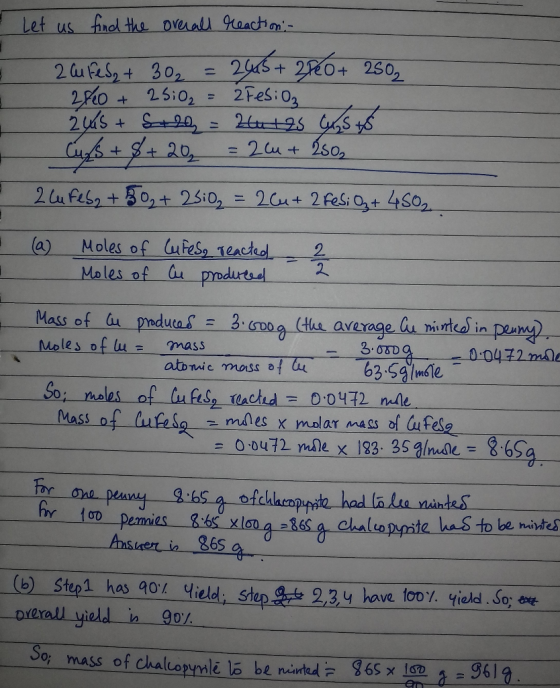
(c) If all the steps have 90% yield, then over all yield is : (0.9 * 0.9 *0.9 *0.9) * 100% = 65.61 %
mass of chalopyrite to be minted = 865 * 100/ 65.61 g = 1318 g
do rate it if you are satisfied with answer
Add Answer to:
"Native," or elemental copper can be found in nature, but most
copper is mined as oxide...
"Native," or elemental copper can be found in nature, but most copper is mined as oxide...
"Native," or elemental copper can be found in nature, but most copper is mined as oxide or sulfide minerals. Chalcopyrite (CuFeS2) is one copper mineral that can be converted to elemental copper in a series of chemical steps. Reacting chalcopyrite with oxygen at high temperature produces a mixture of copper sulfide and iron oxide. The iron oxide is separated from CuS by reaction with sand (SiO2). CuS is converted to Cu2S in the process and the Cu2S is burned in...
19 Question (1 point) See page 302 "Native, or elemental copper can be found in nature,...
 19 Question (1 point) See page 302 "Native, or elemental copper can be found in nature, but most copper is mined as oxide or sulfide minerals. Chalcopyrite (CuFeS2) is one copper mineral that can be converted to elemental copper in a series of chemical steps. Reacting chalcopyrite with oxygen at high temperature produces a mixture of copper sulfide and iron oxide. The iron oxide is separated from CuS by reaction with sand (SiO2). Cus is converted to Cu S in...
See page 302 19 Question (1 point) *Native," or elemental copper can be found in nature,...
 See page 302 19 Question (1 point) *Native," or elemental copper can be found in nature, but most copper is mined as oxide or sulfide minerals. Chalcopyrite (CuFeS2) is one copper mineral that can be converted to elemental copper in a series of chemical steps. Reacting chalcopyrite with oxygen at high temperature produces a mixture of copper sulfide and iron oxide. The iron oxide is separated from CuS by reaction with sand (SiO2). CuS is converted to Cu2S in the...
Part 2 (0.3 point) How much chalcopyrite had to be mined to produce 100 pennies if...
 Part 2 (0.3 point) How much chalcopyrite had to be mined to produce 100 pennies if reaction 1 had a percent yield of 65.00 % and all other reaction steps had yield of 100%? g CuFeS2 Part 3 (0.3 point) How much chalcopyrite had be mined to produce 100 pennies if each reaction involving copper proceeded in 65.00 % yield? g CuFeS2 See page 302 19 Question (1 point) "Native" or elemental copper can be found in nature, but most...
14 Question (a points) See page 302 Native" or elemental copper can be found in nature,...
 14 Question (a points) See page 302 Native" or elemental copper can be found in nature, but most c opper is mined as oxide or sulfide minerals. Chalcopyrite (CuFeS,) is one copper to elemental copper in a series of chemical steps. Reacting chalcopyrite with oxygen at high temperature produces a by reaction with sand (SiO2l. CuS is converted to Cu,S in the process mixture of copper sulfide and iron axide. The iron oxide is separated from Cus and the Cu...
Chalcopyrite (CuFeS2) is an abundant copper mineral that can be converted into elemental copper through the...
Chalcopyrite (CuFeS2) is an abundant copper mineral that can be converted into elemental copper through the four step process below. Part 1 Calculate the mass of Cu in g from 8.40 kg CuFeS2. ________g Part 2 Calculate the mass of CuFeS2 needed in g to produce 300.0 g Cu if the yield for the conversion process is 82%. _________g
Saved Help Save & Edit Submit 17 Copper can be separated from iron in the ore...
 Saved Help Save & Edit Submit 17 Copper can be separated from iron in the ore chalcopyrite (CuFeS2) by heating the ore in the presence of oxygen to form copper(l) sulfide, iron(II)oxide, and one other product. Complete the following partially balanced equation by deciding both the identity of the missing compound and the number of moles required to balance the equation. (Note, no other coefficients are allowed to be changed.) 2CuFeS2(s) + 402(g) → Cu2S(s) + 2FeO(s)+ 8 100:54:07 Multiple...
11. Sulfur hexafluoride is produced by reacting elemental sulfur with fluorine gas. Sg(s) + 24 F2(g)...
 11. Sulfur hexafluoride is produced by reacting elemental sulfur with fluorine gas. Sg(s) + 24 F2(g) - 8 SF6(E) What is the percent vield im 18.3 SF is isolated from the reaction of 10.0 Ss and 300 12 a. 40.2% b. 45.89 c. 47.6% d. 54.656 e. 61.0% 12. The reaction of 5.07 g N with 0.722 g H produces 1.27NH. The percent vield of this reaction is indicate the answer choice that best completes the statement or answers the...
 19 Question (1 point) See page 302 "Native, or elemental copper can be found in nature, but most copper is mined as oxide or sulfide minerals. Chalcopyrite (CuFeS2) is one copper mineral that can be converted to elemental copper in a series of chemical steps. Reacting chalcopyrite with oxygen at high temperature produces a mixture of copper sulfide and iron oxide. The iron oxide is separated from CuS by reaction with sand (SiO2). Cus is converted to Cu S in...
 See page 302 19 Question (1 point) *Native," or elemental copper can be found in nature, but most copper is mined as oxide or sulfide minerals. Chalcopyrite (CuFeS2) is one copper mineral that can be converted to elemental copper in a series of chemical steps. Reacting chalcopyrite with oxygen at high temperature produces a mixture of copper sulfide and iron oxide. The iron oxide is separated from CuS by reaction with sand (SiO2). CuS is converted to Cu2S in the...
 Part 2 (0.3 point) How much chalcopyrite had to be mined to produce 100 pennies if reaction 1 had a percent yield of 65.00 % and all other reaction steps had yield of 100%? g CuFeS2 Part 3 (0.3 point) How much chalcopyrite had be mined to produce 100 pennies if each reaction involving copper proceeded in 65.00 % yield? g CuFeS2 See page 302 19 Question (1 point) "Native" or elemental copper can be found in nature, but most...
 14 Question (a points) See page 302 Native" or elemental copper can be found in nature, but most c opper is mined as oxide or sulfide minerals. Chalcopyrite (CuFeS,) is one copper to elemental copper in a series of chemical steps. Reacting chalcopyrite with oxygen at high temperature produces a by reaction with sand (SiO2l. CuS is converted to Cu,S in the process mixture of copper sulfide and iron axide. The iron oxide is separated from Cus and the Cu...
 Saved Help Save & Edit Submit 17 Copper can be separated from iron in the ore chalcopyrite (CuFeS2) by heating the ore in the presence of oxygen to form copper(l) sulfide, iron(II)oxide, and one other product. Complete the following partially balanced equation by deciding both the identity of the missing compound and the number of moles required to balance the equation. (Note, no other coefficients are allowed to be changed.) 2CuFeS2(s) + 402(g) → Cu2S(s) + 2FeO(s)+ 8 100:54:07 Multiple...
 11. Sulfur hexafluoride is produced by reacting elemental sulfur with fluorine gas. Sg(s) + 24 F2(g) - 8 SF6(E) What is the percent vield im 18.3 SF is isolated from the reaction of 10.0 Ss and 300 12 a. 40.2% b. 45.89 c. 47.6% d. 54.656 e. 61.0% 12. The reaction of 5.07 g N with 0.722 g H produces 1.27NH. The percent vield of this reaction is indicate the answer choice that best completes the statement or answers the...
Most questions answered within 3 hours.
-
Where is the error in this code sequence?
String s1 = "Hello";
String s2 = "ello";...
asked 10 months ago -
Financial data for Joel de Paris, Inc., for last year
follow:
Joel de Paris, Inc.
Balance...
asked 10 months ago -
Consider this reaction:
Al2(SO4)3 (aq)+ BaCl3
(aq) Al2Cl6 (aq)- +
3BaSO4(s) . What is the...
asked 10 months ago -
Suppose that Savneet is considering increasing her
recent random sample from 20 car rentals to 40...
asked 10 months ago -
Trucks arrive at an unloading terminal at an average rate of 120
per hour.
Trucks arrive...
asked 10 months ago -
Why are methanol and ethanol completely soluble in water while
octanol is not very little soluble....
asked 10 months ago -
A facilities manager at a university reads in a research report
that the mean amount of...
asked 10 months ago -
When the CuSO4 is rehydrated by adding water to the anhydrous
compound, is this an endothermic...
asked 10 months ago -
A ray of sunlight is passing from diamond into crown glass; the
angle of incidence is...
asked 10 months ago -
A block of mass 0.249 kg is placed on top of a light, vertical
spring of...
asked 10 months ago -
how do the kidneys compensate in the presences of acidosis
a) trigger hyperventilate
b) reserve acid...
asked 10 months ago -
Question 501 pts
The rental rate of capital to the firm increases. Which of the
following...
asked 10 months ago