Density and Percent Composition Graph Sugar Solution Percents (x-axis): 0.00%, 4.00%, 8.00%, 12.00%, 16.00% Density of...
Density and Percent Composition Graph
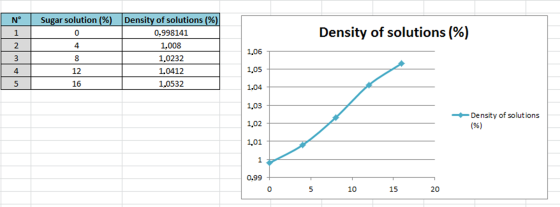
Sugar Solution Percents (x-axis): 0.00%, 4.00%, 8.00%, 12.00%, 16.00%
Density of Solutions (y-axis): 0.998141 (0%), 1.0080 (4%), 1.0232 (8%), 1.0412 (12%), 1.0532 (16%)
I just want to know how you would go about properly organizing the y-axis with all the densities
Homework Answers
Hi,
To prepare the graph: sugar solution (%) vs. solution density (%),
you must choose a scale in which all the points enter.
For the scale of the "Y" axis, 7 values were taken that vary from
0.01 to 0.01. While on the axis of the "X" 5 values were taken in
which they vary from 5 to 5.
Subsequently, each value was intersected until the points that drew
a slope were obtained.
If you find it difficult to locate decimal numbers, I suggest
you do the following,
To choose the scale you will take the highest value of your data
and subtract it less the least value, then divide it by the amount
of values:

A value of 0.01 was obtained, then the scale of "Y" will be made of
0.01 in 0.01.
You will add to your lowest value of your data (0.99) 0.01 in 0.01,
every 0.01 added will be the value of your Y axis, until you reach
your last value.
1st value: 0.99
2nd value: 0.99 + 0.01 = 1
3rd value: 1+ 0.01 = 1.01
4th value: 1.01 + 0.01 = 1.02
5th value: 1.02 + 0.01 = 1.03
6th value: 1.03 + 0.01 = 1.04
7th value: 1.04 + 0.01 = 1.05
8th value: 1.05 + 0.01 = 1.06
If you liked the resolution, a thumbs up would help me a lot.
Thank you very much and success. Regards
Add Answer to:
Density and Percent Composition Graph
Sugar Solution Percents (x-axis): 0.00%, 4.00%, 8.00%, 12.00%,
16.00%
Density of...
Year Stock X Stock Y 8.00% -16.00% -5.00% 12.00% 14.00% 0.00% 4.00% 5.00% What is the...
 Year Stock X Stock Y 8.00% -16.00% -5.00% 12.00% 14.00% 0.00% 4.00% 5.00% What is the standard deviation of Stock Y? Submit Answer format: Percentage Round to: 2 decimal places (Example: 9.24%, % sign required. Will accept decimal format rounded to 4 decimal places (ex: 0.0924))
Stock X Year Stock Y unanswered 8.00% -16.00% not_submitted 12.00% 2 -5.00% 14.00% 0.00% 4 4.00%...
 Stock X Year Stock Y unanswered 8.00% -16.00% not_submitted 12.00% 2 -5.00% 14.00% 0.00% 4 4.00% 5.00% What is the covariance of the returns of Stock X with the returns of Stock Y? Submit Answer format: Number: Round to: 6 decimal places.
Year Stock X Stock Y 8.00% -16.00% -5.00% 12.00% 14.00% 0.00% 4 4.00% 5.00% What is...
 Year Stock X Stock Y 8.00% -16.00% -5.00% 12.00% 14.00% 0.00% 4 4.00% 5.00% What is the standard deviation of the returns of Stock X? Submit Answer format: Percentage Round to: 2 decimal places (Example: 9.24%, % sign required. Will accept decimal format rounded to 4 decimal places (ex: 0.0924))
6. To make solutions for the Density of KCI graph, you are provided with a 12.0%...
 6. To make solutions for the Density of KCI graph, you are provided with a 12.0% KCl solution. You pipet 10.00 mL of this solution into a test tube and then you pipet 30.00 mL of deionized water into the same tube. After stirring, what is the KCl concentration of the new solution you've made? This is KCl 4 solution. V snal = 40.00m Csonal=0-03110.00m 80.12=40.000L XC 1: 24am 2 52:0-037P 40.08 18.00 7. Using the equation of the line...
Table 1. pH readings 12.00 (34.02. 12.58) 11.00 10.00 . 9.00 8.00 7.00 6.00 5.00 р...
 Table 1. pH readings 12.00 (34.02. 12.58) 11.00 10.00 . 9.00 8.00 7.00 6.00 5.00 р 4.00 3.00 2.00 1.00 0.00 0.00 2.00 4.00 6.00 8.00 10.00 12.00 14.00 16.00 18.00 20.00 22.00 24.00 26,00 28.00 30.00 32.00 34.00 Volume (ml) Initial Data Enter the concentration of NaOH used in the titration: 0.500 Enter the mass of unknown acid you used in grams. (g) 0.75 pH vs Volume Measurements Enter all of the following data as prompted by the data...
3. If 15.0 mL of 0.125 M phosphoric acid is titrated with 0.100 M NaOH, what...
 3. If 15.0 mL of 0.125 M phosphoric acid is titrated with 0.100 M NaOH, what volume of the titrant (in mL) must be added to completely neutralize the acid? Show all of your work (including the chemical equation). (1 point) Post-lab Questions: Experiment #9: Acid-Base Titrations Student Learning Objectives : Students will gain practice with the accurate preparation of solutions. Students will perform acid-base titrations and prepare titration curves. Students will identify strong and weak acids by the shapes...
can someone help me answer these 5 questions and figire this graph out please? Acid-Base Titration...
 can
someone help me answer these 5 questions and figire this graph out
please?
Acid-Base Titration of a Weak Acid with a Strong Base: Determination of K. Introduction: You will be titrating a solution of a weak acid with 0.100 M NaOH, while monitoring the reaction using a pH meter. Weak acids have characteristic acid-ionization constants, K. The purpose of this lab is to use the titration to determine the value of this constant for the weak acid called “benzoic...
can
someone help me answer these 5 questions and figire this graph out
please?
Acid-Base Titration of a Weak Acid with a Strong Base: Determination of K. Introduction: You will be titrating a solution of a weak acid with 0.100 M NaOH, while monitoring the reaction using a pH meter. Weak acids have characteristic acid-ionization constants, K. The purpose of this lab is to use the titration to determine the value of this constant for the weak acid called “benzoic...
All of the solutions used today can be washed down the sink with water. Solid waste...
 All of the solutions used today can be washed down the sink with water. Solid waste should be thrown in the bin. Experimental This experiment is to be carried out individually NOTE: Failure to follow the correct procedures as explained in Skill 4 will result in wildly inaccurate results. The notes below do NOT give a full description of the techniques. 0 2 Standardisation of 0.1 M sodium hydroxide with the primary standard potassium hydrogenphthalate Part A (Al) In a...
Consider a cylindrical capacitor like that shown in Fig. 24.6. Let d = rb − ra...
 Consider a cylindrical capacitor like that shown in Fig. 24.6. Let d = rb − ra be the spacing between the inner and outer conductors. (a) Let the radii of the two conductors be only slightly different, so that d << ra. Show that the result derived in Example 24.4 (Section 24.1) for the capacitance of a cylindrical capacitor then reduces to Eq. (24.2), the equation for the capacitance of a parallel-plate capacitor, with A being the surface area of...
 Year Stock X Stock Y 8.00% -16.00% -5.00% 12.00% 14.00% 0.00% 4.00% 5.00% What is the standard deviation of Stock Y? Submit Answer format: Percentage Round to: 2 decimal places (Example: 9.24%, % sign required. Will accept decimal format rounded to 4 decimal places (ex: 0.0924))
 Stock X Year Stock Y unanswered 8.00% -16.00% not_submitted 12.00% 2 -5.00% 14.00% 0.00% 4 4.00% 5.00% What is the covariance of the returns of Stock X with the returns of Stock Y? Submit Answer format: Number: Round to: 6 decimal places.
 Year Stock X Stock Y 8.00% -16.00% -5.00% 12.00% 14.00% 0.00% 4 4.00% 5.00% What is the standard deviation of the returns of Stock X? Submit Answer format: Percentage Round to: 2 decimal places (Example: 9.24%, % sign required. Will accept decimal format rounded to 4 decimal places (ex: 0.0924))
 6. To make solutions for the Density of KCI graph, you are provided with a 12.0% KCl solution. You pipet 10.00 mL of this solution into a test tube and then you pipet 30.00 mL of deionized water into the same tube. After stirring, what is the KCl concentration of the new solution you've made? This is KCl 4 solution. V snal = 40.00m Csonal=0-03110.00m 80.12=40.000L XC 1: 24am 2 52:0-037P 40.08 18.00 7. Using the equation of the line...
 Table 1. pH readings 12.00 (34.02. 12.58) 11.00 10.00 . 9.00 8.00 7.00 6.00 5.00 р 4.00 3.00 2.00 1.00 0.00 0.00 2.00 4.00 6.00 8.00 10.00 12.00 14.00 16.00 18.00 20.00 22.00 24.00 26,00 28.00 30.00 32.00 34.00 Volume (ml) Initial Data Enter the concentration of NaOH used in the titration: 0.500 Enter the mass of unknown acid you used in grams. (g) 0.75 pH vs Volume Measurements Enter all of the following data as prompted by the data...
 3. If 15.0 mL of 0.125 M phosphoric acid is titrated with 0.100 M NaOH, what volume of the titrant (in mL) must be added to completely neutralize the acid? Show all of your work (including the chemical equation). (1 point) Post-lab Questions: Experiment #9: Acid-Base Titrations Student Learning Objectives : Students will gain practice with the accurate preparation of solutions. Students will perform acid-base titrations and prepare titration curves. Students will identify strong and weak acids by the shapes...
 can
someone help me answer these 5 questions and figire this graph out
please?
Acid-Base Titration of a Weak Acid with a Strong Base: Determination of K. Introduction: You will be titrating a solution of a weak acid with 0.100 M NaOH, while monitoring the reaction using a pH meter. Weak acids have characteristic acid-ionization constants, K. The purpose of this lab is to use the titration to determine the value of this constant for the weak acid called “benzoic...
can
someone help me answer these 5 questions and figire this graph out
please?
Acid-Base Titration of a Weak Acid with a Strong Base: Determination of K. Introduction: You will be titrating a solution of a weak acid with 0.100 M NaOH, while monitoring the reaction using a pH meter. Weak acids have characteristic acid-ionization constants, K. The purpose of this lab is to use the titration to determine the value of this constant for the weak acid called “benzoic...
 All of the solutions used today can be washed down the sink with water. Solid waste should be thrown in the bin. Experimental This experiment is to be carried out individually NOTE: Failure to follow the correct procedures as explained in Skill 4 will result in wildly inaccurate results. The notes below do NOT give a full description of the techniques. 0 2 Standardisation of 0.1 M sodium hydroxide with the primary standard potassium hydrogenphthalate Part A (Al) In a...
 Consider a cylindrical capacitor like that shown in Fig. 24.6. Let d = rb − ra be the spacing between the inner and outer conductors. (a) Let the radii of the two conductors be only slightly different, so that d << ra. Show that the result derived in Example 24.4 (Section 24.1) for the capacitance of a cylindrical capacitor then reduces to Eq. (24.2), the equation for the capacitance of a parallel-plate capacitor, with A being the surface area of...
Most questions answered within 3 hours.
-
Where is the error in this code sequence?
String s1 = "Hello";
String s2 = "ello";...
asked 10 months ago -
Financial data for Joel de Paris, Inc., for last year
follow:
Joel de Paris, Inc.
Balance...
asked 10 months ago -
Consider this reaction:
Al2(SO4)3 (aq)+ BaCl3
(aq) Al2Cl6 (aq)- +
3BaSO4(s) . What is the...
asked 10 months ago -
Suppose that Savneet is considering increasing her
recent random sample from 20 car rentals to 40...
asked 10 months ago -
Trucks arrive at an unloading terminal at an average rate of 120
per hour.
Trucks arrive...
asked 10 months ago -
Why are methanol and ethanol completely soluble in water while
octanol is not very little soluble....
asked 10 months ago -
A facilities manager at a university reads in a research report
that the mean amount of...
asked 10 months ago -
When the CuSO4 is rehydrated by adding water to the anhydrous
compound, is this an endothermic...
asked 10 months ago -
A ray of sunlight is passing from diamond into crown glass; the
angle of incidence is...
asked 10 months ago -
A block of mass 0.249 kg is placed on top of a light, vertical
spring of...
asked 10 months ago -
how do the kidneys compensate in the presences of acidosis
a) trigger hyperventilate
b) reserve acid...
asked 10 months ago -
Question 501 pts
The rental rate of capital to the firm increases. Which of the
following...
asked 10 months ago