Ch.3-4 Consider this reaction, which occurs in the atmosphere and contributes to photochemical smog: 2CO(g) +...
Ch.3-4
Consider this reaction, which occurs in the atmosphere and contributes to photochemical smog:
2CO(g) + O2(g) →2CO2(g)
If there is 17.82 g CO and excess O2 present, the reaction yields 23.0 g CO2. Calculate the percent yield for the reaction.
Homework Answers

Add Answer to:
Ch.3-4
Consider this reaction, which occurs in the atmosphere and
contributes to photochemical smog:
2CO(g) +...
Consider this reaction, which occurs in the atmosphere and contributes to photochemical smog: H2(g) + I2(s)...
Consider this reaction, which occurs in the atmosphere and contributes to photochemical smog: H2(g) + I2(s) →2HI(g) If there is 17.29 g H2 and excess I2 present, the reaction yields 1700 g HI. Calculate the percent yield for the reaction.
Consider this reaction, which occurs in the atmosphere and contributes to photochemical smog: ZnO(s) + H2O(l)...
Consider this reaction, which occurs in the atmosphere and contributes to photochemical smog: ZnO(s) + H2O(l) →Zn(OH)2(aq) If there is 16.61 g ZnO and excess H2O present, the reaction yields 18.0 g Zn(OH)2. Calculate the percent yield for the reaction.
Please answer #3 and #4 only Photochemical Smog Photochemical smog is a type of air pollution...
 Please answer #3 and #4
only
Photochemical Smog Photochemical smog is a type of air pollution produced when sunlight acts upon motor vehicle exhaust gases, such as nitrogen oxides (e.g., NO, NO:) to form harmful substances such as ozone (0). These substances participate in a reaction cycle that determines the concentration of pollutants at different times during the day. Ozone Formation: NO:(), is formed by chemical reactions involving N2(g) and O-() at the high temperatures inside internal combustion engines in...
Please answer #3 and #4
only
Photochemical Smog Photochemical smog is a type of air pollution produced when sunlight acts upon motor vehicle exhaust gases, such as nitrogen oxides (e.g., NO, NO:) to form harmful substances such as ozone (0). These substances participate in a reaction cycle that determines the concentration of pollutants at different times during the day. Ozone Formation: NO:(), is formed by chemical reactions involving N2(g) and O-() at the high temperatures inside internal combustion engines in...
Calculate the heat of reaction in (kJ) for the following reaction: 2CO(g) + O2(g) --> 2CO2(g)...
Calculate the heat of reaction in (kJ) for the following reaction: 2CO(g) + O2(g) --> 2CO2(g) given the following data: C + 1/2O2 --> CO(g) delta H= -110.5 KJ/mol C + O2(g) --> CO2(g) delta H= -393.5 KJ/ mol
For the reaction 2CO(g)+O2(g)⇌2CO2(g), the value of K at a certain temperature is 1300. Calculate [CO2]...
For the reaction 2CO(g)+O2(g)⇌2CO2(g), the value of K at a certain temperature is 1300. Calculate [CO2] at equilibrium when [CO] = 9.0×10⁻² mol/L and [O2] = 0.527 mol/L
Assuming that Ac is independent of temperature, calculate AH1200 for the reaction: 2CO(g) + O2(g) →...
 Assuming that Ac is independent of temperature, calculate AH1200 for the reaction: 2CO(g) + O2(g) → 2CO2(g) AH co Chemical KkJ mol-?) U moll) -398.029 39.277 CO2(g) o2g) CO(g) n/a 28.34 -111.42 27.247 -577078.56
What is the percent yield of the reaction shown below if 31.8 g CO2 are obtained...
What is the percent yield of the reaction shown below if 31.8 g CO2 are obtained when 21.0 g of CO reacts with 12.8 g of O2? 2CO(g) + O2(g) => 2CO2(g)
for the reaction 2CO + O2 = 2CO2 it is found that at a certain temperature...
for the reaction 2CO + O2 = 2CO2 it is found that at a certain temperature the concentration are [CO] = 7.2 x 10^-4 M, [O2] = 8.1 x 10^-3 M, and [CO2] = 2.3 x 10⁻² M. write out the equilibrium expression and calculate K for the reaction at this temperature? How would the equilibrium position change if CO2 was added?
Which reaction is accompanied by an increase in entropy? A. (CH3)2CO() + 4 O2(g) → 3...
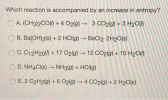 Which reaction is accompanied by an increase in entropy? A. (CH3)2CO() + 4 O2(g) → 3 CO2(g) + 3 H2011) B. Ba(OH)2(s) + 2 HCl(g) → BaCl2.2H2O(s) OC.C12H20() + 17 O2(g) → 12 CO2(g) + 10 H2O() D. NH4Cl(s) + NH3(g) + HCl(g) E. 2 C2H2(g) + 5 O2(g) → 4 CO2(g) + 2 H2O(s)
Consider the following reaction at equilibrium. 2CO2 (g) 2CO (g) + O2 (g) ΔH° = -514...
Consider the following reaction at equilibrium. 2CO2 (g) 2CO (g) + O2 (g) ΔH° = -514 kJ Le Châtelier's principle predicts that the equilibrium partial pressure of CO (g) can be maximized by carrying out the reaction ________. A.) at low temperature and low pressure B.) at low temperature and high pressure C.) at high temperature and low pressure D.) in the presence of solid carbon E.) at high temperature and high pressure
 Please answer #3 and #4
only
Photochemical Smog Photochemical smog is a type of air pollution produced when sunlight acts upon motor vehicle exhaust gases, such as nitrogen oxides (e.g., NO, NO:) to form harmful substances such as ozone (0). These substances participate in a reaction cycle that determines the concentration of pollutants at different times during the day. Ozone Formation: NO:(), is formed by chemical reactions involving N2(g) and O-() at the high temperatures inside internal combustion engines in...
Please answer #3 and #4
only
Photochemical Smog Photochemical smog is a type of air pollution produced when sunlight acts upon motor vehicle exhaust gases, such as nitrogen oxides (e.g., NO, NO:) to form harmful substances such as ozone (0). These substances participate in a reaction cycle that determines the concentration of pollutants at different times during the day. Ozone Formation: NO:(), is formed by chemical reactions involving N2(g) and O-() at the high temperatures inside internal combustion engines in...
 Assuming that Ac is independent of temperature, calculate AH1200 for the reaction: 2CO(g) + O2(g) → 2CO2(g) AH co Chemical KkJ mol-?) U moll) -398.029 39.277 CO2(g) o2g) CO(g) n/a 28.34 -111.42 27.247 -577078.56
 Which reaction is accompanied by an increase in entropy? A. (CH3)2CO() + 4 O2(g) → 3 CO2(g) + 3 H2011) B. Ba(OH)2(s) + 2 HCl(g) → BaCl2.2H2O(s) OC.C12H20() + 17 O2(g) → 12 CO2(g) + 10 H2O() D. NH4Cl(s) + NH3(g) + HCl(g) E. 2 C2H2(g) + 5 O2(g) → 4 CO2(g) + 2 H2O(s)
Most questions answered within 3 hours.
-
Where is the error in this code sequence?
String s1 = "Hello";
String s2 = "ello";...
asked 10 months ago -
Financial data for Joel de Paris, Inc., for last year
follow:
Joel de Paris, Inc.
Balance...
asked 10 months ago -
Consider this reaction:
Al2(SO4)3 (aq)+ BaCl3
(aq) Al2Cl6 (aq)- +
3BaSO4(s) . What is the...
asked 10 months ago -
Suppose that Savneet is considering increasing her
recent random sample from 20 car rentals to 40...
asked 10 months ago -
Trucks arrive at an unloading terminal at an average rate of 120
per hour.
Trucks arrive...
asked 10 months ago -
Why are methanol and ethanol completely soluble in water while
octanol is not very little soluble....
asked 10 months ago -
A facilities manager at a university reads in a research report
that the mean amount of...
asked 10 months ago -
When the CuSO4 is rehydrated by adding water to the anhydrous
compound, is this an endothermic...
asked 10 months ago -
A ray of sunlight is passing from diamond into crown glass; the
angle of incidence is...
asked 10 months ago -
A block of mass 0.249 kg is placed on top of a light, vertical
spring of...
asked 10 months ago -
how do the kidneys compensate in the presences of acidosis
a) trigger hyperventilate
b) reserve acid...
asked 10 months ago -
Question 501 pts
The rental rate of capital to the firm increases. Which of the
following...
asked 10 months ago