In Java: The Fibonacci sequence is a series of numbers beginning with 0 and 1, in...
In Java:
The Fibonacci sequence is a series of numbers beginning with 0 and 1, in which each succeeding number is the sum of the previous two. 0, 1, 1, 2, 3, 5, 8, 13, 21, ….
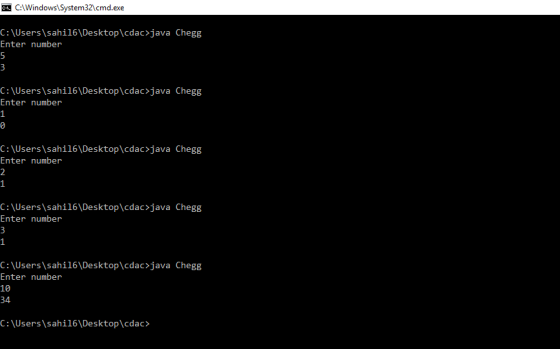
Practice your knowledge of recursion by producing a program that prints the nth Fibonacci number. That is, the program should accept an integer (n) as input and output the number that is the nth number in the Fibonacci sequence. For example, if n is 5, your output should be 3, because 3 is the fifth number in the Fibonacci sequence.
To get credit, your code must
- be free from compile-time or runtime errors, and
- work properly to find the correct number;
- your code must recursively call methods and may not use nested for loops of any kind.
Homework Answers
import java.util.*;
public class Chegg
{
static int fib(int n)
{
// if n==0 return 0
if (n == 0)
return 0;
// if n==0 return 0
if (n == 1)
return 1;
//return the sum of last two
terms
return fib(n - 1) + fib(n - 2);
}
public static void main(String[] args) {
// taking user input
Scanner scan= new Scanner(System.in);
System.out.println("Enter number");
int n=scan.nextInt();
// here we are passing the index at whhich we require
the fibonacci number
System.out.println(fib(n-1));
}
}
Add Answer to:
In Java:
The Fibonacci sequence is a series of numbers beginning with 0
and 1, in...
use Java please. The Fibonacci Sequence Given the initial Fibonacci numbers 0 and 1, we can...
 use Java please.
The Fibonacci Sequence Given the initial Fibonacci numbers 0 and 1, we can generate the next number by adding the two previous Fibonacci numbers together. For this sequence, you will be asked to take an input, denoting how many Fibonacci numbers you want to generate. Call this input upperFibLimit. The longest Fib sequence you should generate is 40 and the shortest you should generate is 1. So,1<upperFibLimit<40 The rule is simple given f(0) 0, f(1) 1 ....
use Java please.
The Fibonacci Sequence Given the initial Fibonacci numbers 0 and 1, we can generate the next number by adding the two previous Fibonacci numbers together. For this sequence, you will be asked to take an input, denoting how many Fibonacci numbers you want to generate. Call this input upperFibLimit. The longest Fib sequence you should generate is 40 and the shortest you should generate is 1. So,1<upperFibLimit<40 The rule is simple given f(0) 0, f(1) 1 ....
Fibonacci Sequence The Fibonacci Sequence is the series of numbers: 0, 1, 1, 2, 3, 5,...
Fibonacci Sequence The Fibonacci Sequence is the series of numbers: 0, 1, 1, 2, 3, 5, 8, 13, 21, 34, ... The next number is found by adding up the two numbers before it. The 2 is found by adding the two numbers before it (1+1) The 3 is found by adding the two numbers before it (1+2), And the 5 is (2+3), and so on! Example: the next number in the sequence above is 21+34 = 55 Source:...
2. The Fibonacci numbers are defined by the sequence: f = 1 f2 = 1 fo=fni...
 2. The Fibonacci numbers are defined by the sequence: f = 1 f2 = 1 fo=fni + 2 Implement a program that prompts the user for an integer, n, and prints all the Fibonacci numbers, up to the nth Fibonacci number. Use n=10. Show a sample output with the expected results. Output: Enter a number: 100 number Fib 89
Write a program in MIPs Assembly Language to compute nth number of a fibonacci number sequence....
Write a program in MIPs Assembly Language to compute nth number of a fibonacci number sequence. Your program should prompt for an integer input n from the user. The program should call a recursive function to compute the nth fibonacci number. Your program must follow programming convention. You should submit program and screenshot of output in a single word/pdf file. You should use following recursive definition of fibonacci function: fib(0) = 0 fib(1) = 1 fib(n) = fib(n-1) +fib(n-2)
Write a Java program that generates an array of Fibonacci numbers. Specifications: The program -Fills a...
Write a Java program that generates an array of Fibonacci numbers. Specifications: The program -Fills a one-dimensional array with the first 30 Fibonacci numbers using a calculation to generate the numbers. Note: The first two Fibonacci numbers 0 and 1 should be generated explicitly as in -long[] series = new long[limit]; //create first 2 series elements series[0] = 0; series[1] = 1; -But, it is not permissible to fill the array explicitly with the Fibonacci series’ after the first two...
A Fibonacci sequence is a series of numbers where the next number in the series is...
A Fibonacci sequence is a series of numbers where the next number in the series is the sum of the previous two numbers. The sequence starts with the numbers 0 and 1. Here are the first ten numbers of the Fibonacci sequence: 0 1 1 2 3 5 8 13 21 34 Write a Java program to print out the first fifteen numbers of the Fibonacci sequence using a loop. You will need three variables previous, current, and next...
The Fibonacci sequence is the series of numbers 0, 1, 1, 2, 3, 5, 8, .......
The Fibonacci sequence is the series of numbers 0, 1, 1, 2, 3, 5, 8, .... It is defined by the following mathematical expression, with X0 & X1 being 0 and 1, respectively: Xn = Xn-1 + Xn-2 Write a C program using the fork() system call that generates and prints the Fibonacci sequence in the child process. The number of members in the sequence will be determined by a user provided as a user prompted input. Make the parent...
Using R code only 4. The Fibonacci numbers are the sequence of numbers defined by the...
 Using R code only
4. The Fibonacci numbers are the sequence of numbers defined by the linear recurrence equation Fn F-1 F-2 where F F2 1 and by convention Fo 0. For example, the first 8 Fibonacci numbers are 1, 1, 2, 3, 5, 8, 13, 21. (a) For a given n, compute the nth Fibonnaci number using a for loop (b) For a given n, compute the nth Fibonnaci number using a while loop Print the 15th Fibonacci number...
Using R code only
4. The Fibonacci numbers are the sequence of numbers defined by the linear recurrence equation Fn F-1 F-2 where F F2 1 and by convention Fo 0. For example, the first 8 Fibonacci numbers are 1, 1, 2, 3, 5, 8, 13, 21. (a) For a given n, compute the nth Fibonnaci number using a for loop (b) For a given n, compute the nth Fibonnaci number using a while loop Print the 15th Fibonacci number...
The Fibonacci sequence is the sequence of numbers: 0, 1, 1, 2, 3, 5, 8, 13,...
The Fibonacci sequence is the sequence of numbers: 0, 1, 1, 2, 3, 5, 8, 13, 21, 34, … The next number is found by adding up the two numbers before it. For example, the 2 is found by adding the two numbers before it (1+1). The 3 is found by adding the two numbers before it (1+2). The 5 is found by adding the two numbers before it (2+3), and so on! Each number in the sequence is called...
In mathematics, the Fibonacci numbers are the series of number that exhibit the following pattern: 0,1,1,2,3,5,8,13,21,34,55,89,144,.......
In mathematics, the Fibonacci numbers are the series of number that exhibit the following pattern: 0,1,1,2,3,5,8,13,21,34,55,89,144,.... In mathematical notation the sequence Fn of Fibonacci number is defined by the following recurrence relation: Fn=Fn-1+Fn-2 With the initial values of F0=0 and F1=1. Thus, the next number in the series is the sum of the previous two numbers. Write a program that asks the user for a positive integer N and generate the Nth Fibonacci number. Your main function should handle user...
 use Java please.
The Fibonacci Sequence Given the initial Fibonacci numbers 0 and 1, we can generate the next number by adding the two previous Fibonacci numbers together. For this sequence, you will be asked to take an input, denoting how many Fibonacci numbers you want to generate. Call this input upperFibLimit. The longest Fib sequence you should generate is 40 and the shortest you should generate is 1. So,1<upperFibLimit<40 The rule is simple given f(0) 0, f(1) 1 ....
use Java please.
The Fibonacci Sequence Given the initial Fibonacci numbers 0 and 1, we can generate the next number by adding the two previous Fibonacci numbers together. For this sequence, you will be asked to take an input, denoting how many Fibonacci numbers you want to generate. Call this input upperFibLimit. The longest Fib sequence you should generate is 40 and the shortest you should generate is 1. So,1<upperFibLimit<40 The rule is simple given f(0) 0, f(1) 1 ....
 2. The Fibonacci numbers are defined by the sequence: f = 1 f2 = 1 fo=fni + 2 Implement a program that prompts the user for an integer, n, and prints all the Fibonacci numbers, up to the nth Fibonacci number. Use n=10. Show a sample output with the expected results. Output: Enter a number: 100 number Fib 89
 Using R code only
4. The Fibonacci numbers are the sequence of numbers defined by the linear recurrence equation Fn F-1 F-2 where F F2 1 and by convention Fo 0. For example, the first 8 Fibonacci numbers are 1, 1, 2, 3, 5, 8, 13, 21. (a) For a given n, compute the nth Fibonnaci number using a for loop (b) For a given n, compute the nth Fibonnaci number using a while loop Print the 15th Fibonacci number...
Using R code only
4. The Fibonacci numbers are the sequence of numbers defined by the linear recurrence equation Fn F-1 F-2 where F F2 1 and by convention Fo 0. For example, the first 8 Fibonacci numbers are 1, 1, 2, 3, 5, 8, 13, 21. (a) For a given n, compute the nth Fibonnaci number using a for loop (b) For a given n, compute the nth Fibonnaci number using a while loop Print the 15th Fibonacci number...
Most questions answered within 3 hours.
-
Where is the error in this code sequence?
String s1 = "Hello";
String s2 = "ello";...
asked 11 months ago -
Financial data for Joel de Paris, Inc., for last year
follow:
Joel de Paris, Inc.
Balance...
asked 11 months ago -
Consider this reaction:
Al2(SO4)3 (aq)+ BaCl3
(aq) Al2Cl6 (aq)- +
3BaSO4(s) . What is the...
asked 11 months ago -
Suppose that Savneet is considering increasing her
recent random sample from 20 car rentals to 40...
asked 11 months ago -
Trucks arrive at an unloading terminal at an average rate of 120
per hour.
Trucks arrive...
asked 11 months ago -
Why are methanol and ethanol completely soluble in water while
octanol is not very little soluble....
asked 11 months ago -
A facilities manager at a university reads in a research report
that the mean amount of...
asked 11 months ago -
When the CuSO4 is rehydrated by adding water to the anhydrous
compound, is this an endothermic...
asked 11 months ago -
A ray of sunlight is passing from diamond into crown glass; the
angle of incidence is...
asked 11 months ago -
A block of mass 0.249 kg is placed on top of a light, vertical
spring of...
asked 11 months ago -
how do the kidneys compensate in the presences of acidosis
a) trigger hyperventilate
b) reserve acid...
asked 11 months ago -
Question 501 pts
The rental rate of capital to the firm increases. Which of the
following...
asked 11 months ago