Calculate the net work done by the wings of a 0.300 kg hawk as he flies...
Calculate the net work done by the wings of a 0.300 kg hawk as he flies in a straight line at an angle of 35° above the horizontal from a height of 10.0 m to a height of 50.0 m. His starting speed is 6.00 m/s and his final speed is 10.0 m/s. The drag force is an average of 2.5 N during the flight.
Homework Answers

Add Answer to:
Calculate the net work done by the wings of a 0.300 kg hawk as
he flies...
20m/s 10m/s A sudden breeze hits a 1-kg squirrel while he is in flight. The squirrel...
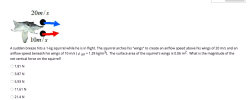 20m/s 10m/s A sudden breeze hits a 1-kg squirrel while he is in flight. The squirrel arches his "wings" to create an airflow speed above his wings of 20 m/s and an airflow speed beneath his wings of 10 m/s ( air = 1.29 kg/m3). The surface area of the squirrel's wings is 0.06 m2. What is the magnitude of the net vertical force on the squirrel? 0 1.81 N 03.87 N 05.93 N O 11.61 N 021.4 N
1- How much work is done by the horizontal force Fp = 150N on the 18-kg...
1- How much work is done by the horizontal force Fp = 150N on the 18-kg block when the force pushes the block 5.0 m up along the 32° frictionless incline? (b) How much work is done by the gravitational force on the block during this displacement? (c) How much work is done by the normal force? (d) What is the speed of the block (assume that it is zero initially) after this displacement? [Hint: Work-energy involves net work done.]...
A 1.1 kg seagull takes off from a piling along the California coast and accelerates in...
A 1.1 kg seagull takes off from a piling along the California coast and accelerates in 0.50 s to a flight speed of 7.5 m/s. Assuming the seagull flies along a horizontal path (at the same height as its takeoff), what average power is delivered by the bird’s wings during the takeoff?
1.20 1.00 Problem 2 (25%) An airplane with a mass of 1000 kg flies at 55...
 1.20 1.00 Problem 2 (25%) An airplane with a mass of 1000 kg flies at 55 m/s in air with a density of 0.9 kg/m”. The wing has an aspect ratio of 5, and has the planform area of 12 m? a) (10%) Assuming that the wing is the only component that produces lift, calculate the lift coefficient, Cl, in a uniform, horizontal flight. b) (5%) Using the figure, calculate the angle of attack and the coefficient of drag c)...
Calculate the work done by an 70.0-kg man who pushes a crate 4.50 m up along...
 Calculate the work done by an 70.0-kg man who pushes a crate 4.50 m up along a ramp that makes an angle of 24.0° with the horizontal. (See figure below.) He exerts a force of 535 N on the crate parallel to the ramp and moves at a constant speed. Be certain to include the work he does on the crate and on his body to get up the ramp 1021.2J Enviar Respuesta Incorrecto. Tries 5/50 Intentos Anteriores
4. A 55 kg box rests on a horizontal surfcion betwce the box and the surface is 0.30, and the coe...
 #4 and #5!!
4. A 55 kg box rests on a horizontal surfcion betwce the box and the surface is 0.30, and the coefficient of kinetic friction is 0.20. What horizontal force must be applied to the box to cause it to start sliding along the surface? 4 :0 ovit 5. A projectile is launched at ground level with an initial speed of 50.0 m/s at an angle of 300 above the horizontal. It strikes a target above the ground...
#4 and #5!!
4. A 55 kg box rests on a horizontal surfcion betwce the box and the surface is 0.30, and the coefficient of kinetic friction is 0.20. What horizontal force must be applied to the box to cause it to start sliding along the surface? 4 :0 ovit 5. A projectile is launched at ground level with an initial speed of 50.0 m/s at an angle of 300 above the horizontal. It strikes a target above the ground...
* This is all the information given QUESTION 1 (iii,iv) PLEASE!!!: Examine the car performance when the angle of both the front and rear wings is set to θ = 10◦. In all the analysis that follows ign...
 * This is all the information given
QUESTION 1 (iii,iv) PLEASE!!!:
Examine the car performance when the angle of both the front and
rear wings is set to θ = 10◦. In all the analysis that follows
ignore frictional losses other than drag. Determine:
(iii) What is the maximum speed the vehicle can safely corner a
bend with R = 30 m (ans. 108Km/hr).
What is the power required at this speed? (ans. 27.8KW)
(iv) What is the maximum speed...
* This is all the information given
QUESTION 1 (iii,iv) PLEASE!!!:
Examine the car performance when the angle of both the front and
rear wings is set to θ = 10◦. In all the analysis that follows
ignore frictional losses other than drag. Determine:
(iii) What is the maximum speed the vehicle can safely corner a
bend with R = 30 m (ans. 108Km/hr).
What is the power required at this speed? (ans. 27.8KW)
(iv) What is the maximum speed...
Please solve for work done by friction force A 3.0-kg block is dragged over a rough...
 Please solve for work done by friction force
A 3.0-kg block is dragged over a rough horizontal surface by a constant force of 16 N acting at an angle of 37degree above the horizontal as shown. The speed of the block increases from 4.0m/s to 6.0m/s in a displacement of 5.0 m. What work was done by the friction force during this displacement?
Please solve for work done by friction force
A 3.0-kg block is dragged over a rough horizontal surface by a constant force of 16 N acting at an angle of 37degree above the horizontal as shown. The speed of the block increases from 4.0m/s to 6.0m/s in a displacement of 5.0 m. What work was done by the friction force during this displacement?
006 10.0 points A model airplane of mass 0.634 kg flies in a horizontal circle at...
 006 10.0 points A model airplane of mass 0.634 kg flies in a horizontal circle at the end of a control wire of length 45.4 m with a speed of 48.2 m/s. The forces exerted on the airplane are the pull of the control wire, its own weight, and aerodynamic lift, which acts at 29.7° inward from the vertical as shown in the figure litft Compute the tension in the wire if it makes a constant angle of 29.7 with...
QUESTION 10 Power, P, is defined as the rate at which work, W, is done, or...
QUESTION 10 Power, P, is defined as the rate at which work, W, is done, or the work divided by the time, t, over which that work occurs: P = W / t. Starting from rest, at the bottom of a flight of stairs, what is the power output for a person of mass 55 kg who runs up a flight of stairs of height 3.0 m and reaches the top of the stairs, in a time of 3.0 s,...
 20m/s 10m/s A sudden breeze hits a 1-kg squirrel while he is in flight. The squirrel arches his "wings" to create an airflow speed above his wings of 20 m/s and an airflow speed beneath his wings of 10 m/s ( air = 1.29 kg/m3). The surface area of the squirrel's wings is 0.06 m2. What is the magnitude of the net vertical force on the squirrel? 0 1.81 N 03.87 N 05.93 N O 11.61 N 021.4 N
 1.20 1.00 Problem 2 (25%) An airplane with a mass of 1000 kg flies at 55 m/s in air with a density of 0.9 kg/m”. The wing has an aspect ratio of 5, and has the planform area of 12 m? a) (10%) Assuming that the wing is the only component that produces lift, calculate the lift coefficient, Cl, in a uniform, horizontal flight. b) (5%) Using the figure, calculate the angle of attack and the coefficient of drag c)...
 Calculate the work done by an 70.0-kg man who pushes a crate 4.50 m up along a ramp that makes an angle of 24.0° with the horizontal. (See figure below.) He exerts a force of 535 N on the crate parallel to the ramp and moves at a constant speed. Be certain to include the work he does on the crate and on his body to get up the ramp 1021.2J Enviar Respuesta Incorrecto. Tries 5/50 Intentos Anteriores
 #4 and #5!!
4. A 55 kg box rests on a horizontal surfcion betwce the box and the surface is 0.30, and the coefficient of kinetic friction is 0.20. What horizontal force must be applied to the box to cause it to start sliding along the surface? 4 :0 ovit 5. A projectile is launched at ground level with an initial speed of 50.0 m/s at an angle of 300 above the horizontal. It strikes a target above the ground...
#4 and #5!!
4. A 55 kg box rests on a horizontal surfcion betwce the box and the surface is 0.30, and the coefficient of kinetic friction is 0.20. What horizontal force must be applied to the box to cause it to start sliding along the surface? 4 :0 ovit 5. A projectile is launched at ground level with an initial speed of 50.0 m/s at an angle of 300 above the horizontal. It strikes a target above the ground...
 * This is all the information given
QUESTION 1 (iii,iv) PLEASE!!!:
Examine the car performance when the angle of both the front and
rear wings is set to θ = 10◦. In all the analysis that follows
ignore frictional losses other than drag. Determine:
(iii) What is the maximum speed the vehicle can safely corner a
bend with R = 30 m (ans. 108Km/hr).
What is the power required at this speed? (ans. 27.8KW)
(iv) What is the maximum speed...
* This is all the information given
QUESTION 1 (iii,iv) PLEASE!!!:
Examine the car performance when the angle of both the front and
rear wings is set to θ = 10◦. In all the analysis that follows
ignore frictional losses other than drag. Determine:
(iii) What is the maximum speed the vehicle can safely corner a
bend with R = 30 m (ans. 108Km/hr).
What is the power required at this speed? (ans. 27.8KW)
(iv) What is the maximum speed...
 Please solve for work done by friction force
A 3.0-kg block is dragged over a rough horizontal surface by a constant force of 16 N acting at an angle of 37degree above the horizontal as shown. The speed of the block increases from 4.0m/s to 6.0m/s in a displacement of 5.0 m. What work was done by the friction force during this displacement?
Please solve for work done by friction force
A 3.0-kg block is dragged over a rough horizontal surface by a constant force of 16 N acting at an angle of 37degree above the horizontal as shown. The speed of the block increases from 4.0m/s to 6.0m/s in a displacement of 5.0 m. What work was done by the friction force during this displacement?
 006 10.0 points A model airplane of mass 0.634 kg flies in a horizontal circle at the end of a control wire of length 45.4 m with a speed of 48.2 m/s. The forces exerted on the airplane are the pull of the control wire, its own weight, and aerodynamic lift, which acts at 29.7° inward from the vertical as shown in the figure litft Compute the tension in the wire if it makes a constant angle of 29.7 with...
Most questions answered within 3 hours.
-
Where is the error in this code sequence?
String s1 = "Hello";
String s2 = "ello";...
asked 11 months ago -
Financial data for Joel de Paris, Inc., for last year
follow:
Joel de Paris, Inc.
Balance...
asked 11 months ago -
Consider this reaction:
Al2(SO4)3 (aq)+ BaCl3
(aq) Al2Cl6 (aq)- +
3BaSO4(s) . What is the...
asked 11 months ago -
Suppose that Savneet is considering increasing her
recent random sample from 20 car rentals to 40...
asked 11 months ago -
Trucks arrive at an unloading terminal at an average rate of 120
per hour.
Trucks arrive...
asked 11 months ago -
Why are methanol and ethanol completely soluble in water while
octanol is not very little soluble....
asked 11 months ago -
A facilities manager at a university reads in a research report
that the mean amount of...
asked 11 months ago -
When the CuSO4 is rehydrated by adding water to the anhydrous
compound, is this an endothermic...
asked 11 months ago -
A ray of sunlight is passing from diamond into crown glass; the
angle of incidence is...
asked 11 months ago -
A block of mass 0.249 kg is placed on top of a light, vertical
spring of...
asked 11 months ago -
how do the kidneys compensate in the presences of acidosis
a) trigger hyperventilate
b) reserve acid...
asked 11 months ago -
Question 501 pts
The rental rate of capital to the firm increases. Which of the
following...
asked 11 months ago