Explain the steps taken in the reaction mechanism of the oxidation of cyclohexanone to adipic acid...
Explain the steps taken in the reaction mechanism of the oxidation of cyclohexanone to adipic acid with potassium permanganate. (Please explain what happens in each step as I do not understand the process and what is going on).
Homework Answers

Add Answer to:
Explain the steps taken in the reaction mechanism of the
oxidation of cyclohexanone to adipic acid...
Organic Chemistry. Please explain well. 1a. Write reaction equation for the vigorous oxidation of cyclohexene with...
Organic Chemistry. Please explain well. 1a. Write reaction equation for the vigorous oxidation of cyclohexene with potassium permanganate. Be sure to use the structural formulas for each species. 1b. Write the complete balanced reaction equation for the vigorous oxidation of cyclohexene with potassium permanganate. Use half-reactions method to balance the redox reaction, just as you would have in General Chemistry assuming basic solution. Show all of the work to balance the equation.
A) What would be the correctly balanced oxidation-reduction reaction equation for this reaction? B) what would...
 A) What would be the correctly balanced oxidation-reduction
reaction equation for this reaction?
B) what would be the reduction half reaction for the
permanganate ion. Be sure to include the oxidation numbers for
manganese and number of electrons transferred
0 ompound and in return the manganese ion is reduced and changes its state from +7 to +4. The product is a derivative of benzoic acid. We will use potassium permanganate to oxidize 2-chlorotoluene (o-chlorota 2-chlorobenzoic acid (o-chlorobenzoic acid). Permanganate solutions...
A) What would be the correctly balanced oxidation-reduction
reaction equation for this reaction?
B) what would be the reduction half reaction for the
permanganate ion. Be sure to include the oxidation numbers for
manganese and number of electrons transferred
0 ompound and in return the manganese ion is reduced and changes its state from +7 to +4. The product is a derivative of benzoic acid. We will use potassium permanganate to oxidize 2-chlorotoluene (o-chlorota 2-chlorobenzoic acid (o-chlorobenzoic acid). Permanganate solutions...
3,4,5,6 QUESTIONS 1. Considering that the Cr in CrO, and Cr,0- is in the 6+ oxidation...
 3,4,5,6
QUESTIONS 1. Considering that the Cr in CrO, and Cr,0- is in the 6+ oxidation state and that each step in the se- quence CH4 → CH3OH → CH- O → HCOOH → CO2 corresponds to a two-electron change, com- plete and balance the following reactions: +HC,O, CH,CH.COCH, +CO2 +Cr 2. Write a balanced equation for the oxidation of cyclohexanone to adipic acid, and calculate the theo- 3. In an oxidation of cyclohexanol in which the temperature was allowed...
3,4,5,6
QUESTIONS 1. Considering that the Cr in CrO, and Cr,0- is in the 6+ oxidation state and that each step in the se- quence CH4 → CH3OH → CH- O → HCOOH → CO2 corresponds to a two-electron change, com- plete and balance the following reactions: +HC,O, CH,CH.COCH, +CO2 +Cr 2. Write a balanced equation for the oxidation of cyclohexanone to adipic acid, and calculate the theo- 3. In an oxidation of cyclohexanol in which the temperature was allowed...
explain in details: Of the four oxidation steps in the Citric Acid Cycle, one is obviously...
explain in details: Of the four oxidation steps in the Citric Acid Cycle, one is obviously different. Explain what is unique in this oxidation step from other three oxidation steps in terms of cofactors, localization, and connection to other metabolic pathways?
Consider the three step reaction mechanism for the atmospheric oxidation in clouds of sulfurous acid to...
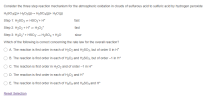 Consider the three step reaction mechanism for the atmospheric oxidation in clouds of sulfurous acid to sulfuric acid by hydrogen peroxide H2SO3(9)+ H2O2(9)- H2SO4(9)+ H20(9) Step 1: H2SO3 = HSO3+H* fast Step 2: H202 + H+ = H302 fast Step 3: H302* + HSO3 + H2SO4+H20 slow Which of the following is correct concerning the rate law for the overall reaction? O A. The reaction is first order in each of H2O2 and H2SO3, but of order 0 in H...
Experiment 2: Grignard synthesis of benzoic acid . Complete reaction, and provide the reaction mechanism for...
 Experiment 2: Grignard synthesis of benzoic acid . Complete reaction, and provide the reaction mechanism for all chemistry in this lab (forming the Grignard reagent, reaction with the CO2 electrophile, and acidification). . What are the side products and salts formed in this reaction? How are they removed from the purified product? . Why do we take precautions to eliminate water from the reaction? Be specific about what would happen if we did not do so. . Why is the...
Please, could you use this reaction steps below to explain to me step by step what...
 Please, could you use this reaction steps below to explain to
me step by step what happens in each step of the reactions above by
identifying what each arrow signifies, which one acts a
nucleophiles, leaving groups and electrophiles. I am interested in
learning the organic chemistry terminology interpretation of whats
going on in each step. Thanks
OHཏཾ HzN། =Vv+ H+ HzN། H20 HzN། NH ། ཨ ་ ་དང་། ལ་ ༡ པའི་ནང་ བར་ དང་ ། OH དOE OH HzNངL _OHH...
Please, could you use this reaction steps below to explain to
me step by step what happens in each step of the reactions above by
identifying what each arrow signifies, which one acts a
nucleophiles, leaving groups and electrophiles. I am interested in
learning the organic chemistry terminology interpretation of whats
going on in each step. Thanks
OHཏཾ HzN། =Vv+ H+ HzN། H20 HzN། NH ། ཨ ་ ་དང་། ལ་ ༡ པའི་ནང་ བར་ དང་ ། OH དOE OH HzNངL _OHH...
n a pink aqueous solution of potassium permanganate, faintly addified with dilute sulfuric acid was treated the reaction took place with the evolution of gas bubbles, and the pink solution turned...
 n a pink aqueous solution of potassium permanganate, faintly addified with dilute sulfuric acid was treated the reaction took place with the evolution of gas bubbles, and the pink solution turned colorless. Further chemical analysis revealed that the evolved gas was oxygen, and the resulting solution contains potassium sulfate and manganese () sulfate; water was also formed during the same reaction. Please with 10% aq. hydrogen peroxide, answer the followings: 1) Write down the balanced chemical equation for this reaction....
Synthesis of benzoic acid( oxidation of toluene) explain clear what happens in this reaction toluene) CH3...
 Synthesis of benzoic acid( oxidation of toluene)
explain clear what happens in this reaction
toluene) CH3 KMnO4 / OH MnO2
Synthesis of benzoic acid( oxidation of toluene)
explain clear what happens in this reaction
toluene) CH3 KMnO4 / OH MnO2
Cobalt oxides have been used as electrocatalysts for water oxidation reaction. Please propose a possible mechanism...
Cobalt oxides have been used as electrocatalysts for water oxidation reaction. Please propose a possible mechanism for the catalytic production of O2 using cobalt oxides-based electrocatalysts? please explain step by step thanks
 A) What would be the correctly balanced oxidation-reduction
reaction equation for this reaction?
B) what would be the reduction half reaction for the
permanganate ion. Be sure to include the oxidation numbers for
manganese and number of electrons transferred
0 ompound and in return the manganese ion is reduced and changes its state from +7 to +4. The product is a derivative of benzoic acid. We will use potassium permanganate to oxidize 2-chlorotoluene (o-chlorota 2-chlorobenzoic acid (o-chlorobenzoic acid). Permanganate solutions...
A) What would be the correctly balanced oxidation-reduction
reaction equation for this reaction?
B) what would be the reduction half reaction for the
permanganate ion. Be sure to include the oxidation numbers for
manganese and number of electrons transferred
0 ompound and in return the manganese ion is reduced and changes its state from +7 to +4. The product is a derivative of benzoic acid. We will use potassium permanganate to oxidize 2-chlorotoluene (o-chlorota 2-chlorobenzoic acid (o-chlorobenzoic acid). Permanganate solutions...
 3,4,5,6
QUESTIONS 1. Considering that the Cr in CrO, and Cr,0- is in the 6+ oxidation state and that each step in the se- quence CH4 → CH3OH → CH- O → HCOOH → CO2 corresponds to a two-electron change, com- plete and balance the following reactions: +HC,O, CH,CH.COCH, +CO2 +Cr 2. Write a balanced equation for the oxidation of cyclohexanone to adipic acid, and calculate the theo- 3. In an oxidation of cyclohexanol in which the temperature was allowed...
3,4,5,6
QUESTIONS 1. Considering that the Cr in CrO, and Cr,0- is in the 6+ oxidation state and that each step in the se- quence CH4 → CH3OH → CH- O → HCOOH → CO2 corresponds to a two-electron change, com- plete and balance the following reactions: +HC,O, CH,CH.COCH, +CO2 +Cr 2. Write a balanced equation for the oxidation of cyclohexanone to adipic acid, and calculate the theo- 3. In an oxidation of cyclohexanol in which the temperature was allowed...
 Consider the three step reaction mechanism for the atmospheric oxidation in clouds of sulfurous acid to sulfuric acid by hydrogen peroxide H2SO3(9)+ H2O2(9)- H2SO4(9)+ H20(9) Step 1: H2SO3 = HSO3+H* fast Step 2: H202 + H+ = H302 fast Step 3: H302* + HSO3 + H2SO4+H20 slow Which of the following is correct concerning the rate law for the overall reaction? O A. The reaction is first order in each of H2O2 and H2SO3, but of order 0 in H...
 Experiment 2: Grignard synthesis of benzoic acid . Complete reaction, and provide the reaction mechanism for all chemistry in this lab (forming the Grignard reagent, reaction with the CO2 electrophile, and acidification). . What are the side products and salts formed in this reaction? How are they removed from the purified product? . Why do we take precautions to eliminate water from the reaction? Be specific about what would happen if we did not do so. . Why is the...
 Please, could you use this reaction steps below to explain to
me step by step what happens in each step of the reactions above by
identifying what each arrow signifies, which one acts a
nucleophiles, leaving groups and electrophiles. I am interested in
learning the organic chemistry terminology interpretation of whats
going on in each step. Thanks
OHཏཾ HzN། =Vv+ H+ HzN། H20 HzN། NH ། ཨ ་ ་དང་། ལ་ ༡ པའི་ནང་ བར་ དང་ ། OH དOE OH HzNངL _OHH...
Please, could you use this reaction steps below to explain to
me step by step what happens in each step of the reactions above by
identifying what each arrow signifies, which one acts a
nucleophiles, leaving groups and electrophiles. I am interested in
learning the organic chemistry terminology interpretation of whats
going on in each step. Thanks
OHཏཾ HzN། =Vv+ H+ HzN། H20 HzN། NH ། ཨ ་ ་དང་། ལ་ ༡ པའི་ནང་ བར་ དང་ ། OH དOE OH HzNངL _OHH...
 n a pink aqueous solution of potassium permanganate, faintly addified with dilute sulfuric acid was treated the reaction took place with the evolution of gas bubbles, and the pink solution turned colorless. Further chemical analysis revealed that the evolved gas was oxygen, and the resulting solution contains potassium sulfate and manganese () sulfate; water was also formed during the same reaction. Please with 10% aq. hydrogen peroxide, answer the followings: 1) Write down the balanced chemical equation for this reaction....
 Synthesis of benzoic acid( oxidation of toluene)
explain clear what happens in this reaction
toluene) CH3 KMnO4 / OH MnO2
Synthesis of benzoic acid( oxidation of toluene)
explain clear what happens in this reaction
toluene) CH3 KMnO4 / OH MnO2
Most questions answered within 3 hours.
-
Where is the error in this code sequence?
String s1 = "Hello";
String s2 = "ello";...
asked 10 months ago -
Financial data for Joel de Paris, Inc., for last year
follow:
Joel de Paris, Inc.
Balance...
asked 10 months ago -
Consider this reaction:
Al2(SO4)3 (aq)+ BaCl3
(aq) Al2Cl6 (aq)- +
3BaSO4(s) . What is the...
asked 10 months ago -
Suppose that Savneet is considering increasing her
recent random sample from 20 car rentals to 40...
asked 10 months ago -
Trucks arrive at an unloading terminal at an average rate of 120
per hour.
Trucks arrive...
asked 10 months ago -
Why are methanol and ethanol completely soluble in water while
octanol is not very little soluble....
asked 10 months ago -
A facilities manager at a university reads in a research report
that the mean amount of...
asked 10 months ago -
When the CuSO4 is rehydrated by adding water to the anhydrous
compound, is this an endothermic...
asked 10 months ago -
A ray of sunlight is passing from diamond into crown glass; the
angle of incidence is...
asked 10 months ago -
A block of mass 0.249 kg is placed on top of a light, vertical
spring of...
asked 10 months ago -
how do the kidneys compensate in the presences of acidosis
a) trigger hyperventilate
b) reserve acid...
asked 10 months ago -
Question 501 pts
The rental rate of capital to the firm increases. Which of the
following...
asked 10 months ago