Upon entering the jail, you draw a ball from a box containing 3 balls numbered 0,...
Upon entering the jail, you draw a ball from a box containing 3 balls numbered 0, 1 and 3 respectively. If you draw the ball numbered 0, you get out of jail immediately. If you draw 1 or 3, you put the ball back in the box and serve that many years in jail, at which time you draw again. This is repeated, until you draw the zero and go free. How long do you expect to be in jail? Hint: condition on the first ball drawn
Homework Answers
here let expexcted time in jail =X
hence P(X=0) =P(getting a 0)=1/3
P(X=1+E(X))=P(getting a 1) =1/3
P(X=3+E(X))=P(getting a 3)=1/3
hence E(X)= xP(x)=0*(1/3)+(1+E(X))*(1/3)+(3+E(X))*(1/3)
3*E(X)=4+2E(X)
E(X)=4 YEars
Add Answer to:
Upon entering the jail, you draw a ball from a box containing 3
balls numbered 0,...
A ball is selected from an box containing two black balls, numbered 1 and 2, and...
 A ball is selected from an box containing two black balls, numbered 1 and 2, and two white balls, numbered 3 and 4. Let the events A, B, and Cbe defined as follows: A-b). (2, b)3. "black ball selected": B (2.b). (4,w)), "even-numbered ball selected": and (3, w). (4, w)). "number of ball is greater than 2." Are events A and B independent? Are events A and C independent? Please show your proofs.
Suppose that a person plays a game in which he draws a ball from a box of 6 balls numbered 1 through 6. He then puts he...
Suppose that a person plays a game in which he draws a ball from a box of 6 balls numbered 1 through 6. He then puts he ball back and continues to draw a ball (with replacement) until he draws another number which is equal or higher than the first draw. Let X and Y denote the number drawn in the first and last try. respectively. a) Find the probability distribution of X (The first draw) b) Find the probability...
A ball is drawn from a bag containing 13 red balls numbered 1-13 and 3 white...
A ball is drawn from a bag containing 13 red balls numbered 1-13 and 3 white balls numbered 14-16. (Enter your probabilities as fractions.) (a) What is the probability that the ball is not even-numbered? (b) What is the probability that the ball is red and even-numbered? (c) What is the probability that the ball is red or even-numbered? (d) What is the probability that the ball is neither red nor even-numbered?
(a) From a box with 5 balls numbered from 1 to 5, we draw a ball...
 (a) From a box with 5 balls numbered from 1 to 5, we draw a ball 500 times with replacement. Approximate the probability that we will draw the ball with the number "1" less than 80 times. (b) We roll a die until the sum of points obtained exceeds 350. Approximate the probability that we will roll more than 120 times.
From a box with 5 balls numbered from 1 to 5, we draw a ball 500...
From a box with 5 balls numbered from 1 to 5, we draw a ball 500 times with replacement. Approximate the probability that we will draw the ball with the number “1” less than 80 times.
9. A ball is drawn from a box containing three balls, one red, one blue, and...
 9. A ball is drawn from a box containing three balls, one red, one blue, and one green. The ball is returned and a second ball is drawn. A tree diagram is drawn to give the outcomes of the experiment with respect to the colors of the two balls. If x represent the number of red balls in the two selected. Must show tree diagram, sample space, and your work. 20 pts. a. What are the possible values of x?...
. A box contains b blue balls and y yellows balls. We take out a ball...
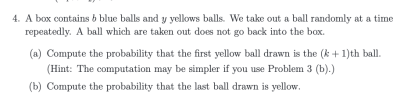 . A box contains b blue balls and y yellows balls. We take out a ball randomly at a time repeatedly. A ball which are taken out does not go back into the box. (a) Compute the probability that the first yellow ball drawn is the (k +1)th ball. (Hint: The computation may be simpler if you use Problem 3 (b).) (b) Compute the probability that the last ball drawn is yellow.
Two balls are drawn in succession out of a box containing 2 red and 3 white...
 Two balls are drawn in succession out of a box containing 2 red and 3 white balls. Find the probability that at least 1 ball was red, given that the first ball was (A Replaced before the second draw. (By Hot replaced before the second draw. (A) Find the probability that at least 1 ball was red, given that the first ball was replaced before the second draw. (Simplify your answer. Type an integer or a fraction) (B) Find the...
Suppose that a person plays a game in which he draws a ball from a box...
Suppose that a person plays a game in which he draws a ball from a box of 10 balls numbered 0 through 9. He then puts the ball back and continue to draw a ball (with replacement) until he draws another number which is equal or higher than the first draw. Let X denote the number drawn in the first draw and Y denote the number of subsequent draws needed. (a) Find the conditional probability distribution of Y given X...
Suppose that a person plays a game in which he draws a ball from a box...
Suppose that a person plays a game in which he draws a ball from a box of 10 balls numbered 0 through 9. He then puts the ball back and continue to draw a ball (with replacement) until he draws another number which is equal or higher than the first draw. Let X denote the number drawn in the first draw and Y denote the number of subsequent draws needed. (a) Find the conditional probability distribution of Y given X...
 A ball is selected from an box containing two black balls, numbered 1 and 2, and two white balls, numbered 3 and 4. Let the events A, B, and Cbe defined as follows: A-b). (2, b)3. "black ball selected": B (2.b). (4,w)), "even-numbered ball selected": and (3, w). (4, w)). "number of ball is greater than 2." Are events A and B independent? Are events A and C independent? Please show your proofs.
 (a) From a box with 5 balls numbered from 1 to 5, we draw a ball 500 times with replacement. Approximate the probability that we will draw the ball with the number "1" less than 80 times. (b) We roll a die until the sum of points obtained exceeds 350. Approximate the probability that we will roll more than 120 times.
 9. A ball is drawn from a box containing three balls, one red, one blue, and one green. The ball is returned and a second ball is drawn. A tree diagram is drawn to give the outcomes of the experiment with respect to the colors of the two balls. If x represent the number of red balls in the two selected. Must show tree diagram, sample space, and your work. 20 pts. a. What are the possible values of x?...
 . A box contains b blue balls and y yellows balls. We take out a ball randomly at a time repeatedly. A ball which are taken out does not go back into the box. (a) Compute the probability that the first yellow ball drawn is the (k +1)th ball. (Hint: The computation may be simpler if you use Problem 3 (b).) (b) Compute the probability that the last ball drawn is yellow.
 Two balls are drawn in succession out of a box containing 2 red and 3 white balls. Find the probability that at least 1 ball was red, given that the first ball was (A Replaced before the second draw. (By Hot replaced before the second draw. (A) Find the probability that at least 1 ball was red, given that the first ball was replaced before the second draw. (Simplify your answer. Type an integer or a fraction) (B) Find the...
Most questions answered within 3 hours.
-
Where is the error in this code sequence?
String s1 = "Hello";
String s2 = "ello";...
asked 10 months ago -
Financial data for Joel de Paris, Inc., for last year
follow:
Joel de Paris, Inc.
Balance...
asked 10 months ago -
Consider this reaction:
Al2(SO4)3 (aq)+ BaCl3
(aq) Al2Cl6 (aq)- +
3BaSO4(s) . What is the...
asked 10 months ago -
Suppose that Savneet is considering increasing her
recent random sample from 20 car rentals to 40...
asked 10 months ago -
Trucks arrive at an unloading terminal at an average rate of 120
per hour.
Trucks arrive...
asked 10 months ago -
Why are methanol and ethanol completely soluble in water while
octanol is not very little soluble....
asked 10 months ago -
A facilities manager at a university reads in a research report
that the mean amount of...
asked 10 months ago -
When the CuSO4 is rehydrated by adding water to the anhydrous
compound, is this an endothermic...
asked 10 months ago -
A ray of sunlight is passing from diamond into crown glass; the
angle of incidence is...
asked 10 months ago -
A block of mass 0.249 kg is placed on top of a light, vertical
spring of...
asked 10 months ago -
how do the kidneys compensate in the presences of acidosis
a) trigger hyperventilate
b) reserve acid...
asked 10 months ago -
Question 501 pts
The rental rate of capital to the firm increases. Which of the
following...
asked 10 months ago